

According to the latest Fire Statistics issued by the U.K. Department for Communities and Local Government, fire and rescue authorities attended 154,000 fires in England between April 2012 and March 2013. This is 31 percent fewer fires than in the same period the year prior. In addition, there were 14 percent fewer fire-related fatalities during this same period. While this reduction is unquestionably good news for the population at large, the official figures only record those incidents that municipal fire services have been called upon to intervene. The statistics do not record the thousands of smaller fires that start every year and are personally managed through the use of a fire extinguisher.
Portable fire extinguishers have long been the unsung heroes of the firefighting world. According to industry surveys, fire extinguishers fight more fires each year than municipal fire services. These extinguishers prevent small fires from developing into major conflagrations, yet this rarely makes the headlines.
Without continuous and robust reporting on the actual use of fire extinguishers on small fires, it is unlikely there will ever be a complete report on fire statistics. And without a complete report, safety regulators, law enforcement officials and employers may not be able to make fully informed choices about effective fire precautions for the workplace. Thankfully, industry experts bring this knowledge to the table in the development of British Standards and other industry guidance.
In late 2012, the British Standard (BS5306-Part 8) for the selection and positioning of portable fire extinguishers was considerably revised and updated. It was reviewed after some 12 years to align with the Regulatory Reform (Fire Safety) Order 2005, the Fire (Safety) Scotland Regulations 2006, and other applicable codes and standards including the extinguisher maintenance standard BS5306: part 3: 2009.
The Part 8 standard is important in many ways, not least because it recognises the use of the extinguisher as a tool to keep routes clear and assist with building evacuation, as well as fighting fires. It also brings clarity in areas that have previously been somewhat vague, such as the definition of a storey, which is now defined as a floor or level within a building including basements, mezzanine and ground floor.
Although voluntary – in effect a Code of Practice rather than a mandatory undertaking – the standard makes a series of very important recommendations. Two of the most important recommendations relate to the siting of extinguishers to ensure quick access to an appropriate device. Distance – or more specifically, the distance an individual may need to travel to reach an extinguisher – is a key issue. An extinguisher should be placed near the fire hazard but not too close that it becomes inaccessible or puts the operator at risk. In addition, if access to an extinguisher requires the user to pass through a door, the travel distance to the extinguisher needs to be reduced.
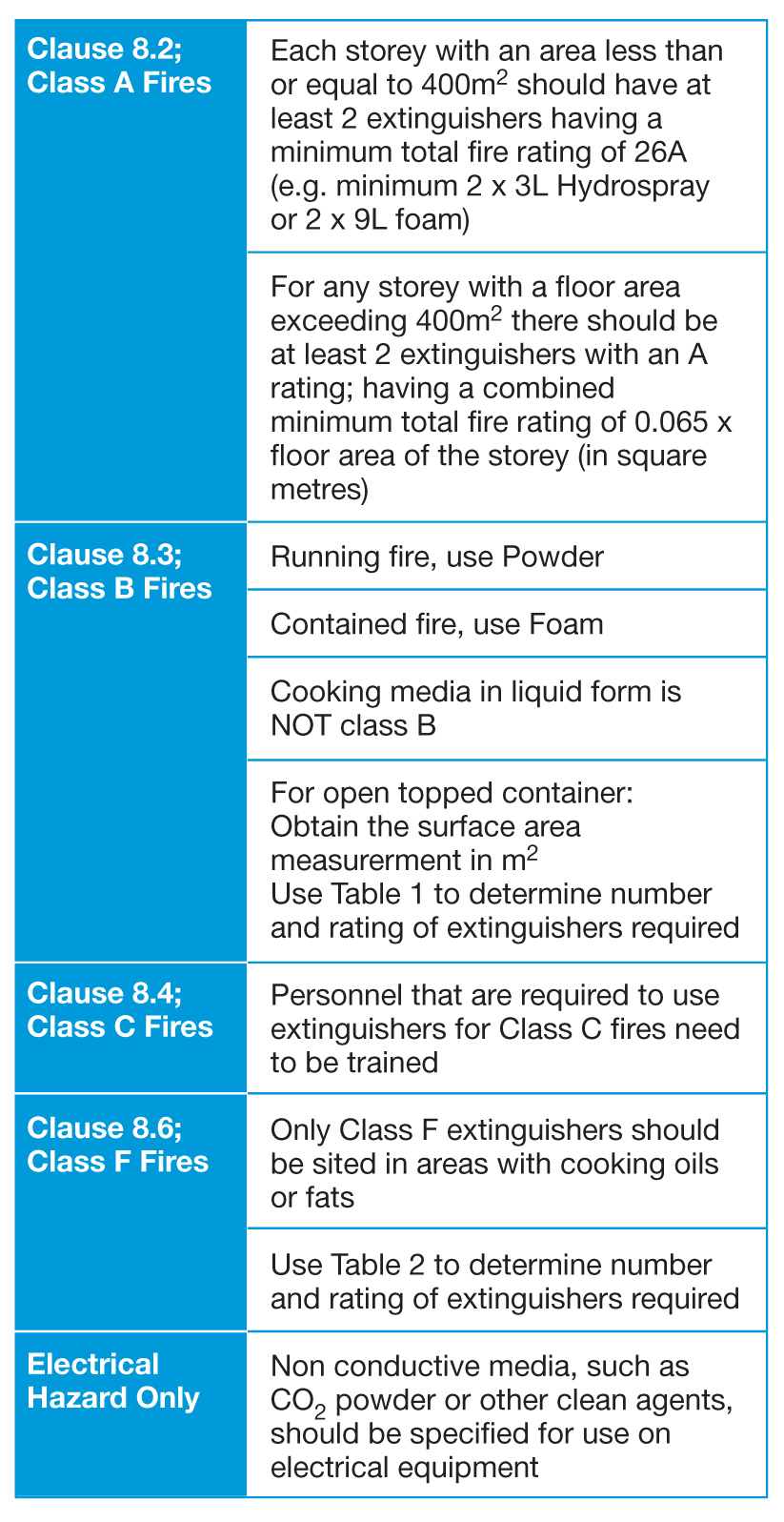
The other important recommendation is for the installer to ensure that the appropriate fire extinguisher is placed next to the associated risk. For example, businesses should position a Class F extinguisher no further than ten meters from a kitchen facility, which uses cooking oils (olive oil, maize oil, etc.) and fats (such as butter and lard).
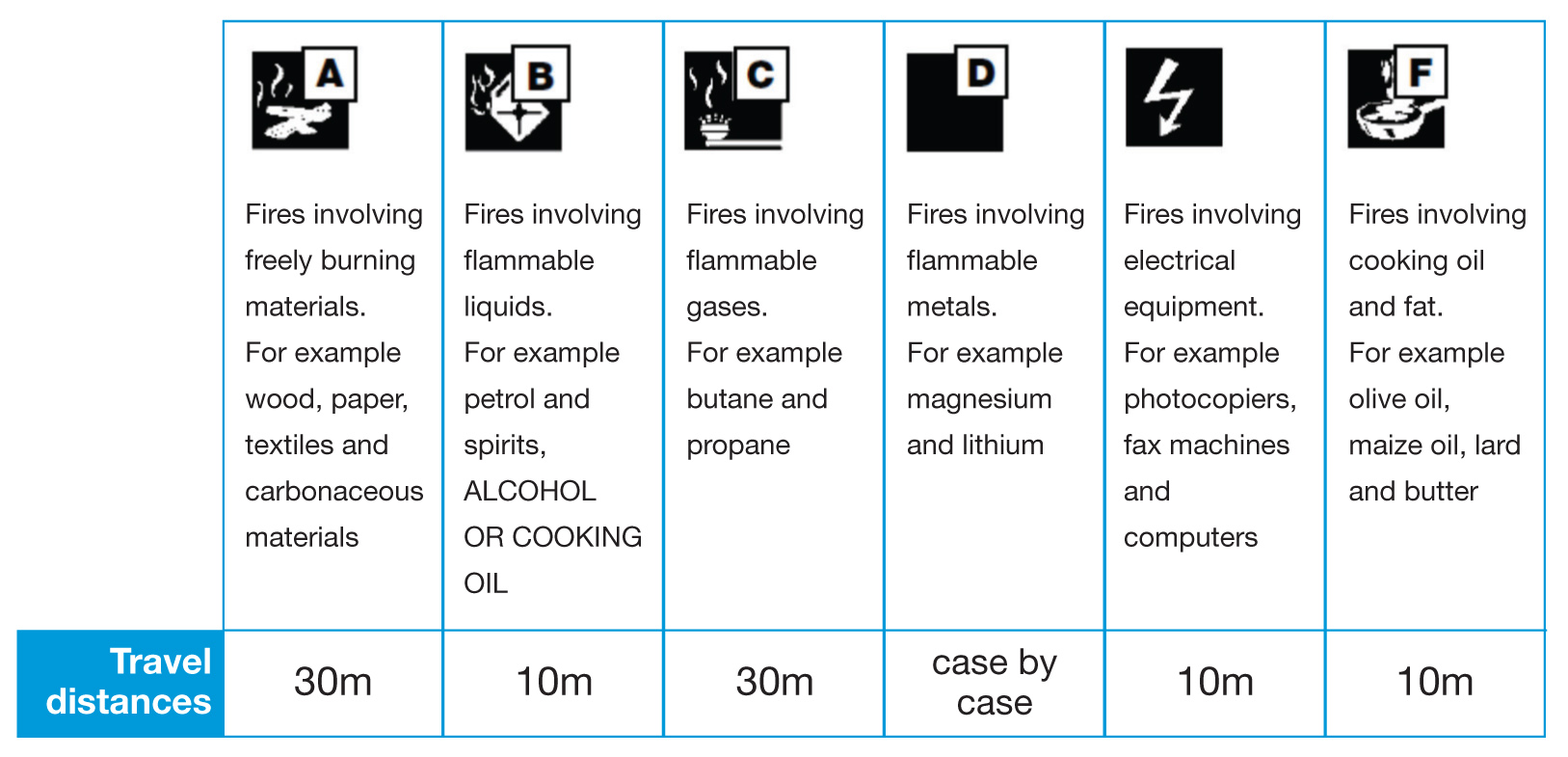
From a product perspective, the standard recommends that powder-based extinguishers should generally not be specified for indoor use unless mitigated by an health and safety assessment, due to sudden visibility loss when discharged, potentially preventing safe evacuation. Class F extinguishers are now required to cover fire risks involving cooking oils and fat, in preference to a fire blanket or other types of extinguishers.
Ensuring Extinguishers Stay in the Correct Location
The standard also provides recommendations on extinguisher signage and protection against vandalism. The position and type of fire extinguisher should be indicated on a sign so that if an extinguisher is removed from its mounting, it can be more easily identified and replaced during a safety inspection.
Unfortunately, the sight of an empty extinguisher bracket or an extinguisher propping open a door is still too common in British workplaces. If an extinguisher has been removed from its fire point, has been used and not refilled or has been vandalised and not reported, it will not be available for use in an emergency, thus leading to the potential spread of a small fire before a working extinguisher is located. Furthermore, time spent searching for a missing or working extinguisher might slow down the building evacuation and increase the risk to life. The standard highlights that measures should be taken to reduce the possibility of an extinguisher being stolen or vandalised by using protective boxes or covers, and/or the use of a stand with an audible alarm to signal when an extinguisher has been removed.
In relation to training, the ‘competent person’ (that is, the supplier) must inform the ‘responsible person’ (that is, the customer) of their legal obligations to train their employees in the use of extinguishers. Such training would also normally include training employees on the emergency procedures and escape routes in their workplace.
The European Angle
Today, there is no European Standard for the installation and maintenance of extinguishers, hence the continued development of the British Standard BS 5306. While strong local standards are already in place across much of Europe in reaction to local building regulations and fire codes, industry working groups have been preparing pan-European guidance on extinguisher installation and maintenance, which could be particularly useful in countries yet to develop their own local codes.
The fire industry developed one of the very first European standards, EN3, for fire extinguisher design and manufacture. EN3 has been in place for nearly 20 years and achieved a good level of standardisation across Europe. Throughout Europe, markings of red cylinders with graphical instructions featuring standard fire classification icons help indicate the appropriate use of the extinguisher regardless of language.
While promoting standardisation, EN3 does allow for innovation and development, for example, the use of new materials and production methods. Equally, given the extensive use of extinguishers on workplace fires, much has also been learned about the practical use and handling of this life saving equipment, leading to advances in product design.
Best-in-class Design
Today’s extinguishers are a vast improvement compared with extinguishers of the past, and now feature an innovative quick release mechanism that could be used by right- or left-handed people, and an ergonomically designed handle, lever and hose grip to make the extinguishers more intuitive and easier to use. They are lighter and more manageable, while still delivering the highest performance when people or property are at risk.
Rubber grips have replaced metal on the top lever, thus improving operational comfort and reducing hand slippage and the risk of wrist injury by evenly displacing weight across the user’s hand. The traditional pin that prevented the extinguisher from being discharged accidentally has also been replaced with an easy-pull clip for intuitive activation of the extinguisher.
Each of these developments – the fire-risk led approach, updated installation and maintenance standards, European codes and new design features, and of course the vital role of the fire service – contributes in some way to a safer environment.
The public, walking past extinguishers on a daily basis, does not need to know the details of such developments because the fire industry is working hard behind the scenes to help improve fire safety and aims to ensure that the right extinguisher will be in the right place when any one of us might need it.

For further information, go to www.chubb.co.uk
