

There’s no denying that the world of product standards, testing and certifications can be complicated; however, it is also an essential part of ensuring product quality and safety. When it comes to fire detection and alarm systems, the product certifications accepted or required in various parts of the world generally fall into two categories: North American standards and European standards often creating an inefficient testing and certification process.
Certification bundling offers benefits
FM Approvals can offer a combined program for European and North American Certification, and save manufacturers administrative overhead time, and provide quicker overall turnaround and reduced costs.
Beyond North America and Europe, FM Approved flame detectors and other fire detection and suppression systems, when combined with EN 54 and other EN certifications, can be a strong differentiator in many global markets.
Many countries throughout the Middle East and Asia have adopted EN 54 and, in some cases, a combination of EN 54 and FM Approvals standards. For instance, in the United Arab Emirates and Saudi Arabia specifiers or end users may require EN 54 for detection, but FM Approvals standards for suppression systems. Many consultants outside of North America may specify EN 54 certification, including Singapore, Malaysia and India. FM Approvals can also test and certify products to EN 54 standards (fig 1) and give manufacturers access to additional markets.
North America Approach
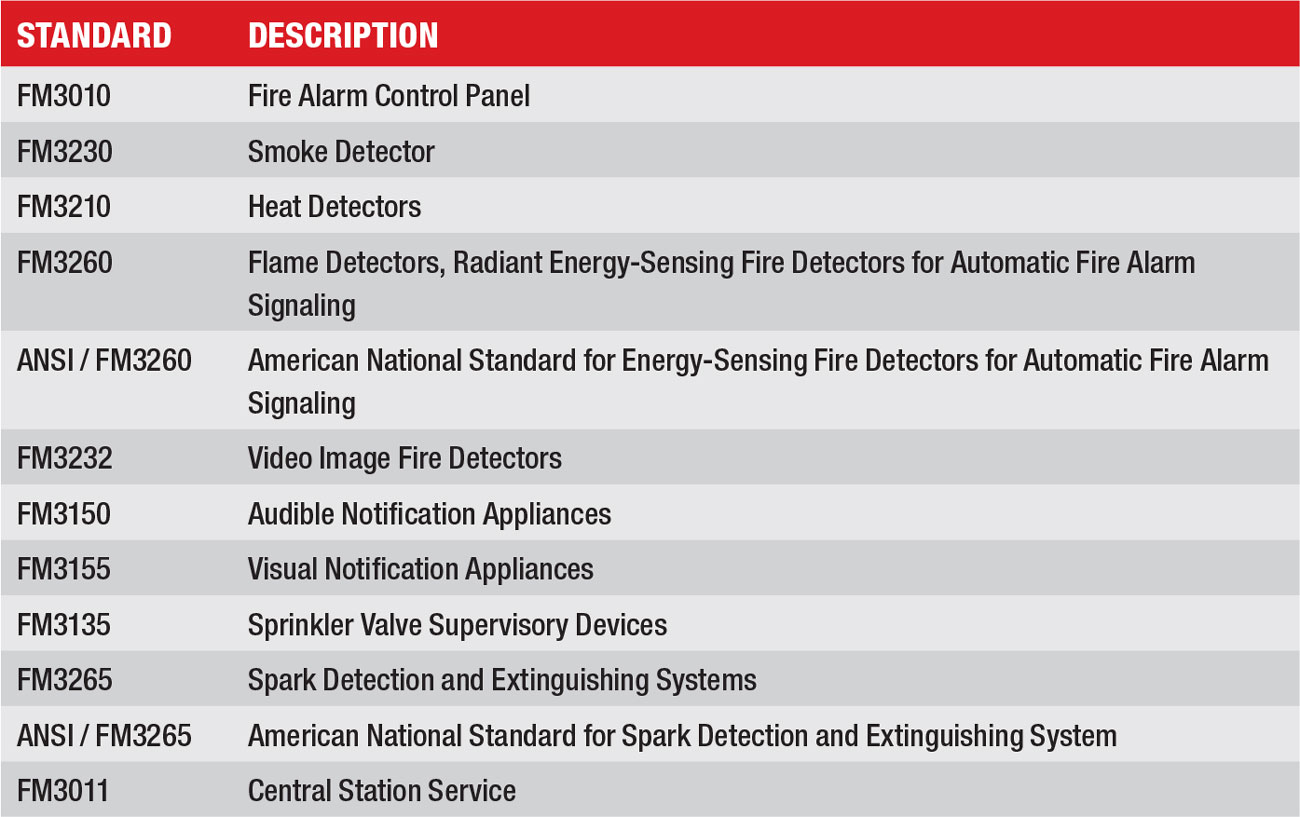
In North America, FM Approvals standards are accepted for fire detection, alarm and suppression systems (fig. 2). For instance, flame detectors are evaluated according to Approval Standard 3260, Radiant Energy-Sensing Fire Detectors for Automatic Fire Alarm Signaling, which is also an American National Standards Institute (ANSI) standard. Smoke detectors are evaluated against Approval Standard 3230, Smoke Actuated Detectors for Automatic Alarm Signaling.
European Approach
In Europe, fire detection, alarm, control, and fixed fire suppression systems and components, including agent storage and distribution must be CE marked in accordance with the European Union’s Construction Products Regulation (CPR). Under the CPR, manufacturers of fire protection and detection/alarm systems are required to use the services of a Notified Body (NB) to independently assess the product’s compliance with applicable EU harmonized standards, known as European Norms (EN).
For instance, the EN 54 family of standards covers a wide range of fire detection and fire alarm systems and are mandatory standards under the CPR for CE marking within the European Economic Area (EEA), which includes the 28 countries of EU, as well as Iceland, Liechtenstein and Norway. EN 54 encompasses 27 individual standards, known as parts.
For the past 12 years, FM Approvals has built a strong presence in the EU, first through FM Approvals Ltd. based in Windsor, England (Notified Body #1725) and now through its new Dublin, Ireland, office and FM Approvals Europe Ltd. (NB #2809). The new Dublin headquarters is staffed by certification managers who are available to assist customers with certificate transfers, new program initiation and other services.
Notified Bodies, such as FM Approvals, are accredited to evaluate and certify certain parts of the EN 54 family of standards (fig. 3) as well as other EN standards. The NB must also perform a Factory Production Control audit to verify the manufacturer’s quality system and, if acceptable, issues a Certificate of Constancy of Performance that the manufacturer uses to issue a Declaration of Performance.

FM Approvals
FM Approvals has more than 130 years of experience in the certification of fire detection and suppression systems and has deep expertise in the certification of equipment for use in hazardous locations such as explosive environments. FM Approvals is also a Notified Body for ATEX, the EU directive for hazardous locations, as well as an Ex Certification Body (ExCB) and Ex Testing Laboratory (ExTL) for the International Electrotechnical Commission Explosive Scheme (IECEx) certification.
In 2014, FM Approvals became accredited as a Notified Body for EN 54-10 (flame detectors), EN 54-2 (control and indicating equipment), and EN 54-4 (power supply equipment). Since that time, FM Approvals has extended its accreditation to include EN 54-5 (heat detectors), EN 54-17 (short circuit isolators), EN 54-18 (addressable I/O devices), and EN 12094-1 (gaseous suppression releasing panels). It is expected that accreditation will also be received for EN 54-3 (fire alarm sounders), EN 54-7 (smoke detectors), EN 54-11 (manual call points), and EN 54-23 (visual alarms).
Each certification requires an initial audit and periodic follow-up audits. Product, quality, and facilities audits are not only a critical requirement of all FM Approvals programs, but also required for CPR, ATEX, IECEx and other certification programs. For instance, ATEX requires a Quality Assurance Notification (QAN) audit and IECEx requires a Quality Audit Report (QAR) audit, both of which FM Approvals can provide.
FM Approvals conducts thousands of product and quality audits throughout the world to validate the production of FM Approved products and to meet the requirements of many other certification programs. Current and prospective FM Approvals customers are able to consolidate multiple certification and audit programs through FM Approvals and thereby achieve greater efficiency and cost reductions.
For more information, email christoph.lenk@fmapprovals.com
About the Author
Christoph Lenk is based in Frankfurt, Germany, and is the FM Approvals Sales Engineer for EMEA.

You must be logged in to post a comment.