
Corrugated Stainless Steel Tubing (CSST) is a semi-flexible gas tubing favored over traditional black iron pipe because it reduces installation time and requires fewer fittings. However, the thickness of CSST is approximately 10 times thinner than traditional black iron pipe, making it more susceptible to perforation when assaulted by lightning. Over the past decade there has been concern over the fire safety of CSST when exposed to lightning with some local fire marshals banning the use of CSST in their jurisdictions.
The original CSST had a yellow polyethylene jacket which is electrically insulating and actually exacerbates the problem of lightning-induced fires. After more than a decade and numerous fires, manufacturers developed black conductive jackets to help dissipate the lightning current that was creating holes in the CSST. There were still 6,000,000 homes with more than 1,000,000,000 ft of the original yellow CSST though. So in 2006 manufacturers added an installation requirement to connect CSST to the electrical grounding system with a bond wire in an effort to prevent damage from lightning. This grounding requirement was adopted into the National Fire Protection Association (NFPA) 54 Fuel Gas code, was promoted by the National Association of State Fire Marshals and the United States Senate.
Nonetheless there continued to be damage from lightning and the NFPA requested further information concerning grounding of CSST. In 2013 reports commissioned by the CSST manufacturers were released which included limited physical testing and circuit simulations to extend the conclusions to practical installations. The reports concluded that grounding was sufficient to prevent perforation of the CSST by lightning and therefore prevent fires.
The recent study described in this article extended the work of those reports to several more practical scenarios than the ones included in the manufacturers’ reports. The study was conducted by a team of metallurgists and electrical engineers at MIT and was published in the peer-reviewed journal Fire Technology. The following provides an overview of the study.

Fire hazard of CSST when assaulted by lightning
A lightning strike carries an enormous amount of high frequency current. Such a current on an electrical conductor results in a voltage on the conductor and if there is a grounded object nearby, will lead to an electrical arc. When the lightning current goes through the arc it is concentrated and the heat can melt the conductor. Field reports from lightning-induced fires show CSST with holes melted at locations near another grounded conductor. The authors tested an arc on CSST filled with gas as seen in the pictures showing (a) the test setup (b) an electrical arc between the CSST and another conductor (c) metal spatter near the arc location (d) metal spatter flying away from arc location (e) gas burning as it escapes from CSST and (f) sustained burning of the gas. This test demonstrates that a sufficient electrical arc between CSST and another conductor can cause a fire. Lightning has enough energy to create such holes, but the question is if grounding the CSST is enough to reduce the amount of energy and prevent perforation and therefore fires.

Simulations of lightning current in a home
The study reports on testing at Lightning Technology Inc. to confirm the thresholds for arc initiation and melting. The authors used circuit simulations as done in the reports previously commissioned by the manufacturers and reproduced their results for the limited scenarios they simulated. They then extended the simulations to include more locations where lightning could enter a structure and extended the ranges of simulation parameters to include more realistic situations. These parameters included the impedance of conductors and the current of the lightning.
There are many ways lightning can enter a structure as shown in the second figure. A direct strike is where lightning directly enters a conductor that is part of the structure. Lightning could also strike near the structure and current through the ground could enter a conductor connected to the structure. It is also possible for lightning to strike nearby and induce a current in the structure or arc to a conductor in the structure. The authors simulate lightning entering in several different locations. They also vary the current to simulate a direct strike or a weaker indirect strike.
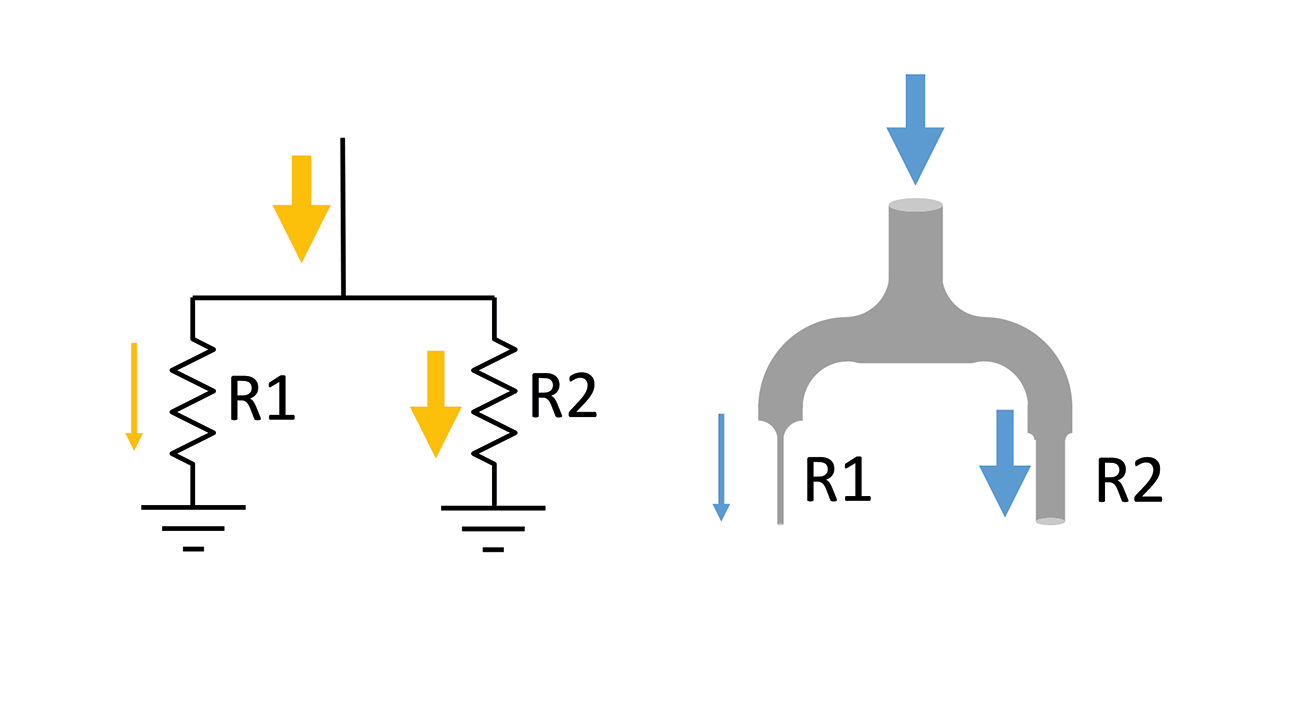
The authors also varied the impedance parameters within the circuit because the lengths of wires, CSST and other conductors will vary depending on the structure. The earth ground of the CSST or the electrical line buried outside the structure will also vary. Electrical impedance is important because it determines how much current flows. This is analogous to water pipes where a narrower pipe will have larger resistance and less water will flow through it. In the diagram above, more electrical current will flow through the resistor with impedance R2 just as more water will flow through the pipe with resistance R2.
The reports commissioned by the CSST manufacturers used a limited set of impedance parameters and only considered lightning entering through the gas line or the electrical line.


Grounding can actually increase fire risk
The voltage threshold of an arc is approximately 25 kV for CSST. The simulations from the study showed that even though grounding helped reduce the voltage in many cases, it was not sufficient to prevent arcing for lightning entering many of the locations simulated. The voltage was largest when the impedance in the structure was large and when the lightning current was stronger.
In simulating the current through the arc, there were some cases where grounding increased the charge through the arc and increased the risk of fire. The plot below shows the simulation results of a moderate indirect strike entering the house through a lighting structure on the outside of the house. The charge through the arc determines if a hole is created in the CSST. The authors demonstrated that 1.2 Coulombs of charge was sufficient to create a hole. An average lightning strike has 5 Coulombs, but the top 1% of strongest lightning strikes have approximately 700 Coulombs. In this situation, without grounding, the charge is below the threshold while with grounding the charge is above the threshold. The problem gets worse when some impedances inside the structure are increased, as in the case of longer electrical wiring.
The authors argue that this intuitively makes sense because grounding the CSST essentially turns it into a lightning rod. A case in Lubbock TX where a person died in a house fire where CSST was grounded may be explained by these results.
The study concludes that grounding is often insufficient to prevent an arc. It further concludes that when an arc forms between CSST and another conductor, the factors that determine whether or not there is enough charge to create a hole in the CSST and start a fire depends on the electrical grounding, the impedances of conductors in the structure and where the lightning enters the structure. Depending on these factors, grounding may or may not help and in some cases may make things worse. Complete results and conclusions are published in Fire Technology.
For more information, go to http://link.springer.com/article/10.1007/s10694-015-0557-z
About the Author
Thomas W. Eagar has been a Professor of Materials Engineering at MIT in Cambridge, MA for 40 years. He has investigated dozens of fires and explosions using his knowledge of metallurgy, arc physics and thermodynamics.
