

The Association for Specialist Fire Protection has published a new edition of its ‘Yellow Book’ guide to fire protection for structural steel in buildings.
Fire protection to structural steelwork plays an essential role in ensuring that buildings will not collapse prematurely in the event of a fire, providing time for the occupants to escape and for the fire service to obtain access and fight the fire.
You might ask why steel needs protecting at all? After all, it is non-combustible and does not melt until around 1,500°C, a temperature almost never experienced in fire. However, at a temperature of between 500°C and 600°C, mild steel loses approximately half its strength. Since fires in buildings regularly exceed 1,000°C within a relatively short period of time, fire protection is needed to limit the temperature rise in the steel so that sufficient strength will remain in the structural frame.
In some cases no protection is needed, for example if the fire resistance period is low, for example 30 minutes, and/or if a whole frame structural analysis is undertaken and the interaction between various elements of the frame means that some elements do not need to retain the strength they have in the cold state. However, in most steel framed buildings, protection will be required to some or all of the elements.
Traditionally, fire protection, in the form of non-combustible boards, cementitious/vermiculite sprays or mineral fibre casings is applied to insulate the frame. These materials have the advantages of being robust and tolerant of poor site conditions and abuse. However, increasingly, intumescent or reactive materials (paints) are being used. These are quicker and easier to apply and have good aesthetic properties, but care is needed when applied on site to avoid problems later on in the lifetime of the building. The Association for Specialist Fire Protection (ASFP) has published a number of codes of practice for the application of structural fire protection products.
To aid the evaluation of proprietary fire protection of structural steelwork to comply with Building Regulations for England and Wales, the ASFP has released the fifth edition of its Yellow Book, Fire Protection for Structural Steel in Buildings.
The Yellow Book, which was originally published 30 years ago, has become the definitive reference to the provision of fire protection to structural steel in buildings, and is referenced in Approved Document B to the Building Regulations in England and Wales. It provides a source of validated performance data about such products provided by ASFP members. It also provides a comprehensive guide to proprietary materials and systems, all of which are manufactured, marketed or site applied by ASFP members.
Significant Changes
The fifth edition of the ASFP Yellow Book incorporates a significant number of important changes. It has been completely restructured to take into account major developments in the standardisation of the testing and assessment of products that protect structural steel members. These include:
- The publication of European standards for the evaluation of passive materials, reactive materials and the evaluation of fire protection of cellular beams.
- Reference to a default structural model, commissioned by the ASFP, to predict limiting temperatures for cellular beams with openings of various shapes, which can then be used to generate appropriate thicknesses of fire protection.
- Significant revisions to the sections on structural fire engineering to take into account the advance of the structural Eurocodes and the resultant changes to default critical temperatures.
The new Yellow Book is designed to help all those involved in the design, procurement, specification and manufacture of structural steel in buildings. It is arranged in six sections:
- Section One
Deals with general aspects of passive fire protection to steel; the reduction of strength with temperature, fire protection techniques (profiled, boxed or solid), general principles of the fire tests undertaken (full size loaded beam and column tests, supplemented with data obtained from short sections) and an introduction to the concept of limiting temperatures.
Sections two and three introduce two routes for the evaluation of proprietary fire protection.
- Section Two
A traditional Yellow Book assessment that is based on fire tests on fully loaded sections and thermal data derived from testing to BS 476 or EN 13381 methods. This will most likely be used in the UK while CE marking is still not mandatory for fire protection products for structural steel and in areas of the world where British Standards are still used.
Section 2 is split into reactive products (intumescents) and non-reactive products (boards, sprays and renders). For each product group there are comprehensive details of the test programme (beams/columns and short sections to be tested) and the assessment methodology to be used. For reactive products, the graphical approach is used for the assessment and for non-reactive products a numerical regression analysis is employed.
- Section Three
An assessment of EN 13381-4 (non-reactive products) or EN 13381-8 (reactive products), which can only be based on thermal data derived from testing to European (EN) test methods. This can also be used in the UK and in continental Europe where CE marking against a European Technical Assessment (ETA) will be the route to market. Increasingly, manufacturers will use this route as they use European test standards to avoid duplication of testing to both British and European standards.
Assessment methods that can be used under the EN include: graphical, differential equation (2No) and numerical regression analysis. There is less detail in this section because the test and assessment methodologies are detailed in the relevant European standard. However, there is a significant amount of guidance material including how the test and assessment methodologies vary from the British approach in section two.
- Section Four
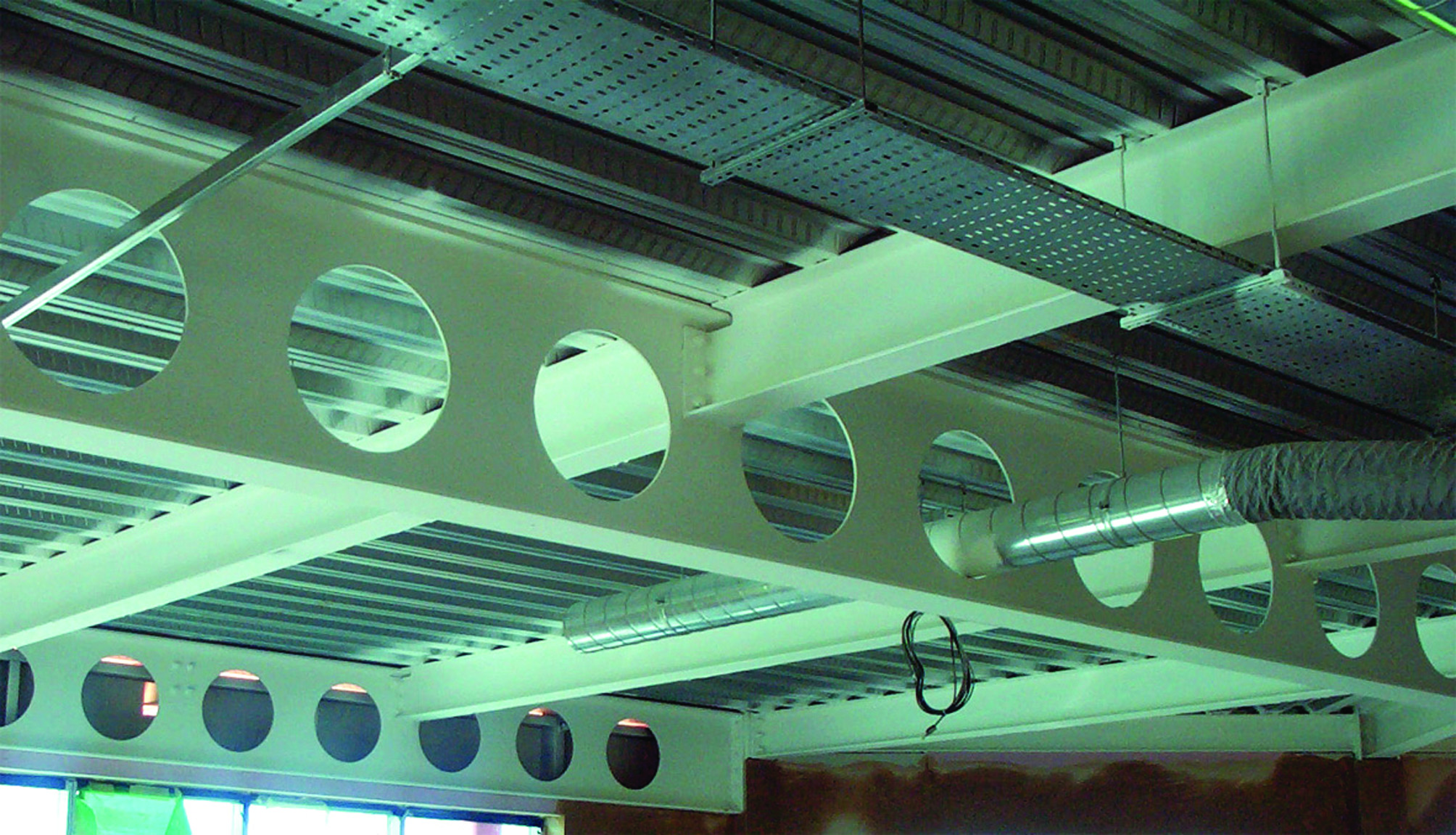
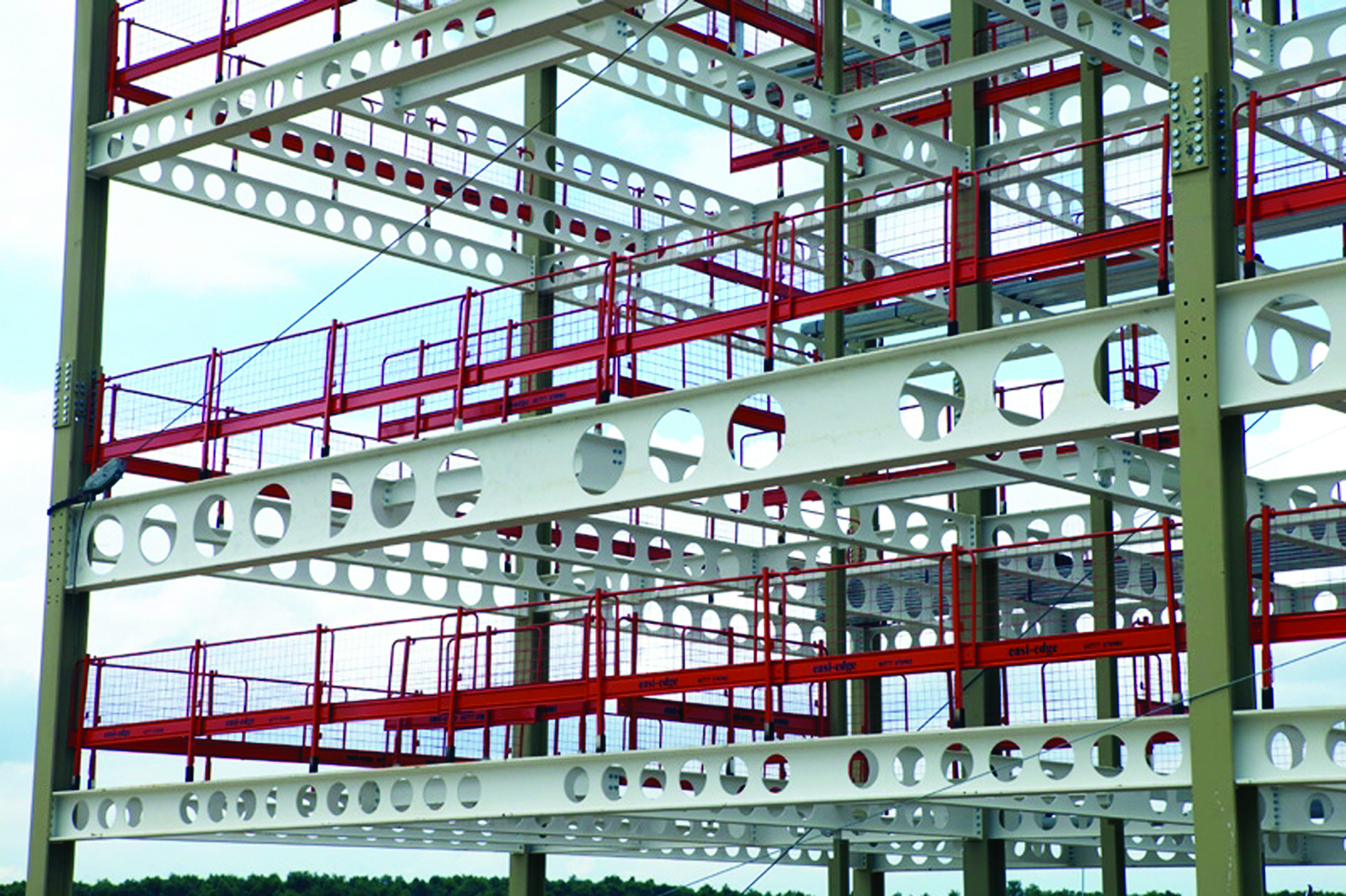
Considers the fire protection of beams with web openings (cellular beams) that are increasingly being used to accommodate services such as cables, pipes and ducts. The inclusion of web openings means the structural capability differs from that of a solid beam in that the failure mode in fire is related to the closeness of holes and the web slenderness in addition to section factor. Structural failure can be through, for example, Vierendeel bending above the opening or buckling of the web post. Such failure modes generally occur at lower temperatures than a plain beam of the same size and, consequently, it is necessary for cellular beams to be structurally evaluated taking into account all possible modes of structural failure.
Additional thermal data measured around the web openings and on the web posts is used in conjunction with a structural model to determine the beam’s limiting temperature under the applied load. To provide a consistent approach, the ASFP sponsored the Steel Construction Institute (SCI) to produce a model (RT 1356) capable of considering a wide range of beam designs and opening shapes and spacing. Other models may also be used but RT 1356 is the default model for the Yellow Book.
Section Four also contains a detailed test and assessment protocol for reactive products following EN 13381 Part 9. Non-reactive products can be evaluated in the same way as reactive products, or may make use of the existing ’20 percent rule’, whereby the thickness used for cellular beams is increased by 20 percent over that used on a plain beam. To ascertain if the 20 percent thickness modification factor is conservative and appropriate, a new short test protocol has been included.
- Section Five
Provides an introduction to the Construction Products Regulation, CE marking and European Technical Assessments (ETAs) for passive fire protection products used to protect structural steel. It explains the current status of CE marking for these products, which depends on whether the products are covered by a European Product Standard or a European Technical Approval. These two types of document may sound the same, but the implications are very different with each type.
If a product standard has been published, then CE marking is mandatory; if the product is covered by a European Technical Approval then it is not. Currently a product standard is being developed for reactive products and there are also moves afoot to ‘convert’ the European Technical Approval Guidelines covering non-reactive products into product standards. All this will eventually lead to mandatory CE marking, although this is some years away.
- Section Six
Explains how material data sheets will be presented for those manufacturers wishing to list their products in the Yellow Book. All products listed in the Yellow Book must be either CE marked under the Construction Products Regulation, or hold third-party certification from a certification body under a scheme accredited to EN 45011 (to become ISO 17065) and carried out by a UKAS-accredited (or nationally equivalent) certification body.
Current entries issued under edition four of the Yellow Book will be carried over into the 5th edition. However, new products and old products as their certification comes up for review (normally five years) will be included in the book only if they have been evaluated against the relevant part of the 5th edition.
Appendices
The new Yellow Book also contains a number of detailed appendices that contain much of the useful guidance material from the 4th edition, suitably updated for the 5th edition.
Appendix One: contains guidance of the British and European test and assessment methods.
Appendix Two: contains detailed guidance on section factors for plain, cellular and castellated beams, structural hollow sections, partially exposed members, tapered sections, lattice members and light gauge rolled steel sections.
Appendix Three: has extensively revised the engineered approach to structural fire protection to take into account the increasing use of the Structural Eurocodes. A new section on default limiting and critical temperatures has been included that provides a range of critical temperatures derived from the Eurocodes, taking into account load factors in different building types. Another set of default critical temperatures is provided if the building type is not known. In addition to the Eurocode approach, default limiting temperatures from BS 5950 Part 8 are also included. Appendix 3 also contains extensively revised guidance on deck voids above composite and non-composite beams.
The new Yellow Book is technically the most advanced and authoritative the ASFP has ever produced, having been revised over a period of two years and via many meetings of the ASFP’s Task Group 1 (reactive products), Task Group 2 (non-reactive products) and the ASFP Technical Committee. It will be an invaluable source of information for all those professionals working with steel that requires fire protection. The new 5th edition of the Yellow book is free to download from the ASFP website at http://asfp.associationhouse.org.uk/default.php?cmd=210&doc_category=119.

For further information, go to www.asfp.org.uk
About the Author
Niall Rowan is Technical Officer at the Association for Specialist Fire Protection.
