
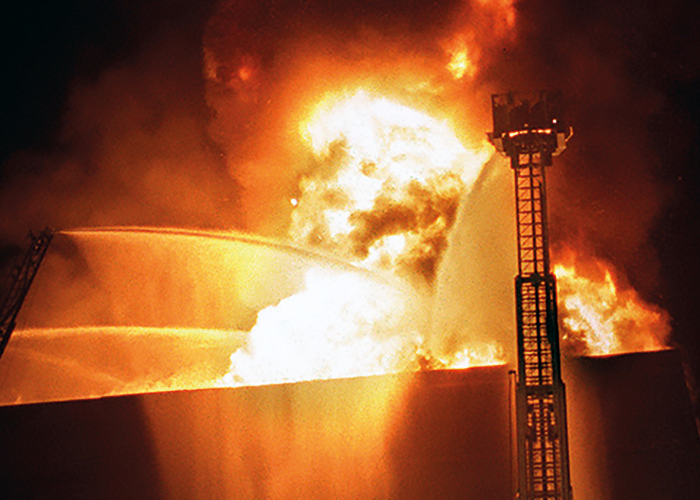
For nearly two centuries, heavy timber structures, predominantly utilized as industrial and commercial occupancies, have encountered fires and yet still remain standing. Oftentimes, firefighters are taught in the academy how treacherous heavy timber structures can be. However, the performance history of heavy timber indicates that they are an exceptionally fire-resistant and stable construction type. These structures were often stocked full of incredibly combustible materials, possessing a fire load that if ignited would turn a building of almost any level of formidability into smoldering ruins.
Heavy timber construction, when properly maintained and built to standards, is quite a stable building type under fire conditions, ones that can often harness inordinate burn times before failing. In fact, a recent fire in an abandoned heavy timber warehouse in St. Louis, Missouri, burned for 18 hours, and yet the building remained standing.
However, the previous sentence gets to the crux of the matter when discussing traditional or old heavy timber buildings. Very few were built strictly according to the standards, most were modified in one way or another, featuring one or more of the cardinal sins expressly forbidden by the original construction standards. Additionally, many of our infamous negative fire service encounters with these structures have occurred in the period following their large-scale abandonment, which occurred around the mid-point of the twentieth century. While we have seen horrific fires such as the 1999 Worcester Cold Storage Warehouse Fire, which on its face gives the impression of heavy timber being quite vulnerable and susceptible to failure, it is important to note that the structure burned anywhere from one and a half to two and a half hours before it failed.
Indeed, when these structures fail it often appears to be due to prior alterations entirely incompatible with the construction type itself, such as the Worcester Cold Storage Warehouse’s walls being lined with anywhere from 6 to 18 inches of asphalt-impregnated corkboard and a third of a foot of polystyrene. Often, these buildings have been abandoned and subjected to horrendous disrepair and even abuse that can result in penetrations of floor decking and removal of fire doors. During their lifetimes, these buildings often suffered repeated small fires in localized areas, with the wooden members themselves soaking up tremendous amounts of solvents and lubricants.

With the general history of these structures in mind, fire service personnel must be cognizant that while heavy timber construction is inherently robust, and almost by definition over-built and capable of withstanding fire for extended periods, that decades of disrepair and dilapidation, and the absence of working fire suppression systems, can cause them to fail sooner than one would anticipate. Furthermore, alterations and damage that allow for the spread of fire in ways the building type was designed to stop, particularly when coupled flame impingement on the unprotected iron or steel connectors that fasten the wooden structural frame and assemblies to the heavy load-bearing walls, can lead to earlier than expected failures.
To be sure, fire service personnel operating at a fire in a heavy timber building would be well-advised to conduct an exceptionally thorough size-up, looking for the hallmarks of an impending catastrophic fire event, things such as volatile brown or black smoke, or the sagging and/or leaning of the structure itself, or fire showing on multiple floors. Fire service personnel should expect the worst and proceed accordingly. If defensive operations are the order of the day, fire service personnel should plan for an extended fight against a conflagration of unparalleled proportions that is draining both in resources and energy.
However, if fire is showing on only one floor and offensive interior operations are warranted, cautious aggression should be the guiding principle. Crews can almost expect maze-like conditions, alterations that may increase the likelihood of encountering untenable conditions, compromised or weakened floors and structural elements, and a fire load that can range from virtually non-existent to downright tremendous. What must be stressed is that while heavy timber has proven to be resistant to failure and capable of absorbing uncanny amounts of punishment, when they fail it is of a catastrophic and almost complete nature in which entire walls and floor assemblies collapse suddenly.
In the current era, many localities and firms are either repurposing or altogether reviving old heavy timber buildings. Often times, these structures are modified to house occupancy types for which they were not designed. It is now commonplace to find old heavy timber mills, factories, and warehouses, being turned into apartment and office buildings. While these revivals almost always feature modern fire detection and suppression systems, they violate the basic rules which govern heavy timber. Plenums for utilities and elevators are installed, timber members are often treated with flammable paints and stains, structural members possessing protruding and sharp edges, and once wide open floors are divided into numerous small compartments.
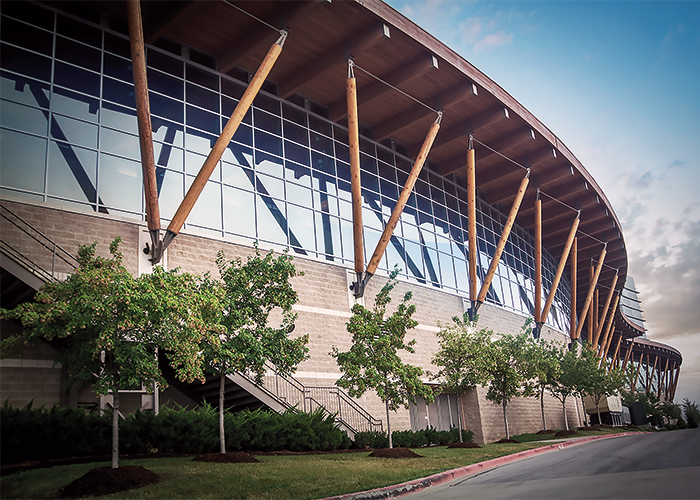
Perhaps what is more concerning is the dramatic rise in the construction of new “heavy timber” buildings. In the spirit of the “green” building movement, it has been found that building with a renewable resource such as wood, is both more economical and environmentally friendly than concrete and steel. However, these new builds are not to be confused with traditional heavy timber construction, they are in fact quite different. They are hybrids that utilize composite wood products such as glulam, cross-laminated timbers, and laminated veneer timbers, all of which are essentially a series of smaller dimension wooden members glued together. Additionally, these buildings are predominantly constructed using new methods such as post-tensioned construction and panelized construction.
New builds are a somewhat troubling breed, overloaded with fire performance questions that have yet to be answered in the real world. These new builds aspire to literally reach heights few traditional heavy timber buildings ever climbed to, with 75 to 125 feet being fairly common. Through the use of precision engineering and the incredible surge in the quantity of unprotected steel connectors and cables holding the structural frame together certainly allows for larger spans, but one wonders about an increase in susceptibility to fire impingement and resultant structural collapse. Additionally, composite timber products compose the structural frame, and while the lumber industry is adamant that they perform just as well as their solid-sawn predecessors, one might be wise to remain skeptical of the fire survivability of timbers held together with adhesives. The great increase in compartmentalization ensures a higher risk of encountering fire events such as flashovers and backdrafts as well. These structures also commonly avoid using traditional heavy masonry bearing walls, instead favoring concrete and steel cores. The timber elements of new builds are often highly finished, ostensibly with flammable materials and may possess sharp or protruding edges. Therefore, a striking fear remains, that while these structures are marvels of modern engineering, they barely resemble traditional heavy timber buildings, and as such, firefighters should expect these buildings to behave differently in a fire than a true heavy timber building, and likewise should exercise extreme caution in the event the fire suppression system has failed or is otherwise offline.
Heavy timber construction was revolutionary in its aggressive approach to fire-resistance, and was commonly encountered by generations of American firefighters. While we are approximately a century removed from their zenith, these monolithic buildings are still scattered across the American built environment. With that in mind, fire service personnel should be familiar with the construction type’s characteristics and tendencies, as well as those of its modern incarnations, and be prepared to adjust their operational and tactical methodologies accordingly.
About the Author
Jesse A. Heitz formerly served as a firefighter with the Chaska Fire Department, and as the Training Officer for the Carver County Fire Departments' Hazardous Materials Response Group. He is the author of Fire Resistance in American Heavy Timber Construction: History and Preservation.
