
Did you know legally in Europe, fire dampers should be tested every 6 months? I personally doubt if this is carried out to 100% across Europe or globally. Perhaps we have some very conscientious individuals who do make these tests, but we live in an age of rising costs, and making these physical tests of mechanical fire dampers can be awfully expensive.
Wouldn’t it be nice to remove this doubt from your buildings? It really is a simple exercise to do and only requires a change from mechanical dampers to motorised dampers with a control system. In an era of the smart building is it unreasonable to expect that the safety of occupants, the fire service and the buildings are not left to chance, that a test of the fire dampers has been carried out and, just like the brakes on a car, that the dampers operate when you need them most?
Peace of mind for your building occupants, fire service and your building
One way is to have regular testing, every 48 hours if this offers peace of mind, once a week like a fire alarm test, even once a month – all are better than every six months or never.
Yes, upfront motorised dampers and a control system is more expensive, but over the lifetime of the products, as compared to mechanical fire dampers, they are a lot less expensive when testing every 6 months is accounted for. Therefore, it makes economic sense as well as peace of mind, to make the switch to motorised fire dampers and a control system.
Now you may be concerned about the use of a control system to manage fire damper closing, opening and regular testing, but I can assure you they are exceptionally reliable and include fail-safe mechanisms. In the case of a power loss to the system, it will automatically close all fire dampers. The same is the case with a loss of communication across the system, all dampers are closed. There are even control systems available that include a safety integrated level (SIL) for their controller, which isolates the application CPU from the controller CPU. The application CPU monitors the controller CPU and resets this in case of a problem. The controller CPU monitors the application CPU and resets this in case of a problem. This watchdog type of control comes from safety automation systems as used in railway applications to help prevent accidents. This is a well-proven safety-control solution and ensures total peace of mind that the system is constantly self-monitoring.
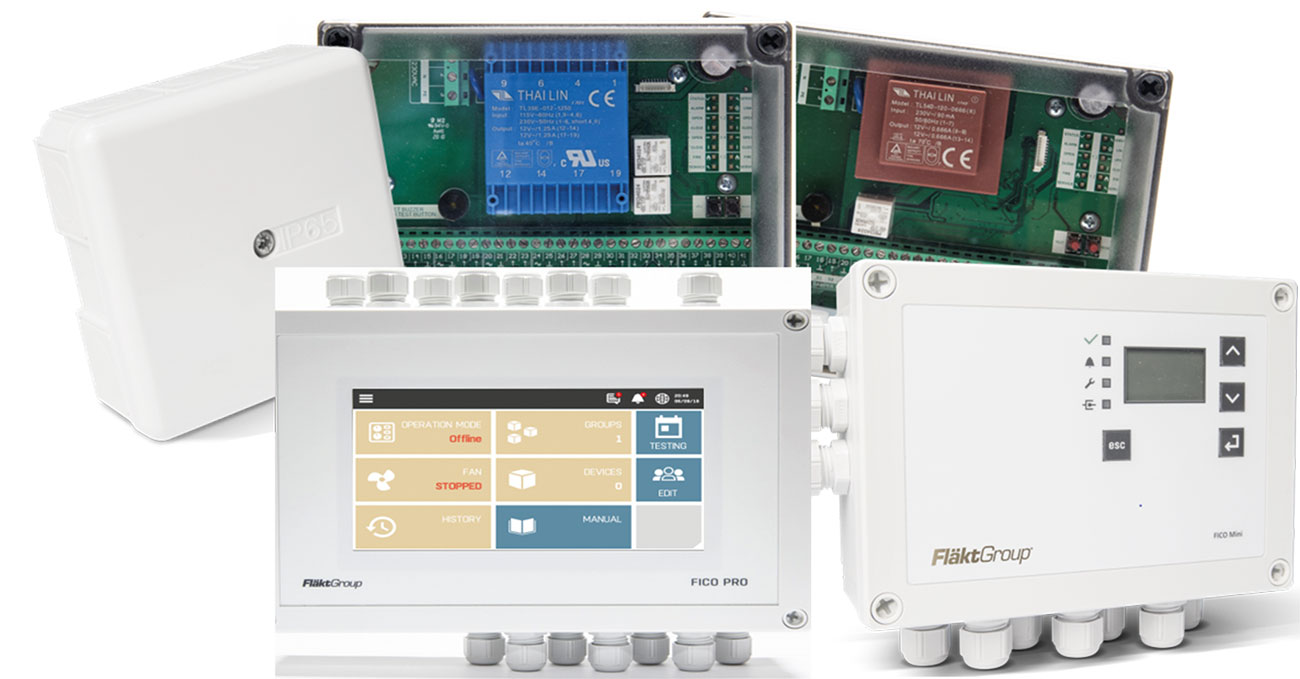
Control systems are flexible, available in many sizes and can manage small one or two fire dampers up to 256 fire dampers or more. These stand-alone safety systems typically use a communication protocol such as Modbus and have a single main controller, which is the brain of the system. This controller is connected to multi-boxes, which in turn manage the fire dampers locally. Image 1: FICO MINI main controller for a small system, allows for the connection of up to four fire dampers to be connected directly to it and up to two multi boxes with either a two-fire-damper capacity or up to four fire dampers. This gives a maximum total of a 12-fire-damper system but with the flexibility to build a system of assorted sizes up to that number. In this case, you can see a small monochrome screen and capacitive buttons for navigation. The unit has a nice wipe-clean surface and is to IP54 standard. There should be some form of visual indication, and in this case, we can see LEDs on the cover to indicate: Fire alarm status, service alarm, communication failure or that the system is working correctly. A scheduler for setting the time and date is included and used to set up the testing time. With the system already communicating with the slave units via Modbus, a Modbus signal can also be sent to a building management system (BMS) for indication of alarms etc., whilst maintaining independence from the BMS or building automation control system (BACS).

Images supplied by Author / Contributor
Certainly, flexibility is one of the key attributes you should be looking for with any fire-damper control system. The idea of utilising either two or four damper slave units and connecting up to four dampers directly to the main controller makes a system more cost-effective. Again, locally it should be possible to identify issues with the system, so a range of LEDs to indicate the current status at the slave unit is desirable. In this instance the LEDs are part of the control board, which is visible through the clear lid of the IP54 enclosure.
We have included a larger system controller here, the FläktGroup FICO PRO (Figure 2). The cover in this instance has a 7in colour touchscreen included. It is not essential, but it allows for clear viewing and navigation of the fire-damper network. With larger systems, they can be more complicated, especially when the application is for a hospital or other sensitive building that cannot allow the shutdown of an entire ventilation system during office hours, or in the case of a hospital at any time, for the testing to take place. You may think this is where mechanical fire dampers come into their own as they are generally closing one or two dampers at a time during testing and therefore there is no requirement to shut down the air handling unit (AHU).
The modern fire-damper controllers like this one allow for far greater flexibility whereby zones can be easily set up to only close the dampers in that zone. And a zone can be just a single damper, making these systems ideal for even the most demanding applications. This controller allows you to do commissioning, set up time and date, set testing times and incorporate dampers into zones all from the main controller. They have contacts for signalling the AHU to close and for fire fans to start in stairwells to keep clear of smoke. It is also possible to connect smoke detectors to each slave unit for fire detection, which works in conjunction with zoning to isolate the closing of dampers to that area. Signals can also be exchanged between the building fire-alarm system and the fire damper control system. There are controllers and slave units that when connected, utilise automatic detection and with this remove the need for these slave units to be addressed during the commissioning process, saving time and money. Speaking of addressing, this main controller allows for building location data to be input, but if this is not utilised then if a damper or slave unit needs inspection, just set off the sounder/buzzer in the slave unit to locate it in the building.
Returning to the testing of fire dampers, which as we mentioned earlier is a legal requirement, even with mechanical fire dampers there is still the potential for disruption. No one is aware of how the office space will be utilised for instance when the building is being designed and the ventilation laid out. Therefore, the testing of these mechanical dampers can either disrupt the occupants’ workplace or must occur outside of office hours. With a control system to operate motorised fire dampers, the testing can be carried out at any time of the day, over any day of the week and, as mentioned, as often as you like. A weekly test of the building fire alarm and a test of the fire dampers weekly seems like good practice.
Finally, I just want to cover service and maintenance as this kind of follows on from the testing regime. No matter which country we live in, our vehicles must prove their roadworthiness. Our fire dampers, even tested every 6 months, could still fail us when we need them most, endangering the lives of building occupants and the fire service. A control system will monitor the status of the fire damper, and more regular testing ensures the fire dampers are fit for purpose. Some systems will monitor how the damper is performing and offer feedback if there is a change to the opening and closing time of a damper, which could signal that some form of maintenance is required which the FICO PRO controller does. Actually, this particular main controller does allow for the monitoring of mechanical fire dampers when they are fitted with limit switches and can show if the damper is open, closed or is neither fully open nor closed. It allows for a mixture of mechanical and motorised fire dampers to be connected as one system so if you have an existing building with mechanical fire dampers, this controller allows you to upgrade and extend with motorised fire dampers and monitor them all in one system.
Perhaps next time you are designing or constructing a building or advising on fire safety, you will give more emphasis to using motorised fire dampers and a control system that allows the occupants to be forewarned – ‘forewarned is forearmed’ as the saying goes.
For more information, go to www.flaktgroup.com
About the Author
Graham Hordern is Global Product Marketing Manager, Decentralised Product Controls at the FläktGroup.

You must be logged in to post a comment.