
Effective 1 July 2007, the Consumer Product Safety Commission (CPSC) promulgated a standard for mattress flammability for flaming ignitions, 16 CFR Part 1633 (CPSC 2006). This complemented a previous standard from 1972, 16 CFR Part 1632, focused on mattress flammability from ignitions due to cigarettes. 16 CFR Part 1633 (‘the standard’) is based on a test that involves exposing a mattress and foundation to a burner replicating the flames from vigorously burning bedclothes. The objective of the standard is to limit fire growth and the incidence of room flashover from mattress fires, particularly those ignited by flaming sources.
The focus of this article is to evaluate the change in the risk of death and injury due to bed fires from flaming ignitions between a pre-standard period (2005 to 2006) with a period ten years after implementation of the standard (2015 to 2016). It is estimated that the average consumer replaces their mattress every 10 to 12 years. (However, due to the presence of a secondary market, a mattress may last in circulation 20 years.) This implies that a significant number of mattresses conforming to the new standard would be in use by 2015 and therefore it may be possible to statistically measure the impact the standard is having on life safety. This article presents the estimated per cent change in numbers of fatalities and injuries due to bed fires from flaming ignitions, resulting from the standard, based on models developed in Gilbert et al. 2020.
The challenge of comparing fire statistics over the ten-year period is to control for unobserved factors that influence bed fire outcomes (fatalities, injuries) that also occurred during roll-out and use of the new mattresses. For example, fire-standard compliant (FSC) cigarettes were required by New York beginning in 2004, with other states adopting similar regulations over time until nationwide coverage was achieved in 2011. FSC cigarettes have been shown to limit the impact of residential (Butry and Thomas 2017) and wildland fires (Butry et al. 2014). In this article we describe several approaches for controlling for the potential impacts of unobserved factors by indexing bed fires to other fire types.
Approach and method
In this article, we report the impact of the standard on two fire outcomes: civilian (non-fire service) fatalities and injuries resulting from bed fires ignited by flaming sources. Bed fires are defined as those fire incidents where (1) a mattress was identified as the item first ignited, (2) bedding was identified as item first ignited, (3) a mattress was identified as the item contributing most to flame spread, or (4) bedding was identified as the item contributing most to flame spread.
Four approaches were used independently to control or normalize the data to reduce or eliminate the influence of possible confounding factors (unobservables):
- Residential upholstered furniture (RUF)-control: uses (indexes) RUF fires as the control group for bed fires. It assumes that unobserved factors that affect the incident and severity of bed outcomes are similar to those factors that influence RUF fires.
- All-fire control: uses (indexes) all fires as the control group for bed fires. It assumes that unobserved factors that affect the incident and severity of bed outcomes are similar to those factors that influence all other fires.
- Variable fire department (VFD) control: uses (indexes) RUF fires as the control group for bed fires and sets the initial ratio of bed fires to RUF fires based on local fire-department reports. It assumes that unobserved factors that affect the incident and severity of bed outcomes are similar to those factors that influence RUF fires, by fire department.
- Per-bed fire (PBF) approach: compares fire outcomes that have been normalized by number of bed fires.
For each approach, two different evaluation methods were used to assess change:
- Before-after method: compares statistics between two, two-year time periods, 2005–2006 (before) and 2015–2016 (after).
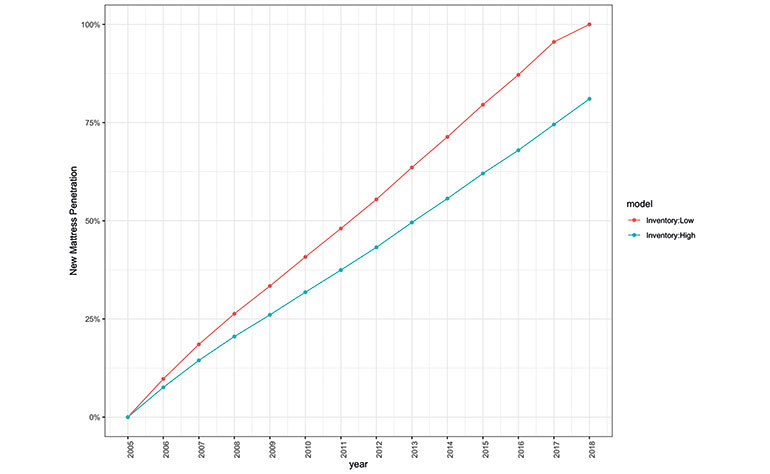
- Year-by-year method: uses annual mattress sales data to estimate market penetration of the new mattress into homes, allowing annual comparisons. It is based on the assumption that the oldest mattresses are replaced first. Due to the uncertainty in knowing the exact number of mattresses in use in 2005–2006, the analysis included two choices, labeled ‘high’ and ‘low’ in Figure 1. (To facilitate like comparisons with the before-after method, the estimated changes shown are based on differences between 2005–2006 and 2015–2016.)
Statistical models were used to estimate the impacts of the standard. The models assume a Poisson process, i.e. bed fire outcomes are independent events occurring at a constant rate. Three data sources were used: National Fire Incident Reporting System (NFIRS), US Census, and the International Sleep Products Association (ISPA). For more details on the statistical methods, see Gilbert et al. 2020.
Results
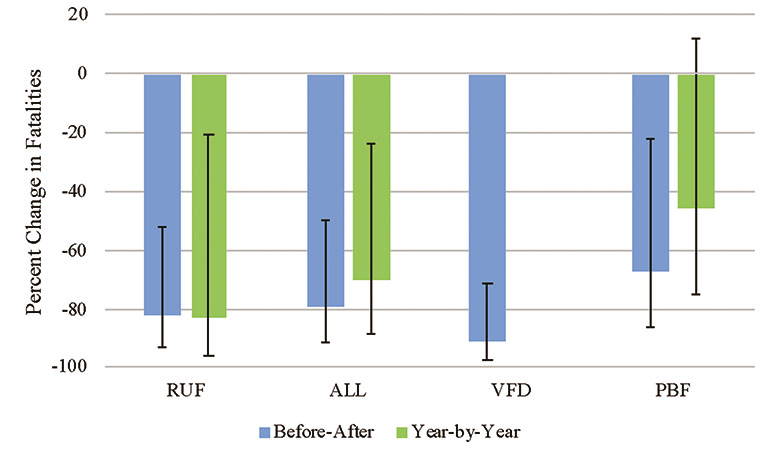
The results are summarized in Figure 2 and Figure 3. Figure 2 presents the estimated per cent change in fatalities, and 95% confidence intervals, from 2005–2006 to 2015–2016 by approach and method. Using the before-after method, the VFD approach estimates a 91% reduction in fatalities due to bed fires from flaming ignitions, followed by the RUF Fire control (82%), All-Fire control (79%), and PBF normalization (67%). Using the year-by-year method, the RUF Fire control estimates the largest change of 83%, followed by All-Fire control (70%) and PBF normalization (46%). (The VFD approach was not estimable for the year-by-year method and is excluded.) All estimates are significant at the 95% confidence level except for the PBF/year-by-year model.
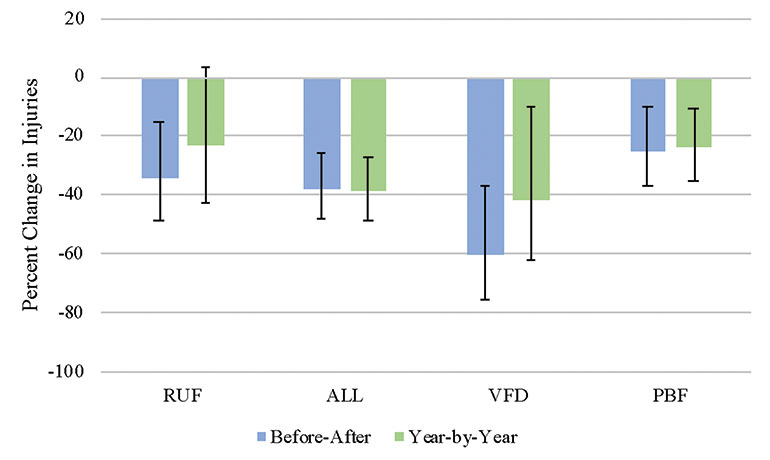
Figure 3 presents the estimated percent change in injuries, and 95% confidence intervals, from 2005–2006 to 2015–2016 by approach and method. Using the before-after method, the VFD approach estimates a 60% reduction in fatalities due to bed fires from flaming ignitions, followed by the All-Fire control (38%), RUF Fire control (34%), and PBF normalization (25%). Using the year-by-year method, the VFD control estimates the largest change of 42%, followed by All-Fire control (39%) and PBF normalization (24%). All estimates are significant at the 95% confidence level except for the RUF/year-by-year model.
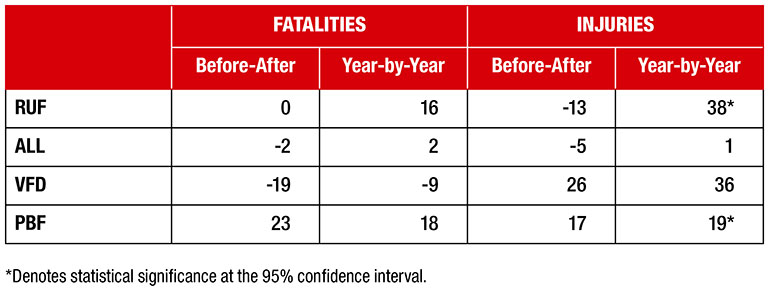
As an additional test of model specification, the models were re-estimated using outcomes from bed fires ignited by smoking materials. Because the standard was designed for flaming ignitions, we would expect limited impact on cigarette-ignited bed fires. Table 1 presents the per cent change in fatalities and injuries by approach and method for bed fires ignited by smoking materials. None of the estimates are statistically significant for fatalities and for injuries are significant for only two of the eight models. Given our expectation of limited impacts from the standard on cigarette-initiated bed fires, had we found similar results to the models with flaming ignitions, it would have raised the possibility of spurious correlations due to model misspecification.
The positive correlation between the standard and injuries from cigarette-initiated bed fires likely indicate that the bedclothes were ignited by the cigarette (bedclothes performance is not considered in 16 CFR Part 1632 or 1633) and their hazard is increasing, smaller fires are more likely to result in injury due to intervention, the flaming performance of RUF is not regulated, or some fraction of smoldering fires transitioned to flaming.
Discussion
Statistical analysis provides evidence that 16 CFR Part 1633 reduces fatalities and injuries from bed fires ignited by flaming sources. The results are robust to estimation approach, comparison method and misspecification. In general, we see the standard has a larger statistical impact on fatalities (82% reduction compared to RUF fires using the before-after method) compared to injuries (34% reduction compared to RUF fires using the before-after method). The differences may imply that the standard reduces the risk of harm from the most dangerous fires. Additionally, Gilbert and Butry (2017) demonstrated that the populations fatally injured during a fire are different (e.g. more vulnerable or frailty) than those non-fatally injured, suggesting the standard may provide greater benefits to those most at risk of serious health outcomes.
For more information, go to www.nist.gov
References
- 16 Code of Federal Regulations Part 1633. Consumer Product Safety Commission. (2006). Final rule: Standard for the flammability (open flame) of mattress sets. Federal Register, 71(50), 13472. Retrieved from https://www.federalregister.gov/documents/2006/03/15/06-2206/final-rule-standard-for-the-flammability-open-flame-of-mattress-sets.
- Butry, D.T. and D.S. Thomas. 2017. ‘Cigarette Fires Involving Upholstered Furniture in Residences: The Role that Smokers, Smoker Behavior, and Fire Standard Compliant Cigarettes Play’ Fire Technology 53, 1123-1146.
- Butry, D.T., J.P. Prestemon, and D.S. Thomas. 2014. ‘Investigation of the decline in reported smoking-caused wildfires in the USA from 2000 to 2011’ International Journal of Wildland Fire 23(6): 790-798. doi: http://dx.doi.org/10.1071/WF13146.
- Gilbert, S.W., D.T. Butry, R.D. Davis, R.G. Gann. 2020. Estimating the Impact of 16 CFR Part 1633 on Bed Fire Outcomes. NIST Technical Note 2092. Gaithersburg, MD: National Institute of Standards and Technology. doi: 10.6208/NIST.TN.2092
- Gilbert, S.G., and D.T. Butry. 2017. ‘Identifying Vulnerable Populations to Death and Injuries from Residential Fires’ Injury Prevention. Published Online First: 3 August 2017. doi: 10.1136/injuryprev-2017-042343.
About the Author
David T. Butry is Chief of the Applied Economics Office, Engineering Laboratory.

You must be logged in to post a comment.