

In Part 2 of this article, the smoke detection performance of the particle-charging method is demonstrated. All three commonly used materials, including ABS, tinned copper and PVC, are subjected to the pyrolysis test presenting highly reliable detection performance for various smoke particle characteristics.
Practical application – pyrolysis test
At the pyrolysis stage of fire, the material could be heated to ignition temperature for various reasons, such as the overloading of cables and wire sockets. Overloading of electronic components generates a massive amount of heat, increases the temperature of the material, and releases pyrolysis particles into the surrounding environment. Because the pyrolysis particles are significantly diverse in composition, characteristics and geometric patterns, it is a huge challenge for the smoke detector to reveal fire threats at the very early stage of fire.
To further investigate the performance of the particle ionisation/charging method in practical applications and to explore the influence of smouldering fire, a sample prototype utilising the particle-charging method (PIM) was subjected to the pyrolysis sensitivity evaluation. In addition, two smoke particle measuring devices using optical laser (OLM) and particle-counting methods (PCM) were also subjected to pyrolysis sensitivity evaluation, exploring their own detection performance at the pyrolysis stage of fire. Note that TSI SMPS 3910 provides a reference measurement for the particle-counting method as they have similar measuring principles that both of them focus on the particle-counting technology. For the laser method, a laser-based ASD is used to provide reference measurements.
Test apparatus
The pyrolysis test apparatus illustrated in Figure 6 consisted of a smoke chamber, a baking plate and a ventilation system. The test materials were cut into round plates (80mm in diameter and 5mm in thickness) and placed in the smoke chamber on the baking plate. The test was conducted for 1 hour, during which the test materials were baked slowly from room temperature to the pyrolysis temperature. That is, the temperature at which the material starts releasing an enormous amount of particles or the size of the particle grows significantly.


Test results
Figures 3, 4, and 5 illustrate the pyrolysis sensitivity evaluation results for three materials commonly used in power system design: polyvinyl chloride (PVC), ABS and tin-coated red copper plates (CPs).
PVC is widely used in power transmission applications and electronic circuit design. This material has a unique pyrolysis property in which the particle concentration decreases with temperature while the particle diameter increases rapidly after reaching the pyrolysis temperature. Figures 3a and 3b illustrate the sensitivity evaluation results of the PVC pyrolysis test. The pyrolysis temperature of PVC is approximately 98°C, while the mean particle diameter is approximately 70nm. The electrode voltage signal of the sample prototype using PIM starts rising linearly at this temperature point. This result suggests that both receiving electrodes successfully identify the pyrolysis particles. In addition, PIM is found to be very sensitive to particle size variation. For OLM, the sensitivity measurement shows signs of increase after reaching 135°C, and the mean particle diameter increases rapidly at the same time. However, as the particle concentration slightly decreases against the temperature, the sensitivity measurement of the PCM, referring to the particle concentration of TSI shown in Figure 5b, shows a weak sign of increase.
Figure 4a shows the pyrolysis sensitivity test results of the ABS plate. The temperature at which the pyrolysis process was started is approximately 136°C. As the particle concentration grows exponentially, the readings on electrode A quickly reach the saturation region. This finding indicates an excellent detection performance of ABS particles by the particle-charging method. Similarly, PCM is highly sensitive to ABS particles due to the dramatic increase in particle concentration. However, the optical detector shows no signs of detecting such a pyrolysis process until the mean particle diameter reaches 150nm.
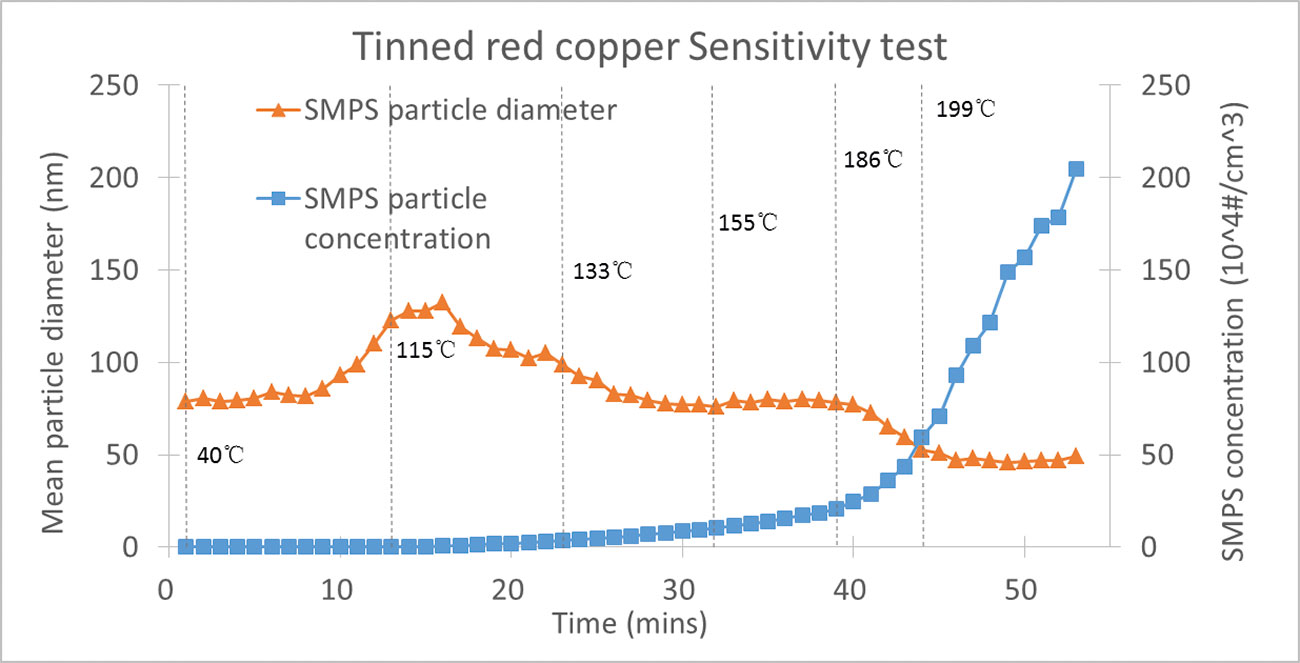
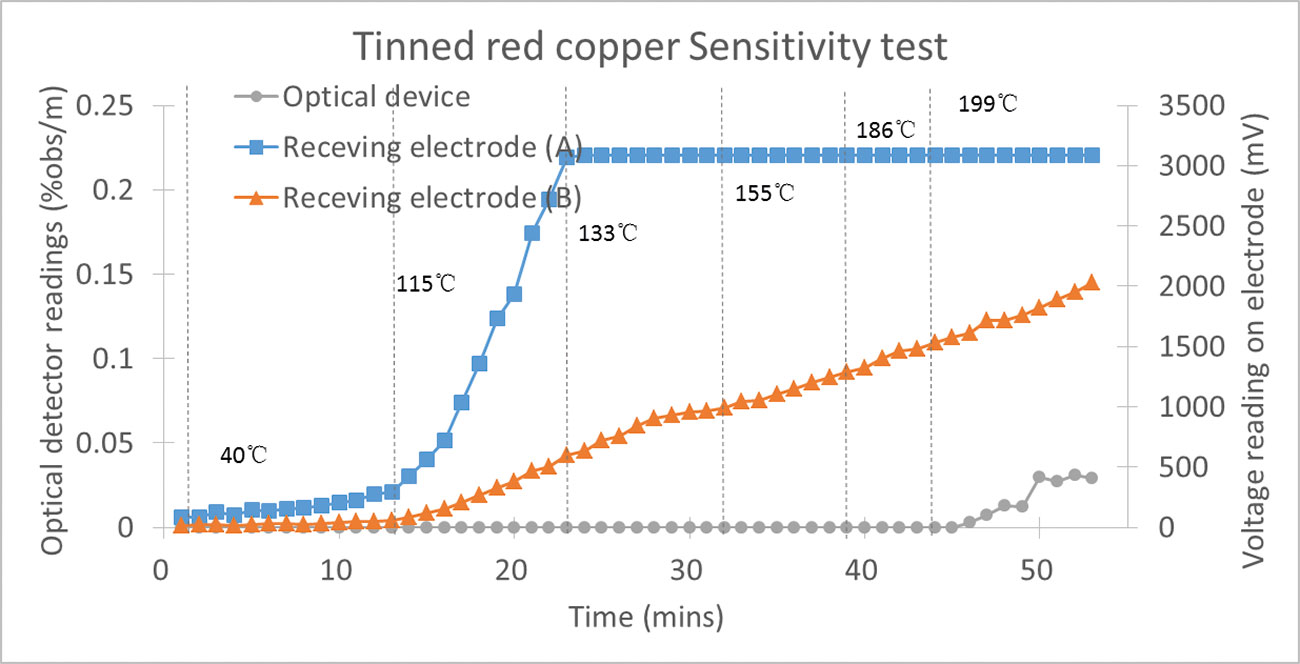
Tinned red copper, commonly used in circuit system design and power transmission lines, was subjected to sensitivity evaluation. The result is shown in Figures 5a and 5b. Significant growth in the mean particle diameter at 155°C facilities the voltage rising on the receiving electrode A, confirming microparticle detection by PIM. However, OLM barely detects any signal of the releasing particle until the total particle concentration reaches three times as much as ABS and four times as much as PVC.


Performance evaluation
PCM is highly sensitive to variation of particle concentration; thus, it obtains a very high detection performance for materials having pyrolysis properties similar to those of tin-coated copper. However, the particle concentration released by PVC is not enough to reach the alarm threshold value of the PCM, leading to a severe delay of alarm time and neglection of the particular fire threat.
The limitation of the OLM is amplified by the tinned copper sensitivity test. Through the heating process, tinned copper releases an enormous number of particles below 100nm. The laser diffraction effect is restricted by the particle size; therefore, there will be a greater delay in alarm time compared to other detection methods. With a unique detection mechanism, PIM is able to sense specific changes in the crucial particle characteristics: particle concentration and diameter. Therefore, the detection performance of PIM is outstanding for all three materials.
Conclusions
Particle charging and electromobility technology have been widely used in laboratory instruments for particle sizing and particle distribution. Nevertheless, practical application in the very early fire alarm industry is rare.
In this work, the standard PSL nanoaerosols sensitivity evaluation of PIM for various particle diameters is presented. The average charging efficiency is 40–50%.
A sensitivity evaluation of pyrolysis particles for various materials was also conducted in this work. PIM has advantages over other detection mechanisms, as it is sensitive to both particle concentration and particle size variation. Therefore, regardless of the material, PIM presents a high performance for sensing diverse pyrolysis particles in the incipient stage of fire regardless of the material’s type. Additional conclusions can be drawn from the pyrolysis test result that significant time-lead for sensing the pyrolysis particles can be achieved by PIM as well as compensating for the drawbacks of existing detectors based on different methods. PIM has been proven to have great potential in the very early fire warning industry.
Obscuration % obs/m refers to the fraction of light absorbed by smoke particles to the overall light intensity. This measurement is particularly used as a criterion in the smoke-detection industry to indicate the sensitivity of a smoke detector. However, the criterion is not effective enough to indicate the detector’s sensitivity for smoke particles less than 150nm (microparticles). It is necessary to introduce a new sensitivity criterion to precisely indicate the detection sensitivity for microparticles. PIM sensitivity measurement based on the number of charges on the surface of particles may be a possible solution for giving a new sensitivity criterion to early fire warning systems.
For more information, email info@partrixfire.com

You must be logged in to post a comment.