

Although fire dampers are a key component in the passive fire protection of commercial buildings and multiple occupancy dwellings, many managers are unaware of their role in safeguarding the building and its occupants. Consequently, they are often equally unaware of the critical need to ensure that they are tested, cleaned and maintained at the regular prescribed intervals.
It is one of the ironies in commercial property construction that there are tensions in the way that we build; trying to balance the equation between energy efficiency and indoor air quality. In most properties this is resolved through mechanical ventilation or air conditioning systems as the air changes achieved throughout the building can be measured and controlled.
The installation of ventilation ductwork creates its own tension, however, between the compartmentation of buildings to delay or halt the spread of fire and the need to allow air to circulate freely. The latter, of course, inevitably reintroduces a route through which fire can spread, using the path through the ventilation ductwork. Clearly this interrupts the compartmentation and presents ‘chinks’ in the building’s passive fire protection armour.
To resolve this tension, therefore, it makes sense to attempt to compartmentalise the ductwork itself, at least on a part-time basis. This is achieved through the installation of fire dampers, which are required by law to be installed within the building’s ductwork systems. The exception to this is in a kitchen extract system, which is needed to expel smoke in the event of fire and which attracts fat, oil and grease deposits, which would impede fire dampers very quickly as they accumulate, making the extract ductwork an unsuitable location for these products. Typically, with kitchen extract systems the exterior of the ducts are given special external fire protection where they pass through fire escape routes as an alternative to fire dampers.
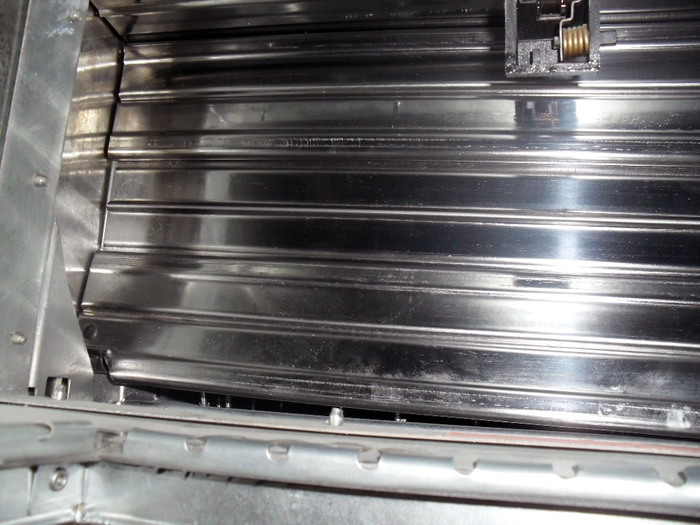
Fire dampers are however, in general, crucial passive fire protection products used in ventilation ductwork to prevent the spread of fire inside the ductwork through fire-resistance rated walls and floors. Essentially, they are metal louvres installed across a section of the ductwork at right-angles to its walls. When closed they will form barriers that turn the ductwork into a series of long narrow compartments designed to slow or prevent the spread of fire. The requirement is for the installation of the fire dampers to correspond with the location of the fire-resistance rated walls and floors, so that the chink in the armour is filled when necessary. Building Regulations stipulate that the fire damper should be situated within the thickness of the fire separating element – either the floor or the wall – and be securely fixed. It is also necessary to ensure that, in a fire, expansion of the ductwork would not push the fire damper through the structure. The compartment is therefore restored when the fire damper is closed, albeit temporarily.
Once installed, normally, fire dampers remain open so that the free flow of air or heat is unhindered throughout the building. In the event of a significant rise in temperature, the fire damper is designed to close, usually activated by a thermal element. This melts at temperatures higher than ambient but low enough to indicate the presence of a fire, allowing springs or gravity to close the damper blades. Fire dampers can also close following receipt of an electrical signal from a fire alarm system utilising detectors remote from the damper, indicating the sensing of heat or smoke in the building occupied spaces or in the duct system.
Hopefully, there will not be a fire, so these fire dampers will remain in the open position. This, again, can create its own problem, as fire dampers can become dirt laden, stiff and sluggish over time. As they are open most, if not all of the time, it is vital to ensure that they will still close effectively when required.
Determining this is not always a simple task because of the location of the installed fire dampers. More obvious fire prevention equipment such as fire extinguishers and bells are, due to their purpose, installed in plain sight and easily accessed for testing and repairing or replacing if faulty. Fire dampers, however, although equally valuable in delaying fires, because they are hidden away within ductwork, easily fall into the “out of mind” category, as well as being out of sight. It is essential that they are brought to front of mind when it comes to building maintenance schedules and fire prevention processes.
By providing a barrier beyond which the fire is less likely to pass, or is at least delayed from spreading, effective fire dampers save lives; so regular fire damper testing (known as drop testing) as well as fire damper cleaning and maintenance is both a legal requirement and a critical part of building fire safety management. This is governed by the British Standard BS9999:2008.
BS 9999:2008 gives guidance for the two main types of fire damper. Spring-operated fire dampers should be drop tested, cleaned and maintained at intervals of no greater than 12 months; while all other models (such as remotely operated ones) should be drop tested, cleaned and maintained at least every two years. This is because normal use of the ventilation system gathers an accumulation of contamination on the fire damper and its operational parts. This must be removed and the fire damper tested regularly to ensure that it operates as designed, should a fire occur.

In a healthcare setting, additional care is needed, due to the more vulnerable nature of the building occupants, many of whom will have impaired mobility and will therefore require additional time to be evacuated than a more able bodied office worker or younger, fitter domestic resident. Care sector applications must therefore also comply with the Health Technical Memorandum (HTM) 03-01: Specialised ventilation for healthcare premises Part B: Operational management and performance verification. This memorandum is issued by the Department of Health.
Before you can test or maintain a fire damper, you must be able to locate it. This may sound basic, but it entails identifying and logging the location of every fire damper in each building in which they have been installed. This is a task for the responsible person and a clear record should be kept of where each fire damper is located. This can be easier said than done.
Depending when the ductwork and the fire dampers were installed, there may have been greater or lesser understanding of the importance of fire dampers. Some fire prevention or health and safety professionals will therefore inherit clear documentation of the locations of fire dampers and records of past testing. Others will have to start with a clean sheet and physically track dawn the fire dampers. This is, unfortunately, still more common that we would wish.
As they are installed within ductwork, some fire dampers will be inaccessible even once that have been located using plans and drawings. In order to test these, access doors will have to be retrofitted in order to perform the drop test, cleaning and any maintenance required. This is a specialist job as it must be done without compromising the integrity of the ductwork, either for use as a ductwork system component or as a means of containing fire.
Once located and accessed, the type of fire damper must be determined. Each fire damper should be identified and given a schedule of testing on a frequency that will comply with BS: 9999 (and HTM 03-01 in care settings.) The regular testing interval for fire dampers should be agreed with the local Fire Prevention Officer and a maintenance schedule should be established to ensure that testing, cleaning and maintenance are all carried out on time at the correct intervals.
Each fire damper must be tested individually. There are two main types of fire damper, those which are spring operated and those which are not. Spring operated fire dampers must be tested and cleaned at least every twelve months, while non- spring operated models must be tested, cleaned and maintained at least every two years. The method used for testing fire dampers is known as drop testing and is designed to establish that they close properly; and that, when closed, they do not lose air pressure across the damper. Each fire damper should be cleaned, lubricated, drop tested to ensure they are in good working order and reset ready to offer protection in the event of fire.
If the fire damper does not pass the drop test, it will require maintenance. This will often involve the replacement of the linkages or springs that operate the opening and closing action. Or the operating remote system may exhibit a fault. Any faults should be identified at the inspection and testing stage and a remedial work plan drawn up. Once any problems have been identified it is essential that the recommended remedial action is taken and the repair effected rapidly. Once you know that the passive fire protection has a flaw, you will be aware that the building is more vulnerable to fire, so maintenance must be of the highest priority. An expert testing and maintenance provider should be able to effect repairs within a very short time frame. If faults are not rectified in a rapid and timely manner, this could be construed as negligent.
It is essential to ensure that there are accurate records of fire damper inspection, cleaning, drop testing, and maintenance, including before and after photographs of cleaning and any repairs. This is essential for a number of reasons, the first of which is peace of mind. Lives may depend on the fire damper being in good working order, so the building manager should be confident that it is.
Secondly, these records may be needed if there is a fire, particularly should the worst happens in the form of a fatality. In the event of an investigation, accurate, dated, photographic records will help to demonstrate that there has been no negligence. This will help to protect those responsible for the building from prosecution for negligence, the penalties for which are severe and can include imprisonment.
Thirdly, this documentation can be presented to the building’s insurer to demonstrate that the building’s passive fire protection was compliant and that there were no negligent contributory factors to the fire. Insurers expect that those they ensure will comply with all their legal responsibilities. It is advisable to keep more than one copy or to use cloud storage for maximum peace of mind.
As with so many elements of any building, the adage is, if it is installed, it should be compliant. Fire damper testing is an expert task, but it is also a relatively inexpensive one, particularly when compared with the likely outcomes of not complying with the testing requirements. Even if the building has more than one type of fire damper, a specialist provider will be able to help devise a cost effective testing, cleaning and maintenance schedule that will keep the building compliant and protected. The consequences of not maintaining fire dampers are far too costly to contemplate, both in material and personal terms, for everyone involved.
For further information, go to www.swiftclean.co.uk
About the Author
Gary Nicholls is Managing Director of Swiftclean.
