
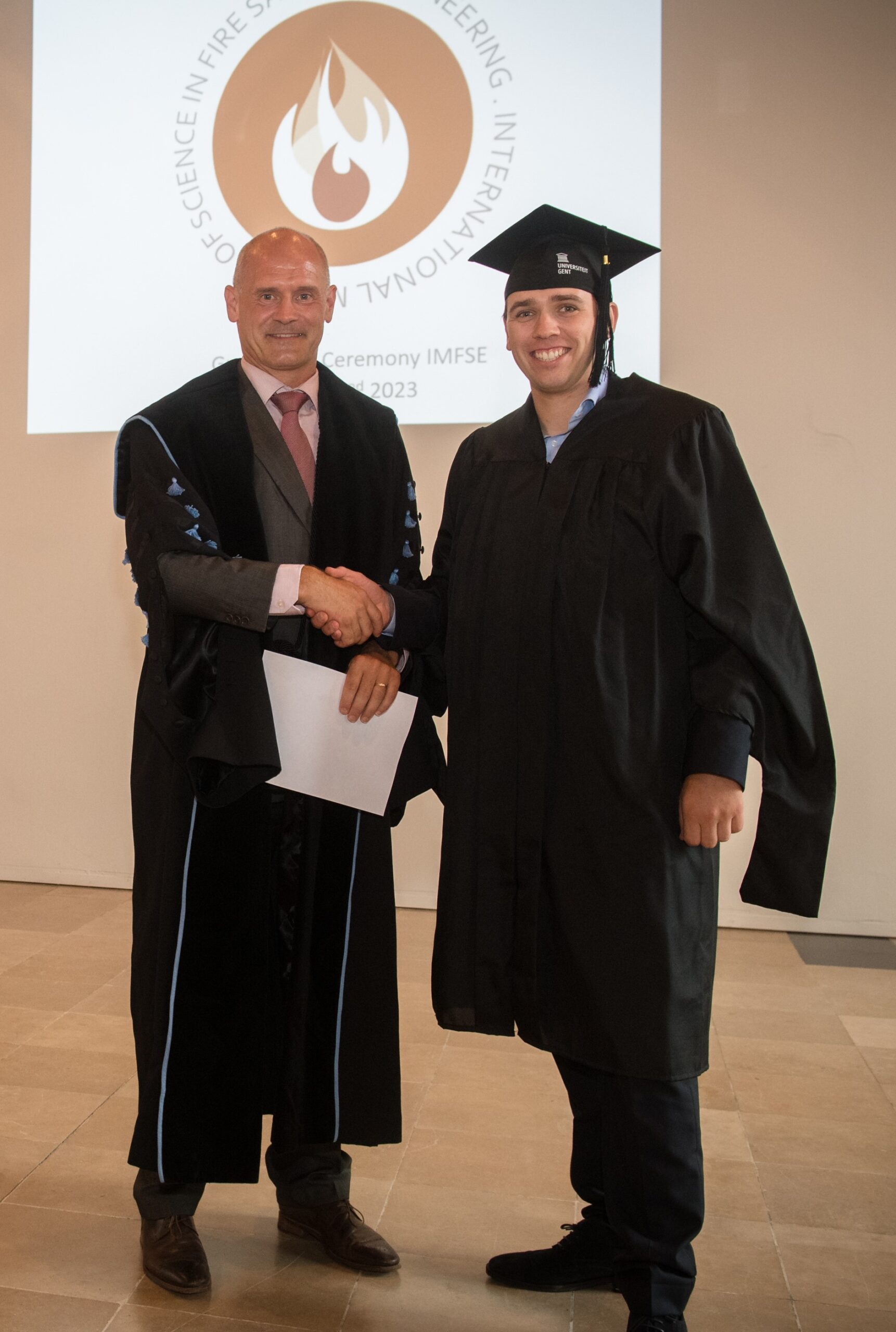
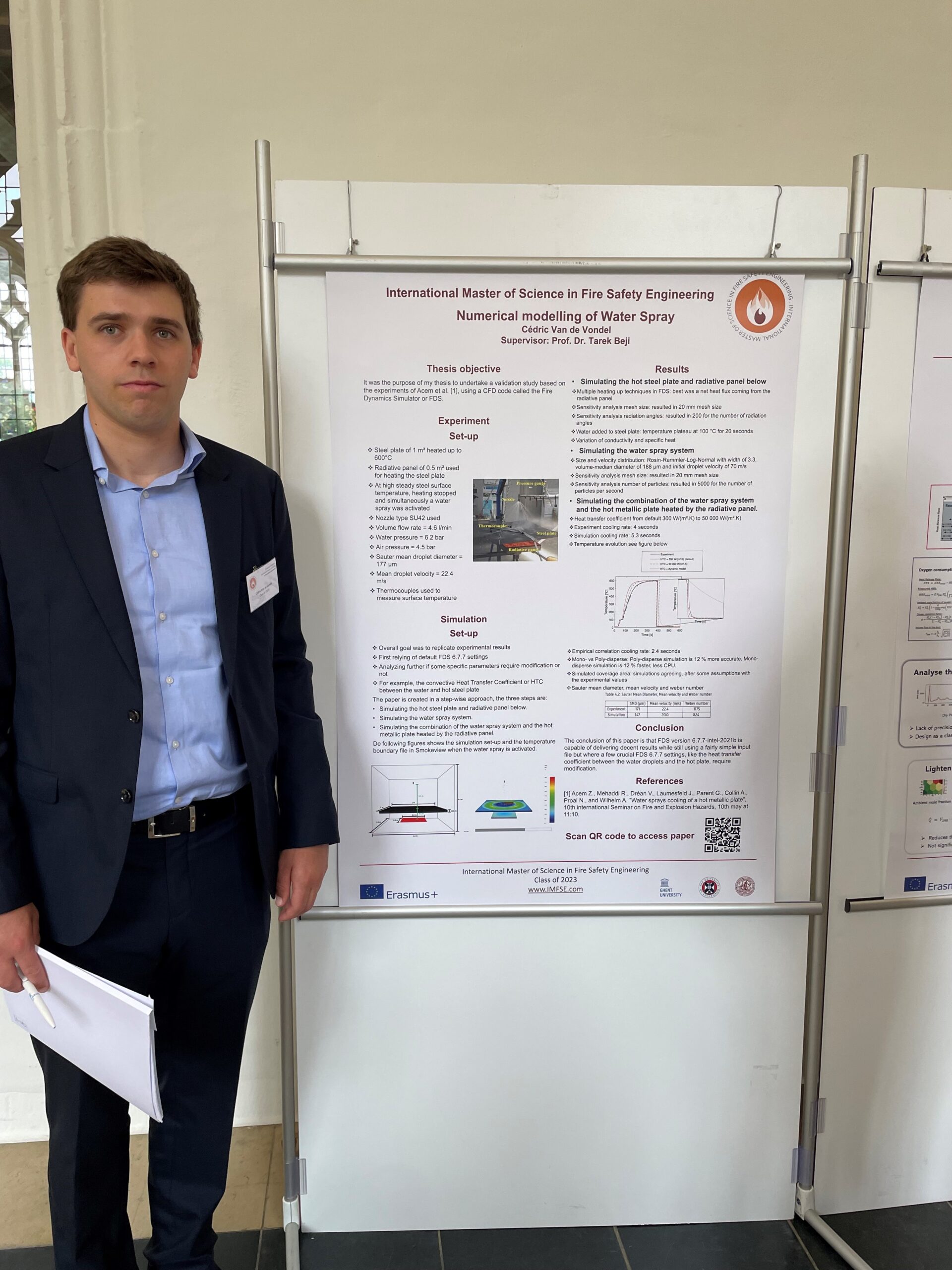
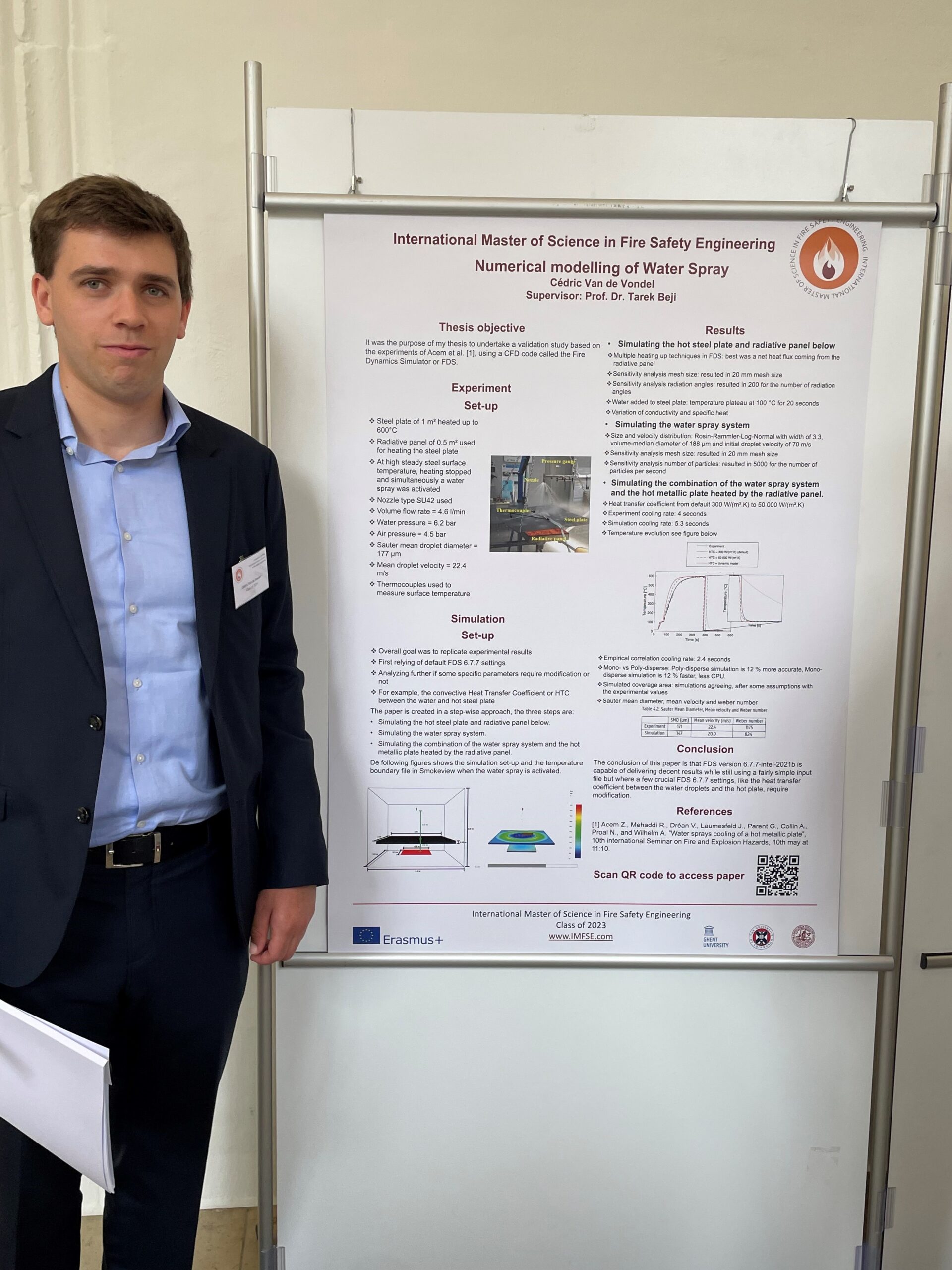
Since 2016, the International Water Mist Association (IWMA) has awarded a prize for a thesis written by young scientists. In the beginning, the award was called the IWMA Young Talent Award. Last year the IWMA members decided to rename it and thus honour their late president Ragnar Wighus. In 2024, the Ragnar Wighus Award goes to Cédric van de Vondel who graduated from Ghent University in 2023. The title of his master thesis is: ‘Numerical Modelling of Water Spray Impingement Cooling’. Here we interview Cédric.
From where does your interest in fire-safety engineering derive?
My interest in fire safety and especially extinguishing systems comes mainly from my father, Dirk Van de Vondel. He founded a company more than 30 years ago with a few others (Wilfried De Niel) in fire safety, more specifically in automatic extinguishing systems, and has always been very passionate about this. I liked the work he did and found it so interesting that, after graduating as an industrial engineer, I started looking for something else to do with this interest, and so I ended up in the IMFSE (International Master in Fire Safety Engineering) field. This was really something that fulfilled all my expectations and here I learned a lot about the world of fire safety.
On your first day at university, did you know that you would be writing your master thesis about watermist?
No, my interest was more related to active fire protection and thus I opted for a thesis in this field. During the classes the FDS simulation software sparked my interest. As a result, the combination of active fire protection of watermist and FDS simulations provided an ideal option. And especially when I saw who the supervisor was, Professor Dr Tarek Beji. He was very helpful and always passionate about his work in all his classes and thus also as a supervisor. When we started talking and learning about watermist during the lessons, I was fascinated by it immediately, and my father and Wilfried told me that watermist is the future and that it could be very helpful for my professional career later on.
Ghent – from where you have graduated – is a lovely town in Belgium. What was the atmosphere like on campus?
Awesome! Ghent is indeed a great city with a wonderful university. The only downside to my education in both Ghent and Lund was the lack of interaction, due to the coronavirus. For example, the cancellation of on-campus lectures and labs. Understandably this was done in order to ensure the safety of the students and the staff. The IMFSE is a smaller but very close-knit group, where I had a great time.
Have you been to other universities before you graduated?
Yes, before my studies in the IMFSE, I graduated as an industrial engineer at the Free University of Brussels. And then during the IMFSE years themselves, I also got to go to Lund, a beautiful city in the south of Sweden, for six months.
How was your interest in watermist aroused?
Through the lectures concerning active fire protection and the knowledge I acquired through my father. The simplicity of such systems along with their high efficiency in extinguishing or containing fires is remarkable. It is more convenient in many scenarios than the traditional sprinkler system.
What do you think are the great advantages of the watermist technology?
Watermist technology has many advantages! Firstly, the small water droplets of watermist allow for an increased efficiency in heat removal compared to a conventional sprinkler system. As a result of this the required water volume is significantly lower. This aspect allows for smaller water tanks or in some cases it even eliminates the need for tanks, if the water supply is high enough. Another beneficial aspect of watermist is the ability to use smaller pipe diameters, which leads to an easier installation. One of the party pieces of watermist is its efficiency in putting out fires in large industrial fryers. It is clear that watermist is a formidable technology that will increase in importance in the near future.
How was the time during which you wrote your thesis? How will you look back at it in years to come?
The academic year in which I had to write my thesis, I had to take some time off for my health, which meant I needed a longer period to write my thesis. Apart from this, it was a very quiet period in which I could count on a lot of help from my family and supervisor, Professor Dr Tarek Beji. It was a real pleasure to schedule meetings with him and talk about the work. I am therefore incredibly grateful to him for everything!
What do you think will the future of watermist look like?
I think the future of watermist looks very promising. I expect that more and more applications will be protected with watermist due to its many advantages.
What are your personal plans for your future regarding your career?
My professional future lies with the company EXPRO Fire Protection, the company that my father, Dirk Van de Vondel and his colleague Wilfried De Niel founded. EXPRO is responsible for designing, installing and maintaining all kinds of automatic extinguishing systems such as watermist, gas extinguishing systems and kitchen extinguishers. The experience of working at EXPRO is worth its weight in gold to learn about the practical applications of the active fire-protection business.
Will watermist be a part of your future?
Definitely. As mentioned earlier, my future lies at EXPRO. Here we design and install, among other things: low-pressure watermist systems with pumps and high-pressure watermist systems with cylinders of nitrogen and water. I am convinced that we at EXPRO will be installing more and more watermist systems in the future. It can be used for so many applications: industrial fryers, spray booths, data centres, underground garages, building protection and so on.
For more information: www.iwma.net
About the Author

Bettina McDowell is the General Manager at the International Water Mist Association (IWMA).
You must be logged in to post a comment.