
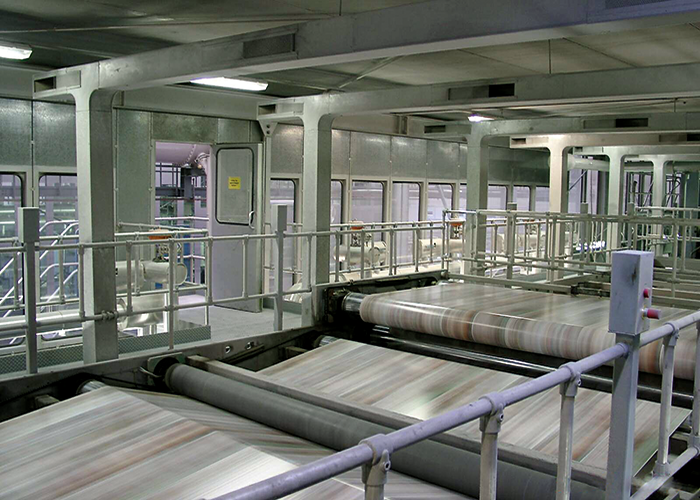
Solvents used in printing machines for magazines constitute a substantial fire risk potentially causing large scale fires and losses of parts, if not the entire printing machine. This has dramatic effects on the production process and leads to considerable consequential losses.
To date printing machines are protected with CO2, Aerosol or foam fire fighting systems. Due to the open environment around the printing machines and the presence of personnel, safe and effective alternatives are sought by printing companies.
High pressure water mist technology ideally matches the printing machine operator’s needs and fulfils the requirements of insurers.
Fire Protection Challenge in the Printing Industry
In the printing industry, fire protection plays a particularly important role. Flammable solvents in paints and materials, machine parts operating at high speed, the electrostatic charging of components are all potential hazards.
That is why CO2 and Aerosol extinguishing systems are often used in this industrial sector. These extinguishing agents are effective, clean, and residue-free. They neither damage the items to be protected, nor do they conduct electricity. CO2 systems, though, can only be activated after a specific pre-warning phase to not endanger any operation personnel. Both CO2 and Aerosol extinguishing systems are limited in their discharge time. If fires have not been extinguished during system discharge this can lead to substantial fire damages.
These two system types have so far protected the printing machines at PRINOVIS, Europe’s largest printing group, operating at four locations in Germany and the United Kingdom. In their production site in Dresden every year about 150.000 tons of printed papers are processed.
So far all printing machines were protected by an Aerosol extinguishing system as local protection systems within the paint trays containing solvent based colours, which is automatically activated after fire detection and a manually operated CO2 extinguishing system as additional safety measure.

Fire Incident with Tremendous Effect
On May 19th 2013, an alarm went off at the Dresden fire brigade. One of the six large retro gravure printing machines in the PRINOVIS printing group was on fire. Three fire engines of the fire brigade have been alerted as well as some voluntary fire brigades from the surrounding neighborhood.
A total of about 90 emergency services arrived at the scene and extinguished the fire within two hours. The cause of the fire was found to be a technical defect in the control box which is situated near the printing mechanism. The fire could spread easily due to the solvent-based printing colour that is used for the printing process.
The fire not only affected directly the printing machine, but in consequence also the production hall and stocks.
Even though the May 2013 fire in the large printing plant could be extinguished fairly quickly, the results for the company were devastating. One of its six retro gravure printing machines was completely destroyed. The cleaning and the clean-up measures after the fire proved to be time consuming and cost intensive. Fine soot particles had accumulated on the walls, ceilings, and technical equipment. In addition, the large quantities of fire extinguishing water had partially destroyed the paper stocks.
As a consequence of this fire, PRINOVIS decided to revise its fire protection concept. Together with its insurance company and the local fire brigade, the corporation decided to supplement the existing Aerosol and CO2 local extinguishing systems, which are used to protect certain areas within the printing machines, with a water mist system. An extension of the CO2 system was not taken into consideration. With a surface area of approximately 120 m x 60 m, the production hall is too large and spacious. At the same time, the company wants to keep the potential risk to human life at a minimum.
High Pressure Water Mist: An Advantageous Technology
High pressure water mist has been increasingly used in fire fighting since the early 1990s. Compared to other fire fighting methods, this technology provides many advantages.
High pressure water mist can be applied without pre-warning times. With just a small amount of water, it generates a considerable cooling and local oxygen displacement effect. It is safe to humans and the environment. Due to the small amount of water discharged, it does not have any serious impact on electric components, thus the risk of water damage is minimal. High pressure water mist partially washes toxic smoke particles.
All of this helps keeping the cleaning and clean-up measures as well as the renovation work after a fire incident to a minimum while assuring operational continuity. Another advantage is that water mist systems are space saving and can be integrated into existing machines and infrastructures at a later stage.
Water Mist System Standards and Approvals
Water mist systems are designed and approved based on internationally recognized standards, as the NFPA 750, the FM 5560 by Factory Mutual and the European CEN TS 14972 standard. Based on these international standards, national guidelines and standards have been development and published by organisations like VdS in Germany, APSAD in France, BSI in the UK and others.
All standards for water mist technology have in common that these standards do not prescribe the required nozzle type, droplet distribution, flow rate, nozzle spacing and discharge time, as standards for sprinklers or gas extinguishing system do. These parameters have to be individually determined by carrying out application related full scale fire tests to provide optimum protection of the respective risk.
In the past years numerous full scale fire tests have been carried out at independent fire research institutes and laboratories which have led to a broad acceptance basis of water mist systems as alternative to conventional systems.
For the protection of printing machines no general fire test scenarios exist. Fire test scenarios for machinery spaces exist, but printing machines represent special fire risks, mainly due to the highly flammable solvents used in the printing process. Special fire test scenarios have to be developed with an independent fire test institutes and system approval bodies.

Printing Machine Protection Concept based on Full Scale Fire Tests
PRINOVIS developed jointly with its insurance company, the water mist manufacturer FOGTEC as well as the VdS, as independent inspection body and test institute, a specific fire protection concept for protection of their printing machines. The concept is based on fire tests developed in accordance with Annex B of CEN TS 14972 standard. The type and composition of the fire load, the ventilation conditions, and the acceptance criteria have jointly been defined.
Any and all conceivable fire risks in the surrounding area of a retro gravure printing machine have been taken into consideration in the fire tests that were conducted at full scale. The spillage of colours within two printing units, a leakage or rupture in the supply of lubricants or the burning of large amounts of paper within the printing machine were simulated in these tests.
The different test series were successfully completed, witnessed by VdS as third party, and confirmed the measures which were subsequently integrated into the fire protection concept.
A FOGTEC high pressure water mist system has been installed at three levels within the printing machines enclosures of 8 m width, 30 m length and 10 m height. The water mist system is complementing the previous local Aerosol protection.
A deluge system with more than 500 open nozzles has been installed. Every retro gravure printing machine is divided into three sections in which water mist can be released simultaneously. To achieve fast extinguishment, one of sections containing the paint mixing units is supplied with a mixture of water and AFFF additive.
Linear heat detectors are installed throughout the printing machines to permit rapid detection of a fire.
All of these measures assure that the water mist system is operating automatically on fire detection. The water supply has been dimensioned with 100% safety factor and 30 minutes autonomy, resulting in a water tank volume of only 29m3.
The water mist system at PRINOVIS has been retrofitted to the printing machines under running production infrastructure without hassles and minimal business interruption. Operational continuity was, thus, assured and maintained at all times.
Conclusion
A number of different industrial fire risks which traditionally have been protected with conventional gas extinguishing or sprinkler systems are today seen as excellent applications for water mist technology due to its efficiency, environmental friendliness and its safety for operation personnel. This application field is continuously growing for water mist technology.
Particularly for the printing industry high pressure water mist has demonstrated excellent extinguishing abilities for printing machine environment to the satisfaction of companies as PRINOVIS as well as to their insurers, assuring best possible fire protection to their assets.
Partly higher initial investment cost than conventional technologies and the application related full scale fire test requirements request for proper evaluation of the suitability
of water mist for the application. Users, insurers and fire experts around the world today know and acknowledge the benefits of water mist and approach system manufacturers to jointly develop fire protection concepts based on this advantageous technology.
For further information, go to www.fogtec.com
