
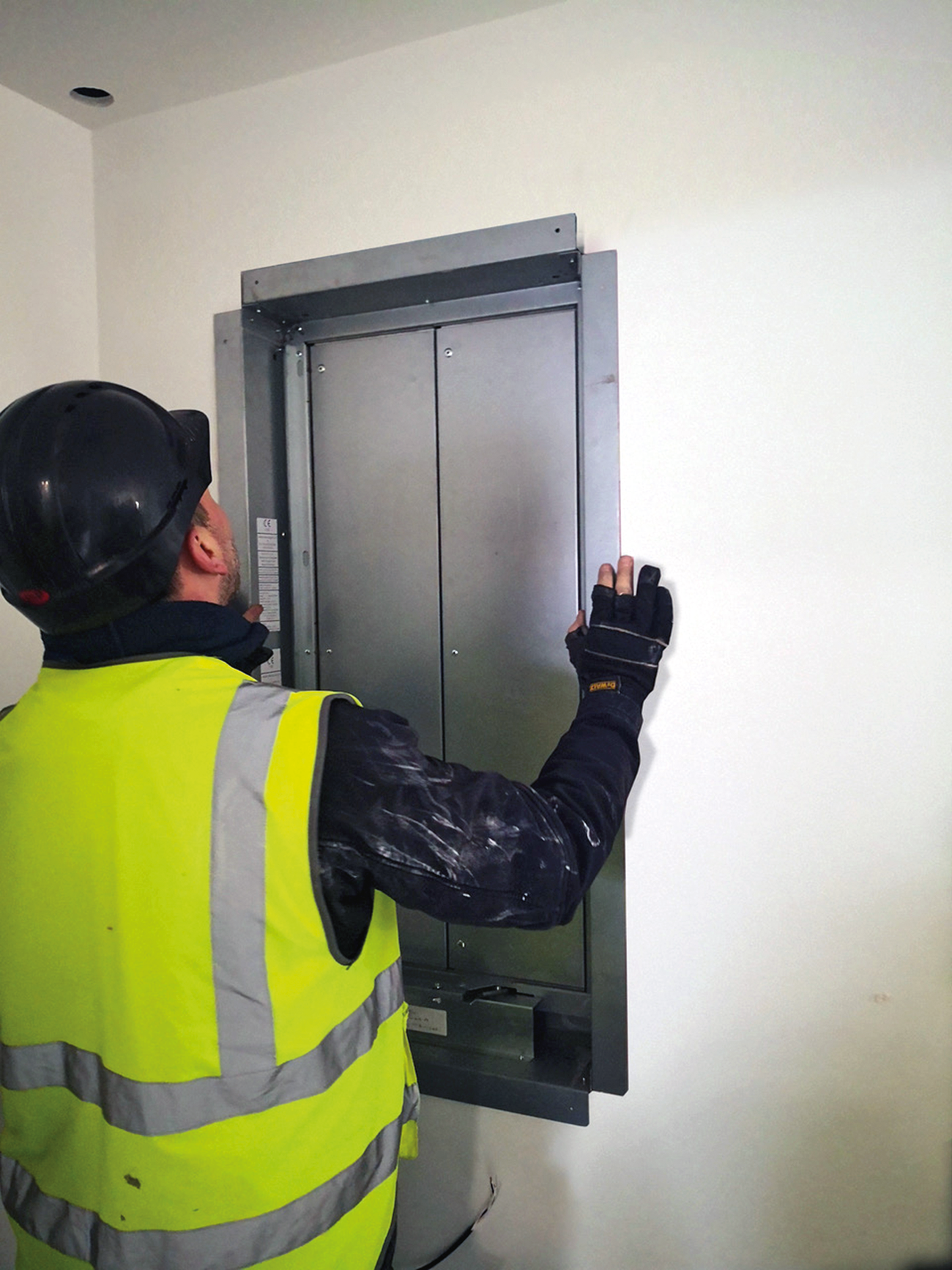
This article reviews the latest changes to testing and standards for smoke control dampers to deliver safer solutions in smoke control. The UK fire safety Regulations are undergoing major change, in an effort to “raise the bar” on current standards, to future-proof the safety of buildings going forward.
Dame Judith Hackitt’s “Building a Safer Future: independent Review of Building Regulations and Fire Safety” is the major driver behind revised guidance for the UK. Alongside that are revisions to Building Regulations Approved Document B: Fire Safety – Volumes 1 and 2 : 2019 (affecting England & Wales), published as recently as May 2020, along with the Scotland Building Regulations Technical Handbook Part 2 updated in 2019 and the CIBSE Guide E Fire Safety Engineering (4th edition 2019).
What is clear is that smoke control systems must be designed, installed
and maintained, as part of a holistic and on-going process.
To cater for the lifetime of the building, the “golden thread” model of balancing objectives and performance must be understood at the design stage and followed through. This will ensure not only compliance, but the confidence that best practice has been used at all levels, and that the building will be safe throughout its intended use, by detailing operational, management and maintenance functions.
Whenever there is a fire in any occupied building, whether residential or commercial, one of the most significant risks for the occupants is smoke inhalation. It is therefore crucial that a robust system exists to contain the smoke and then extract it via an uninterrupted path, away from those occupants to outside of the building.
On high rise buildings a stairwell or service shaft is commonly used as the smoke stack or “protected shaft”. Smoke dampers are employed and strategically positioned to preserve the integrity of these and all corridors and lobbies within the building. This ensures correct compartmentation is maintained during any such fire event.
According to the relevant guidance BS EN 1366-10:2011 Smoke and heat control systems – Smoke control dampers: ‘smoke control dampers at the fire and along the path have to be open and remain open. Smoke control dampers at branches, or on the surface of the duct, along the path need to be closed and remain closed”.
In simple terms this means that, if a fire starts on a floor, that damper should open (or move to the open position if closed) to evacuate the smoke into the smoke shaft. On all other floors the dampers remain closed (or move to the closed position if open) to protect these floors from the fire and smoke now moving up the shaft to the evacuation point, usually on the roof
of the building.
To develop the most effective deployment of dampers for smoke control in ventilation systems, it is important to consider risks holistically, to develop and consider the array of “cause and effect” as early as possible in the design process. For operational success, the specification should be critically assessed, so that the systems maintain appropriate simplicity. This ensures that they not only protect life and property, but also reduce the responsibility on firefighter operation of numerous override controls.
The smoke/ fire detection system needs to be sited to activate the
protective system/smoke dampers and limit the spread of fire and smoke as early as possible. Early warning will allow almost immediate activation of the smoke control system and ensure it operates as designed.
A typical smoke control system with automatic (motorised) activation requires a damper that operates automatically on a signal such as a fire alarm, without any manual action/intervention. In this application, once initiated, the system will not allow the damper position to be changed by external input or firefighter’s override with this design.

Less common are smoke control systems that allow manual intervention to be put into operation, leading to a sequence of actions in the operation
of the smoke control system.
Such systems will allow the smoke control damper position to be changed by external input/firefighter’s override. The system design must allow for this intervention and products utilised must conform to the standard that allows them to be operated during the fire event. Dampers especially must be even more carefully selected for this adjustment in a dynamic system and checked to confirm that the DOP provided by the manufacturer allows for such a damper to be adjusted during the fire event.
To ensure the validity of any smoke evacuation damper, ensure it is CE marked to BS EN 12101-8:2011 smoke and heat control systems. This also involves the product being tested to BS EN 1366-10 fire resistance tests for service installations, and classified to BS EN 13501-4:2016 fire classification of construction products and building elements. Dampers must meet these standards and thus the specific criteria within that need to be met.
By law, manufacturers must provide a DOP (declaration of performance), which must include the required criteria for each application to clearly detail the level of test for which the damper can be utilised. It is essential to check this, as not all dampers are rated and tested to the same level of the standard.
The simplest and clearest current detail is provided in the SCA (Smoke Control Association) guidance document “Guidance on Smoke Control to Common Escape Routes in Apartment Buildings (Flats and Maisonettes)”. This confirms the required level of damper testing for application.
A further consideration during selection of a system of smoke evacuation, is that if dampers are chosen to be employed, these will need to be periodically tested to ensure they remain operational.
Maintenance of the system and the damper itself should be regularly checked to prove this. This will ensure the life safety system that has been put in place will operate as designed when called upon should the fire event occur. Manufacturers will advise a period for general testing but it is incumbent upon the designer to set the smallest time frame for repeat testing, to keep the building system maintained to its required level. To this end with whole life building use in mind, the designer should look at the most effective system with a focus on quality, simplicity, ease of use and maintenance, for not just dampers but for all systems and components.
Smoke protection is, like many other areas of buildings, a specialised area. It is therefore helpful to design and develop the system in partnership with established proven professionals and manufacturers.
For more information, go to www.gilbertsblackpool.com
About the Author
Roy Jones is Technical Director at Gilberts Blackpool, the UK’s leading independent air movement specialist. He is one of the country’s leading authorities on air movement for Mechanical, Natural and Hybrid applications, sitting on numerous committees for BSI, CIBSE and HEVAC, as well as being a guest speaker on air movement and air diffusion, to leading colleges and universities.

You must be logged in to post a comment.