
The automatic sprinkler system is the most commonly used fire protection system for industrial and commercial occupancies. Sprinkler systems were first employed in the early 20th Century to protect the equipment and textile goods stored in multi-story textile mills. Ceilings in such buildings were low and goods were mostly stored in wooden crates. Designed to project approximately half of the water to the ceiling and half toward the floor, an important function of those early sprinkler systems was to wet and protect the combustible ceiling structure.
This design philosophy was changed when Factory Mutual (FM) introduced the spray sprinkler in the 1950s. At that time, it was recognized that applying water directly to the ceiling was not necessary, provided that high ceiling temperatures could be avoided and the spray from each sprinkler could be more efficiently distributed over a larger floor area. The new spray sprinkler was designed to project all the water downward toward the fire on the floor. Featuring a K-factor (discharge coefficient) of 8.1 and a nominal orifice diameter of 13 mm, these sprinklers were more than adequate to provide fire protection for the industrial occupancies of that time.
Changes in manufacturing and storage practices
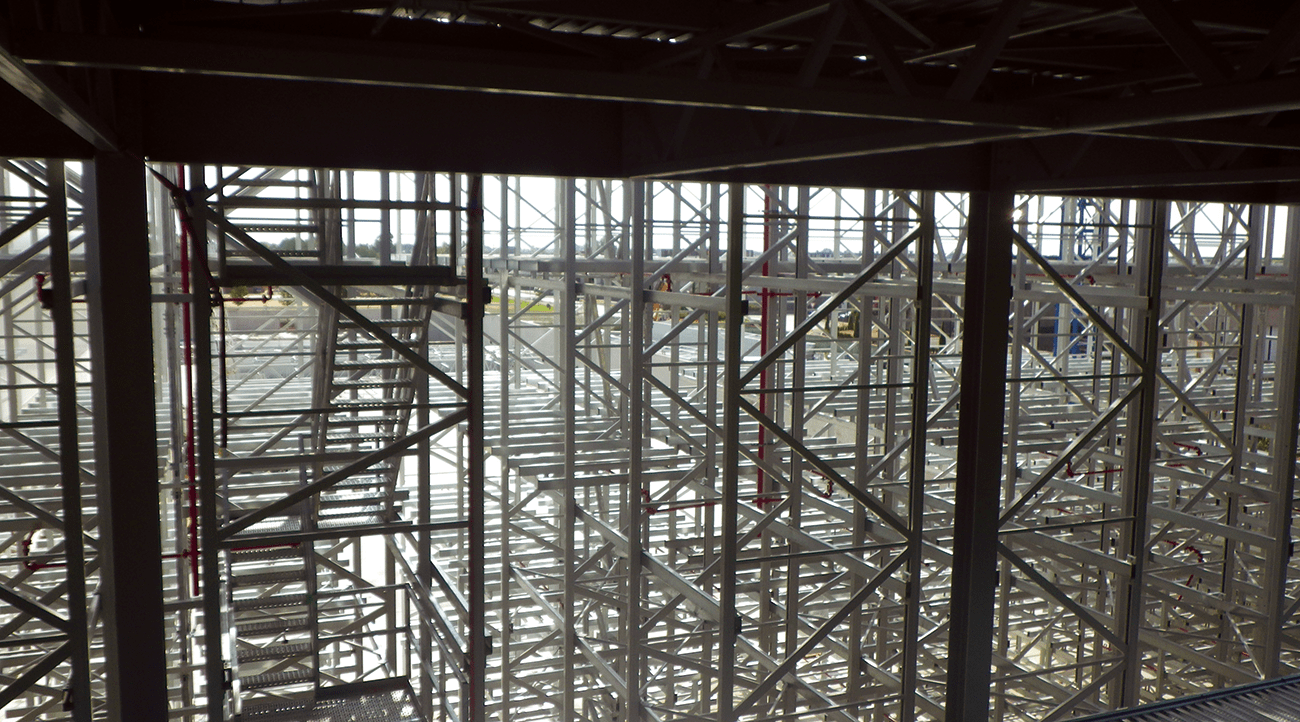
Industrial, manufacturing and storage occupancies have undergone dramatic changes in the interim decades. The proliferation of plastics in packaging materials and the increased use of cardboard cartons created entirely new, unprecedented challenges for fire protection sprinkler systems to overcome. These newer, lightweight storage materials allowed for storage racks to be built to greater heights and changed the dynamic of how storage spaces were designed. Taller storage racks create a ‘chimney effect’ when their contents burn, changing the way fires grow and increasing the challenge for adequate sprinkler protection. In addition, plastic materials generate more heat than previously used manufacturing materials when burned, increasing the hazard.
Overall, fires in a rack storage environment are characterized by extremely fast fire growth, high heat release rate and high plume velocity; and have therefore challenged the standard sprinkler to its limit of effectiveness. In some cases, combustibles are stored on solid shelves in their rack arrangements or the storage height and commodity fire challenge are beyond the effectiveness of ceiling-based sprinkler systems. In these instances, in-rack sprinklers are needed to provide sufficient fire protection.
Under these more challenging circumstances, a standard sprinkler system is required to supply a relatively large number of sprinklers with sufficient water to control and limit the fire spread within a particular design area by keeping the surrounding combustibles wet enough so that they do not ignite. In the years following the adoption of the spray sprinkler solution, it became evident that sprinkler system design requirements for each storage condition had to be individually determined.
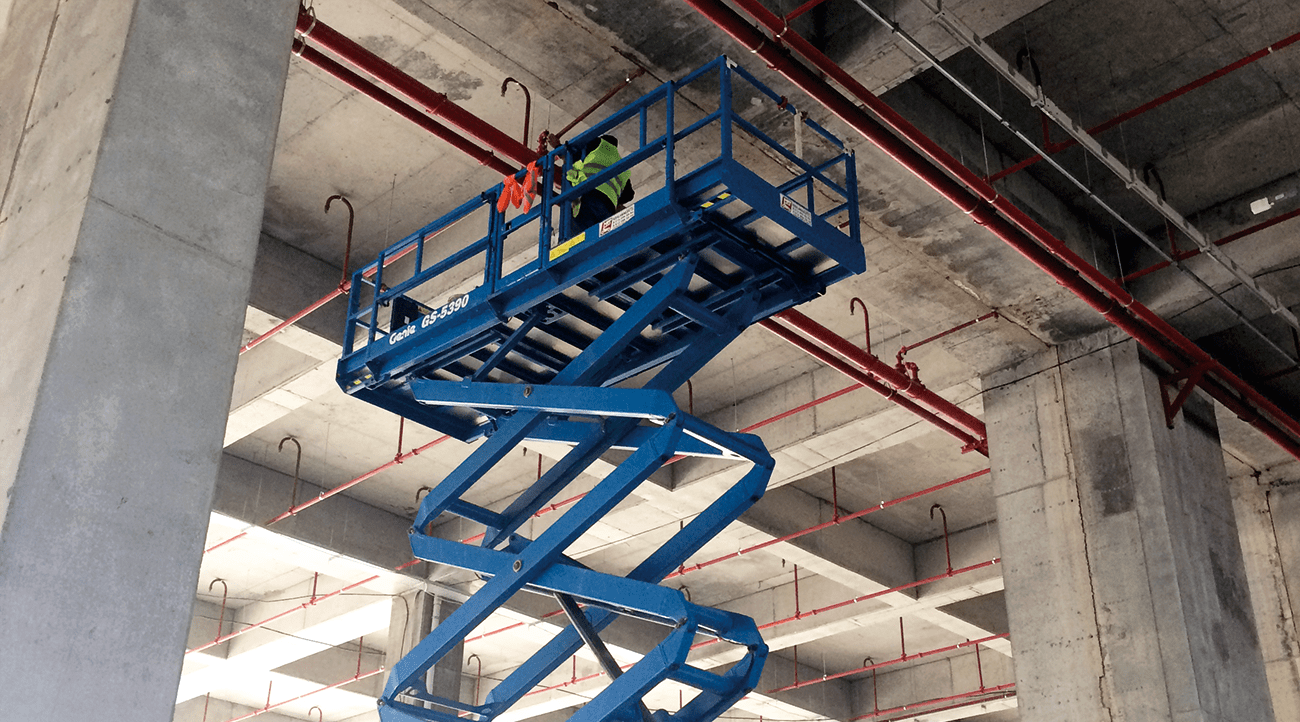
In 1967, FM built a large sprinkler fire test facility in the United States to seek solutions for fire protection challenges of storage environments through large-scale fire tests. Two fire test programmes – for rack storage and for plastic storage – were conducted from 1968 to 1972.
To provide the data needed with a reasonable number of fire tests, a concept called ‘parallelism’ was adopted by the FM steering committee which involved establishing a base density (water flux) versus area of demand curve for a standard test commodity and a set of test conditions utilizing a given brand of sprinkler. Additional curves for other stored commodities, storage conditions, and sprinkler variables – such as aisle width, type of storage rack and sprinkler temperature rating – were then constructed by drawing a parallel to the base curve through a single test point of the new commodity and test variables. All the tests were conducted with the ignition source centered below four sprinklers. By definition, the density/area rule assumes that – for a given density – the performance of all listed sprinklers in a given category would be the same, regardless of their manufacturer, orifice size, spacing, or pressure.
Unfortunately, over the years, test results have shown that different sprinkler models and ignition locations can cause significant differences in area demands. In addition, the density/area rule which has been used as the basis of traditional sprinkler system design is not always appropriate for modern storage protection.
Furthermore, fire tests in the ‘Plastic Storage Programme’ at FM revealed that rack storage of a plastic commodity over 4.5 m in height could not be protected with a ceiling-based sprinkler system alone, using the standard sprinklers. The standard sprinklers at the ceiling needed to be supplemented with in-rack sprinklers, in order to adequately control the fire. In-rack sprinkler systems are susceptible to damage by warehouse operators and create inflexibility in warehouse storage reconfiguration. To warehouse owners looking at cost-effectiveness and future expansion or reconfiguration, it is highly desirable to have ceiling-only sprinkler protection.
To respond to this need, new sprinkler technologies came into the marketplace. For protection of 6 m high rack storage of cartoned plastic commodities under a 7.5 m high ceiling, large-orifice sprinklers with a K-factor of 11.5 and a nominal orifice of 14 mm were developed. As the storage height increases, the fire challenge becomes greater for the ceiling-only sprinkler systems and more water is required to be discharged from the ceiling sprinklers to protect the stored commodities. With the available pressure from the water source as a fixed value, the sprinkler orifice needs to be increased to provide a higher discharge rate. This relationship between storage height, available pressure, sprinkler orifice size and K-factor has been understood by sprinkler designers for decades.
Measurement of the effectiveness of storage sprinklers
In response to these ongoing challenges, an additional, more comprehensive series of research programmes were conducted by scientists and engineers at Factory Mutual from the 1970s through the 1990s, exploring the principles of sprinkler performance in rack storage fires. These research programs included:
Response Time Index (RTI):
a measurement of the sprinkler’s response sensitivity to the gas temperature and velocity in the vicinity of the sprinkler as the fire grows large and hot enough to activate the sprinkler
Prediction of fire size at sprinkler actuation:
developing correlations of fire plume and ceiling flow, and sprinkler response model using RTI and ceiling flow correlation
Required Delivery Density (RDD):
determining the water flux required to be delivered to the top surface of a burning array to achieve fire suppression.
Actual Delivery Density (ADD):
measurement of the actual water flux delivered by the sprinkler to the top surface of a burning array that penetrates the fire plume – dependent upon water droplet size, spray pattern, discharge rate and fire size.
Aided by these scientific principles, the desired effectiveness of sprinkler fire protection could be targeted and the optimal use of water quantity could be determined, resulting in optimized, cost-effective sprinkler protection of a range of commodity storage in warehouses.

Large-drop sprinkler development
In response to the need to provide fire protection for 9 m high warehouses containing storage of cartoned plastic up to 6 m high, the large-drop sprinkler was developed in the mid-1970s. This sprinkler had a nominal orifice diameter of 16mm and a K-factor of 15.9, compared with the large-orifice sprinklers that featured an orifice diameter of 14 mm and a K-factor of 11.5. At a given discharge pressure, this large-drop sprinkler delivered a larger quantity of water and larger droplet sizes than the large-orifice sprinkler and demonstrated the superior performance that was expected.
The design goal of large-drop sprinkler systems was to provide a minimum number of sprinklers operating at a minimum pressure for a specific occupancy and commodity class, storage height and storage arrangement. This approach differed from the traditional density/area approach (sprinkler water flux density over sprinkler operation area), allowing the sprinkler design density (sprinkler discharge pressure) to decrease as the sprinkler operation area increases.
For more information, go to www.victaulicfire.com
About the Author
Simon Ouellette is Engineering Services Supervisor at Victaulic.
