

Creating more resilient buildings is a watchword in the construction industry. Organisations including the influential Rockefeller Foundation are taking a lead in the debate around how we create cities for the future that can cope with climate change and consume less energy.
Urban administrations have also started to take practical steps to re-define how buildings are developed. New York has incorporated resilience into its building codes and 100 cities globally have been awarded grants by the Rockefeller Foundation to hire chief resilient officers to lead the global push to create stronger, more energy efficient and better buildings. The resilience movement is far more than just an academic debate.
However, while improving environmental protection and creating sustainable buildings has been a core focus for the resilience movement, fire protection has tended not to be seen as such a critical part of this approach. This now needs to change. The new building methods being adopted to create more energy efficient, warmer and environmentally friendly homes could also be storing up new fire risks and structural weaknesses that we cannot ignore. So to ensure buildings are resilient a ‘life-cycle’ approach to building design is needed, protecting against a wide range of threats, of which climate change risks such as flooding and extreme weather are not the only problem.
Creating low carbon homes often leads to the use of new materials and new construction methods – and the building regulations have to keep up. If they do not then that puts firefighters, building occupants and construction teams at increased risk in the event of a blaze.
Buildings being created today use lighter weight construction methods and materials that cut heat loss and improve energy efficiency but can also significantly change the dynamics of how buildings contain and spread fire, and also affect the structural strength the building offers in the event of a blaze or other damage. While the light-weighting and use of new construction methods is necessary to create more sustainable and carbon-neutral buildings, we are at the edge of a new construction frontier, and it is one where the rules have yet to catch up with the reality of the new building environment.
That should be something that profoundly worries legislators and the building industry and we need to act now before we create a new generation of structurally risky buildings.
Currently, the regulation of construction methods and building design across Europe varies enormously. While the EU is setting clear guidelines for energy output and consumption in buildings (including Carbon Reduction 20:20:20 and Roadmap 2050 targets), it has yet to give a similar lead on how buildings should be designed and the construction standards maintained to create resilient buildings when using these new materials and methods. Yet the reality is the goals of creating more sustainable buildings and improving building standards are interdependent. Ultimately the most sustainable buildings are those that last.
In the past, buildings were typically constructed of brick and stone. Solid, heavy materials that are not flammable and which tend to retain much of their structural integrity even in the event of a catastrophic event like a fire. However, today modern buildings are frequently created using a light framework and insulation products. Often the framework is created using wood, one of the oldest and most widely used construction materials. These frames are then filled with insulation and clad with rendered insulation panels. This creates very energy efficient and relatively lightweight constructions that retain heat in the building and cut domestic fuel bills and consumption.
Yet in many structures the internal and external insulation materials used can help accelerate and spread fire, and only certain types of insulation materials will prevent flames spreading. If the materials that form the structure, walls and roof of the building are not able to protect it adequately, the structural strength in the building can quickly dissipate, creating huge risk to residents and firefighters, and reducing the window of opportunity that people have to escape.
It is not just insulation used internally in buildings that can cause problems. In order to improve energy efficiency and reduce weight and materials used in the structure, external insulation cladding is increasingly being used in place of brick and stone facades to create a water resistant and energy efficient ‘skin’. However these materials too must not participate in the fire or they can spread flames up the outside of the structure rather than containing it in a localised area.
Another facet of the scale of the problem is highlighted by investigations undertaken by the Underwriters Laboratory. These showed that a living room configured in the style of the 1950s would, in the event of a fire, take almost 30 minutes to develop into a fully-fledged blaze. The same room furnished with modern furniture would take less than five minutes.
It is not just the risk of fire spreading that has to be guarded against. The UK fire Statistics from 2011-2012 highlight that smoke plays a key role in 53 percent of fire fatalities and is the prime cause of death in more than a third of all fire deaths (34 percent). So fire safety is about more than just the structural strength of the materials, their propensity to ignite and how they react in the event of fire. It is also about the way these new materials burn and the toxic smoke they emit when they do.
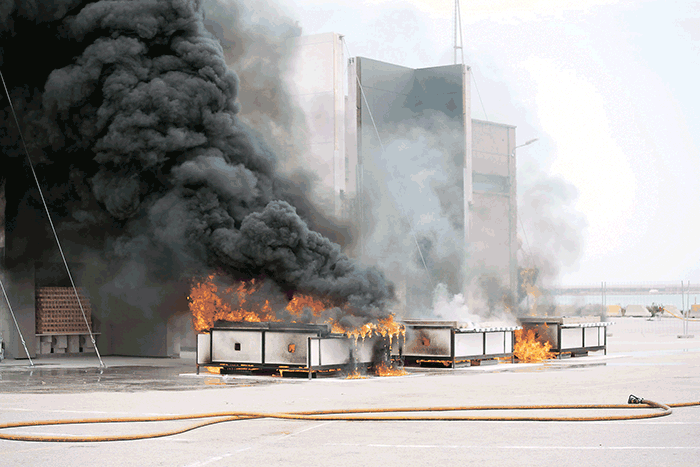
To show the importance of taking a joined up approach to fire protection in buildings Rockwool sponsored, in June 2014, a fire demonstration in Barcelona testing different types of insulation materials (including external wall cladding systems, sandwich panels and directly exposed insulation). The results of the tests were spectacular and demonstrated the significant difference in burning behaviour between different insulation products, both when directly exposed to flames and when tested as part of assembled systems.
Building design and material specification across the EU needs to be looked at afresh in light of the emergence of new construction methods to ensure that buildings continue to offer better fire performance than they did in the past, not less.
Equally, as other cities follow the lead of New York and incorporate resilience into building codes, and as more cities join programmes such as the Rockefeller Foundation 100 Resilient Cities Challenge, making building safer, as well as stronger and more energy efficient needs to be given greater prominence. According to the UN, by 2050 three-quarters of the global population is expected to be living in urban areas. That may seem a vision for the future but in reality many buildings being developed today will still be in use in 2050, particularly if they are to meet new sustainability and resilience criteria.
Setting higher standards for fire safety that reflect the reality of new construction methods is critical as we move towards a more densely populated urban environment. We are at a new frontier for building design. It is one that offers huge opportunities but it also brings risk. Maintaining and improving fire protection is too important to leave to chance – building standards and planning laws have to adapt to keep pace with new ways of building.
For more information, go to www.rockwool.com
About the Author
Director, Applied Research, NFPA
