

The Cameron House Hotel is a luxury hotel on the shores of Loch Lomond consisting of the original B-graded structure of the original 19th-century building and several modern extensions.
On 18 December 2017 a serious fire destroyed much of the older part of the house and killed two guests.
Subsequently, the damaged portions of the property were reconstructed and fitted with an automatic fire-suppression system.
Hotel fire safety
It has long been recognized that hotels present a special risk in terms of fire and life safety.
Many of the greatest death tolls in fires internationally have resulted from fires in hotels. Fires in hotels and similar sleeping accommodation have been subject to special controls in the UK for many years – these being finally codified in the Regulatory Reform (Fire Safety) Order 2005 and the Scottish and NI equivalent.
In fact, the Fire Precautions Act 1971 was almost certainly introduced as a result of public concern following the fire at the Rose & Crown, Saffron Walden on 26 December 1969 which killed 11 people. There have been no further very large life loss UK hotel fires in the past 50 years compared with other countries. Box 1 and 2.
Major International Fatal Hotel Fires
- 1971 Daeyeonggak Hotel 164 deaths
- 1977 Hotel Rossiya, 45 deaths
- 1979 Hotel Corona de Aragon 72 deaths
- 1980 MGM Grand 85 deaths
- 1986 Siddharth Continental 38 deaths
- 1986 Dupont Plaza Hotel 98 deaths
- 2003 Moscow Student Hotel 36 deaths
- 2005 Paris Opera Hotel, 24 deaths
- 2009 Kamien Pomoroski Hotel 21 deaths
UK Fatal Hotel Fires
- 1969 Rose and Crown, Saffron Walden 11 deaths
- 2004 Fairlawn Hotel, Edgbaston, 4 deaths
- 2007 Penhallow Hotel, 3 deaths
- 2017 Cameron House Hotel 2 Deaths
- 2023 New County Hotel, Perth 3 deaths
Home Office 2022/23 data for hotel fires in England records a total of 587 primary fires in ‘Hotels, boarding houses, hostels etc.’ with two fatalities and 83* non-fatal casualties. By comparison, Scotland records 146 fires in similar categories but for a slightly different time scale.
While there have been several serious fires resulting in the virtual destruction of quite modern hotels – for example, the 2019 fires in the Holiday Inn, Willenhall and the Premier Inn, Bristol, there was no loss of life in either fire.
Reasons for concern
The reasons why the potential for large-scale life loss is a concern in hotels is implicit in their function and operation. If we consider the key life-risk factors for all buildings as set out in Government guidance, it is clear that all the prescribed factors are likely to be present (Box 3).
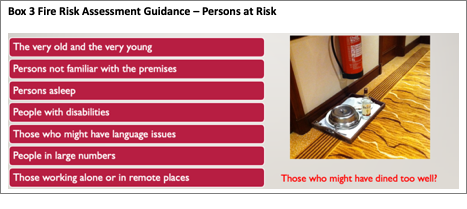
In the case of heritage or historic buildings the usual FRA criteria should be augmented by consideration of the heritage, aesthetic and cultural value of the property and its contents as well as factoring in the impact of firefighting activities. In the case of older buildings, special attention needs to be paid to the potential problems of structure and materials. Fires spread more easily where there is insufficient compartmentation and where there are unstopped shafts, ducts, voids and flues. The age of the building will usually determine its type of construction and the inherent fire risk and fuel load.
Fire-safety planning
Managing fire safety is not onerous and does not require specialist knowledge (although access to professional advice for larger or more complex premises will be useful). Most larger properties will utilise the services of a specialist to undertake the necessary fire risk assessment (FRA) The following sets out the criteria to be adopted when managing fire risks:
- The premises should have a written fire-safety policy. Effective internal mechanisms should exist to ensure that the policy takes account of the needs of special or occasional events and the needs of persons with disabilities.
- The hotel should appoint an individual at senior level as fire-safety manager with specific responsibility to implement the fire-safety policy.
- In larger establishments, the fire-safety manager may be assisted by a full-time, specialist fire officer. This role may be combined with a similar activity such as health and safety or security.
- The hotel should develop and maintain a manual setting out fire-safety strategy and detailing plans for action in case of fire and to be used as a basis for training. The premises should also maintain a logbook to record all fire-related events such as training, drills, inspections and equipment maintenance.
- All hotels must undertake a fire risk assessment (FRA) in compliance with fire legislation. The FRA should be reviewed not less than annually or when any major changes of layout or organisation take place. While the preparation of the FRA can be outsourced to a suitably qualified specialist, the responsibility for the implementation of any findings remains with the owner or manager.
- The testing and maintenance of a reliable fire detection and alarm system should be seen as a high priority.
- Following the completion of the fire risk assessment, management should establish a priority for implementation of necessary fire-safety improvements including establishing or upgrading fire compartments, segregation of areas of high fire risk and providing protected escape routes. Consideration should also be given to the provision of an automatic fire-suppression system should this not already be in place.
- Systematic and effective training programmes should be introduced to ensure that all staff know how to minimise fire risks, how to raise the alarm in case of fire and to provide enough trained staff to tackle incipient fires quickly and evacuate guests.
- A programme of liaison with the local fire and rescue service should be established to ensure that not only are local firefighters familiar with the premises but also that access and facilities such as water supplies are maintained.
- Clear fire-safety requirements should be included in all contracts for building, maintenance and other work and for special events. Management must check to ensure that the requirements are being carried out. This is an area where insurance brokers or underwriters can provide expertise.
Heritage buildings: public domain guidance
The weaknesses of some heritage buildings and the specific causes of the Cameron House Hotel fire are covered in several publicly accessible guides. Most specifically, in Historic (Environment) Scotland Technical Advice Note No 28: Fire Safety Management in Heritage Buildings can be found:
3.1 Routine Inspections, Check Lists and Hazard Spotting
Ashes from open fires removed from the building in steel container with lid and disposed of safely
Similar advice can be found in other guidance from the Fire Protection Association and insurers.
Identification of the need to firestop or compartment historic buildings that are being converted to new uses is covered in great detail in Historic Environment Scotland’s Guide for Practitioners Numbers 6 and 7. Guide Number 6 provides in-depth data on how traditional buildings can be converted to new uses in compliance with Scottish Building Standards. Guide Number 7 covers in some detail deficiencies in fire separation and how fire-suppression systems can be retrofitted.
*It is a matter of some concern that of this number, 23 result from involvement in deliberate fires.
About the Author

Stewart Kidd MA, MSc, FIFireE, FIFSM, FSyI, FSA (Scot), CPP is a Chartered Security Professional. He has worked in security and fire protection since 1974 and now combines consultancy with expert witness assignments. He has a particular interest in the protection of national patrimony and built heritage, and he lectures and writes extensively on this subject. He is the author of eight books on fire and security topics including the Historic Environment Scotland’s Guide for Practitioners No 7, the Scottish Building Standards ACOP.
