

It all started with marine and offshore applications. However, for many years watermist systems have been installed in buildings on solid ground. When it comes to the different classes of fires, watermist ticks more boxes than any other kind of fire-suppression system. This is due to the smaller droplets that interact with the fire in a different way compared to the interaction between a fire and the larger droplets coming from traditional sprinkler systems. Watermist systems deal with heat and oxygen, whereas sprinkler systems can only deal with heat. This is reflected in the list of applications that – over the years – has grown to considerable length.
One typical area is the health sector, including hospitals, health centres and care homes. Derek Killaspy, Managing Director of Fireworks Fire Protection and IWMA (International Water Mist Association) member, explains: ‘While fire sprinklers have been the traditionally chosen solution in the past, we saw the beginnings of the transition to watermist fire protection around a decade ago. Private clinics were amongst the first to benefit from the superior life-saving properties offered by watermist. Many large hospitals around the world are following suit, especially now that total cost of ownership over the lifetime of the system has become more competitive.’
One hospital which is equipped with a watermist system is the VUmc University Medical Centre in Amsterdam, one of the largest high-pressure watermist projects in the Netherlands. Provider of the system is the German company Fogtec (also an IWMA member). Rüdiger Kopp, Fogtec’s Managing Director fixed systems, says: ‘We believe that high-pressure watermist offers the best fire protection for the hospital environment. Two points in favour of this technology are the high cooling effect and the minimal water usage. The result is an easy evacuation in case of a fire and limited fire and water damage to the valuable equipment and the building.’
Particularly in retrofit situations to existing hospitals, the small pipe diameters and reduced water storage requirements render a flexible and space-saving installation of the system possible.
In 2020, the installation process started. The system was selected as an integral part of the buildings’ engineering scheme to lift the hospital complex’ fire-safety concept to the highest level. It was installed while the medical centre was in full operation, which means that installation works were carried out while patients were taken care of and doctors, nurses and students were on duty.
Special installation concepts had been developed by Fogtec to ensure as little interference as possible to the daily routine in the hospital. The use of flexible high-pressure stainless-steel hoses in conjunction with high-pressure press fittings reduces the site presence to a minimum and guarantees a quiet and clean system integration.
Once the installation is finished, the Fogtec system will protect more than 43,000m2 of nursing rooms, public spaces, escape routes, technical areas and car parks. It will – in case of a fire – provide safe evacuation conditions, protect valuable assets and assure operation continuity of the university hospital.
Two further, nowadays typical and common applications are the protection of archives and electric power plants.
One famous archive which is protected with watermist is the Bodleian Library at Oxford University. Another is the Hubei Provincial Archives. They maintain the province’s collection of nearly one million extremely valuable books, paintings, calligraphies and other historical documents – many dating back to the Ming Dynasty. ‘When the government built the new 60,000 square-metres building to house these very flammable treasures, the responsible engineers selected amongst others Danfoss PAH (Pump Axial-Piston High-Pressure) pumps to power our advanced high-pressure watermist fire suppression system,’ says Amin Hadian, Application Manager at Danfoss High-Pressure Pumps.
The focus lay on providing a compact, reliable, simple-to-maintain, high-pressure watermist system that would protect these historical treasures. Because the collection is largely paper-based, engineers from fire-suppression specialist HeFei KDLian proposed installing a watermist system, which reduces water damage significantly better than traditional sprinklers.
Amin Hadian explains: ‘For this project, high-pressure pumps by Danfoss were definitely part of the solution.’ Based on project requirements and positive past experience with Danfoss products, the HeFei KDLian engineers specified 85 PAH 80 pumps to provide misting pressure. They also selected Danfoss solenoid, check and pressure relief valves.
Amin Hadian summarizes: ‘The installation went ahead smoothly, and the archive was opened in 2021. Since then, the suppression system was, fortunately, not in use. However, regular maintenance and security checks have been carried out according to plan so that it will function if it has to.’
Another project is one by EmiControls. Deputy CEO Francesco Fritz explains: ‘Since 2020, we have equipped numerous transformer stations at electric power plants throughout China with watermist turbines. One of them was a substation in Zhejiang province.’
EmiControls firefighting turbines produce microscopic, non-cohesive water droplets, which cannot conduct electricity. Hence, 12 FT10e firefighting turbines could be installed in a substation in Zhejiang province, each one protecting two transformers, of which the plant houses a total of 24. The turbines are placed on 8m-high towers, protecting an area 35m in diameter. If activated, watermist is sprayed from high up onto the transformers below, which ensures an optimum coverage of the burning surface by reaching all hidden spots and prevents the fire spreading to other transformers or the entire plant.
Francesco Fritz says: ‘The detection system is automatic. As soon as the alarm is triggered, the turbines start extinguishing with 600 litres/minute and a pressure of 12 bar. The foam proportioning rate is 1 to 3 per cent.’
During real-size validation tests the system extinguished a burning transformer within 30 to 40 seconds. In phase one, watermist helps to keep the temperature low. When a transformer catches fire, it must be extinguished quickly to avoid injuries and blackouts of entire city districts but also to keep material damage as low as possible.
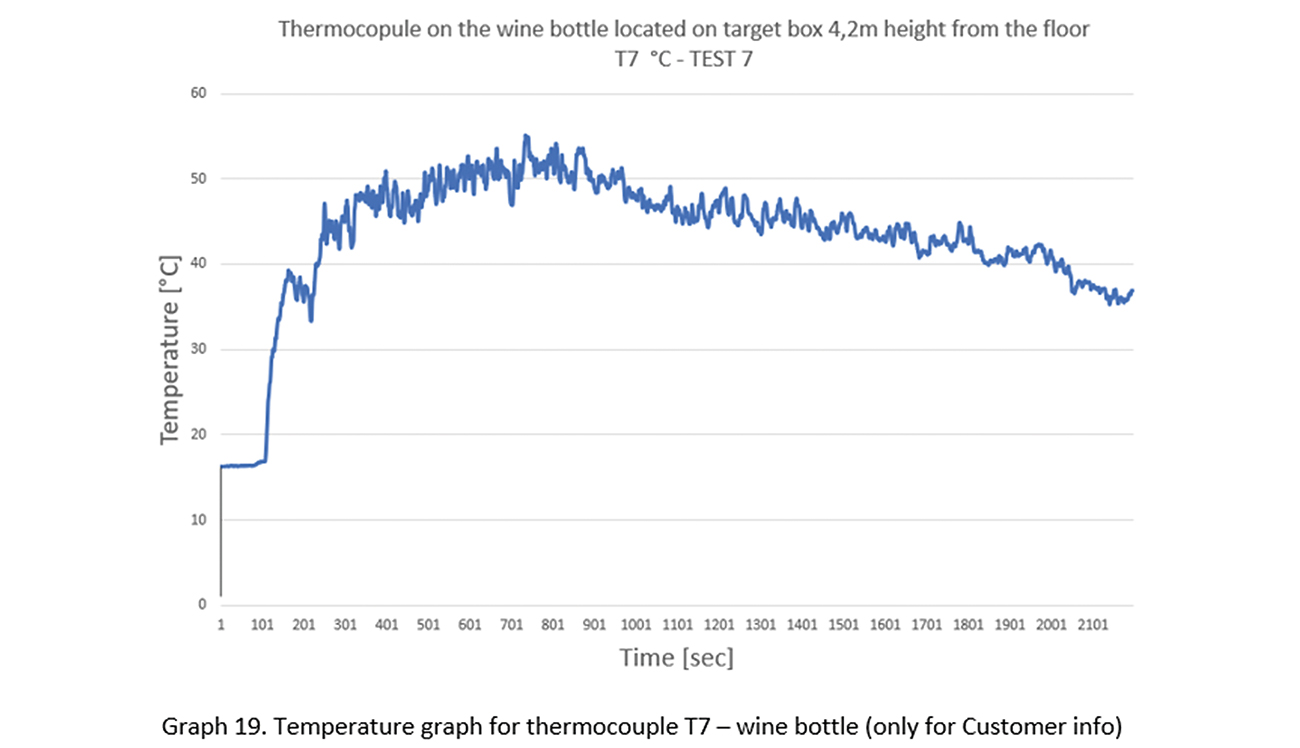
Of course, in most cases, what is protected are lives, properties and jobs. In other cases, it is seemingly small things like labels on wine bottles. ‘But if that is your business, it is also your livelihood,’ says Bettina McDowell, General Manager of the IWMA. Fact is that valuable bottles of wine – which may cost thousands of euros – lose their value if the label is flawed by – for example – activated sprinkler systems that can impair or even wash labels off wine bottles. In this case, IWMA member the Baltic Fire Laboratory (BFL) was contracted by Ultra Fog – also a member of IWMA – to check nozzle capacity against storage racks with a very high fire load. The end customer had already experienced fire incidents including exactly that kind of loss and wanted to make sure that the loss through water damage would not outweigh the loss through a fire and also that if one rack of bottles was affected by a fire the one next to it would not. To validate the damage on goods, BFL suggested making the test more realistic by placing a bottle of wine in the rack next to the burning one to make sure it did not explode due to heat exposure (which it did not) but also that the water would not wash the label off the bottle (which also did not happen). The bottle temperature was constantly measured during the entire test using thermocouple T7 while the thermal camera logged into the laboratory data acquisition system. ‘’As a fire laboratory our aim is to come as close to the real fire scenario as possible. During full-scale tests we try to help the end customer understand what we do, why we are doing it and at the same time show what benefits watermist has,’ says BFL director Bogdan Raciega. ‘The data and conclusion that could be drawn from this test underlined the cooling effect and radiation shielding watermist provides.’
Other applications include, for example, heritage buildings, tunnels and data centres as well as the protection of shopping malls, trains, train stations and hotel rooms. These diverse settings share a unique need for the features only watermist systems can provide. Over the years, speakers at the International Water Mist Conference have introduced their projects: The Spanish Congress Palace in Madrid, the Hungarian Parliament in Budapest, St. Mark’s Basilica in Venice and St. Patrick’s Church in New York. They talked about safeguarding escape routes in high-rise buildings, about the protection of industrial oil cookers, saunas and wooden churches and sensitive roof structures.
‘It will be interesting to see what topics will be submitted for the 22nd International Water Mist Conference,’ says Bettina McDowell. This event will take place in Copenhagen, Denmark, on 11–12 October 2023. The conference hotel will be the Copenhagen Marriott. The call for papers will be released on 1 February, and the deadline by which an abstract should be submitted and the date from which onwards delegates can purchase their tickets is 15 May 2023.
For more information, go to www.iwma.net

You must be logged in to post a comment.