

The terms “combustible”, “non-combustible” and “limited-combustibility” are frequently referenced as part of the debate surrounding the changes to the Building Regulations in England in relation to fire. These classifications, achieved largely through bench tests of small product samples under the National and/or European Classes, are designed to provide clarity to specifiers and installers. In practice, however, they often lead to misplaced assumptions, perhaps the most common of which being that all materials classified as “combustible” have similar reaction to fire performance.
The 2017 Government testing programme for cladding systems clearly highlighted the flaw in this logic. The tests, in combination with further research carried out since, revealed that the impact of polyethylene (PE) cored aluminium composite material panels (ACMs) have on fire spread is several orders of magnitude greater than that of commonly used “combustible” insulation, such as phenolic. They also showed that in tests of complete cladding systems, those featuring combustible materials can perform just as well as those without.
To better understand the reasons for this, it is useful to first look at how one of the so called “combustible” materials featured in the tests – phenolic insulation – performs when exposed to fire.
Phenolic charring
When exposed to heat, phenolic insulation undergoes a process called pyrolysis (thermal decomposition). This results in two products: hot combustible gases (pyrolysis gasses) and a black char which forms on the surface of the material. It is important to note that pyrolysis is an endothermic reaction, meaning it absorbs heat.
In image 1 you can see a sample of phenolic insulation being exposed to a blow torch flame. In the first half minute of exposure, additional flames become visible (over and above those from the blow torch). These are a result of an exothermic reaction (combustion) between the hot gases and oxygen. The additional flaming dies down after the first 30 seconds of exposure as a black char forms. This char protects the insulation beneath it from the flame (and the heat from the combustion of pyrolysis gases).
Whilst the surface of the char keeps on pyrolising, the rate of emission of gases lessens, and the nature of these gases changes the more pyrolised the char becomes. The net effect is that the rate of production of combustible gasses, and the intensity of the flaming produced, reduces after the formation of the initial char layer.
When the blow torch flame is taken away, the energy from combustion of these gases alone is insufficient to support further pyrolysis, and the insulation self-extinguishes.
This shows that materials classed as “combustible” will not necessarily burn or combust in all eventualities. So, “combustible” does not automatically mean “flammable”. “Flammability” is scenario specific whereas “combustibility” is an intrinsic property based solely on a material’s calorific content.

Looking at the full system
In practice, what matters is not how each individual product is labelled or classified. For example, even when the insulation and cladding materials in an external façade system are classed as Euroclass A1 (“non-combustible” ) or Euroclass A2 (of “limited combustibility”), there will still be a surprising amount of combustible material within the overall construction, such as thermal breaks, sealants, vapour barriers and tapes. It is the interaction between the different components, their spatial arrangement, and how they are installed that will ultimately determine how a façade system behaves when exposed to fire.
Therefore, whilst the individual product tests used within the European and National Classes to determine reaction to fire performance can provide a useful baseline measure, they have severe limitations when assessing the performance of a complete system, such as a rainscreen façade. These limitations have been highlighted by recent testing which has shown that, even when both the cladding and the insulation are of ‘limited combustibility’, they can fail a large-scale test as part of a system.
This is why it is so important to test the whole wall assembly to ensure that it will achieve the desired performance.
Intermediate scale testing
Kingspan Insulation recently commissioned testing of constructions which matched those for the Government Building Safety programme. The tests were carried out to ISO 13785: 1- an intermediate scale reaction to fire test for façade systems. As with BS 8414 (the large-scale test used within the Government programme), it is designed to simulate a fire beginning in a building, breaking out through the window and impinging on the façade.
The ISO 13785: 1 test comprises a 2.4 m tall wall with a corner. It is, essentially, one third of the size of the BS 8414 test with a lower fire load to compensate for the smaller scale. During the test, a gas burner at the base of the wall is ignited and allowed to burn at 100 kW for a period of 30 minutes or until the top of the specimen is extensively flaming.
Marked change
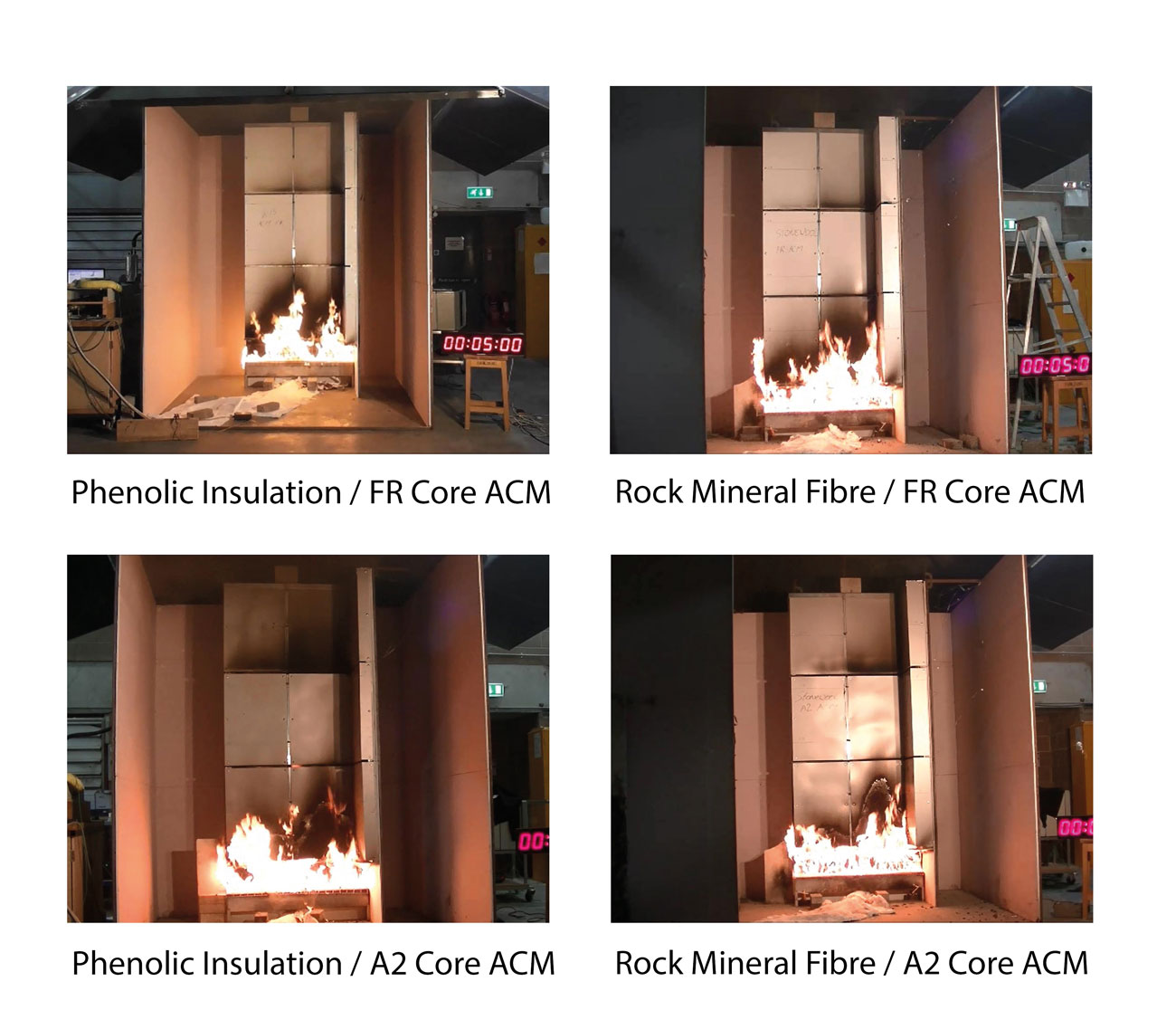
The first set of tests featured phenolic and rock mineral fibre insulation with A2 classed solid core and FR (Fire Resistant) cored ACMs. The construction comprising rock mineral fibre insulation and the A2 solid cored ACM is the only system which would comply with the new ban on the use of combustible materials in cladding systems on a variety of buildings with useable floors over 18 metres including flats, student accommodation, care homes, hospitals and sheltered housing.
The systems performed very similarly throughout the test duration. Despite all constructions containing elements which are classified as “combustible” fire spread was limited. There was some damage to the ACM cladding as it disintegrated in the tests, but the insulation materials did not propagate the fire.
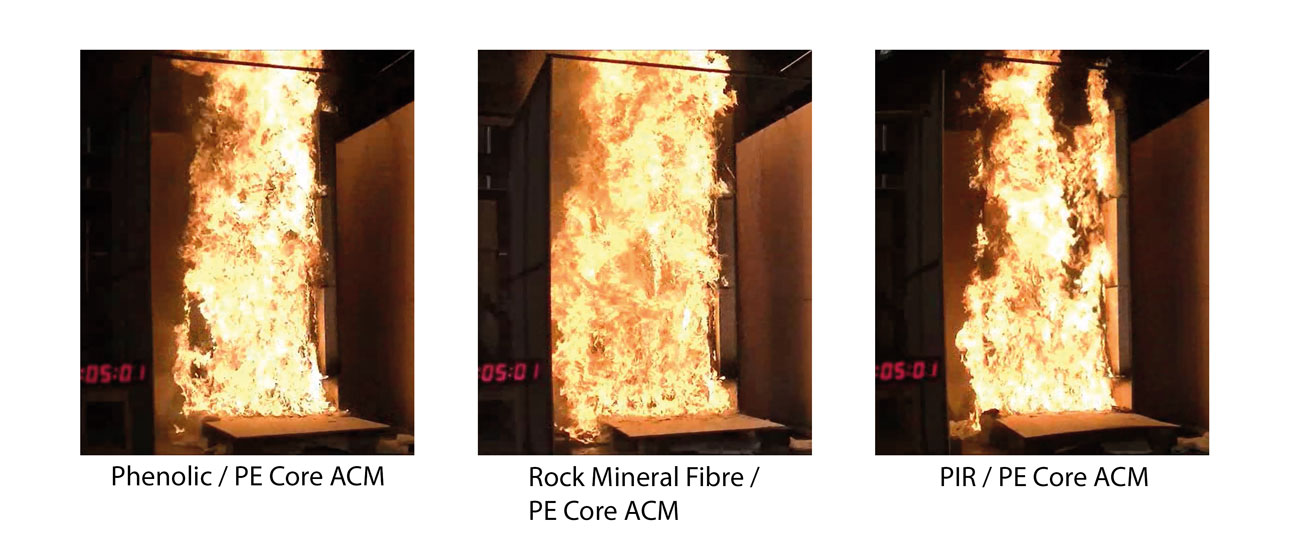
Further testing was carried out with separate constructions comprising three insulation materials: polyisocyanurate (PIR), phenolic and rock mineral fibre insulation, with a PE cored ACM such as the type installed on Grenfell Tower. The PIR system shown comprises the insulation material and ACM panel that was used on over 90% of Grenfell Tower.
The difference from the previous set of tests was clear. Images 3 and 4 show the different rig configurations at 5 minutes test duration. Whilst configurations with A2 and FR core ACMs show only limited fire spread, all of the PE cored ACM panels are burning. By 10 minutes, the PE cored ACMs had completely burnt away leaving the insulation material behind, which, in all three cases, had self-extinguished.
Thinking holistically
The tests clearly illustrate that the impact of using PE cored ACMs in these constructions was far more significant for fire development than the choice of insulation material. It provides a clear demonstration that the label of “combustible” is too imprecise and that systems that feature “combustible” materials can perform as well as those that don’t.
If we are to fundamentally improve fire safety, it is vital that we take a more comprehensive approach as suggested within the Building a Safer Future report from the Independent Review of Building and Fire Safety. Significantly, this did not recommend an outright ban but instead highlighted the “need for a radical rethink of the whole system and how it works”.
Its proposed framework is outcomes-based, meaning that the regulations would focus on making it clear what the industry needs to achieve, rather than telling it how it must achieve it. This does not mean that the regulations would become more lax, quite the opposite. An important part of the proposed reform is clearer lines of responsibility, much more effective oversight, and serious consequences for non-compliance. It should always be remembered that the system used on Grenfell Tower was not compliant with the regulations. What an outcomes-based approach does allow is greater flexibility, future innovation, and an acknowledgement of the wealth of research and experience that the industry already has.
Changes include a new regulatory framework for higher risk residential buildings (HRRBs), which would be overseen by a new Joint Competent Authority (JCA) and an improved focus on building safety during construction and refurbishment, with stronger oversight. Improved levels of competence is another significant area where we can expect to see change enacted, with a working group already set up to create a framework for those installing safety critical systems.
Next Steps
It is crucial that the work currently being undertaken to revise the Building Regulations in England, and the consultations on the Building Standards in Scotland and Building Regulations in Wales, fully consider the findings from the Building a Safer Future report. Rather than rely on supposed “quick-fix” solutions, the response must be comprehensive and address all the various failings identified from design and installation, to oversight and long-term maintenance. As the most accurate means to assessing the reaction to fire performance of the complete cladding system, large-scale testing provides a more logical fit within this new framework than reliance on broad and potentially misleading classifications.
For more information, go to www.kingspaninsulation.co.uk
References
- Achieved either through a specific combination of tests from the BS476 suite referenced within the Building Regulations (National Classes) or tests outlined within EN 13501-1 (European Classes).
- https://www.bbc.co.uk/news/uk-44748514 BBC – Replacement cladding fails fire safety test
- P5, Building a Safer Future Independent Review of Building Regulations and Fire Safety: Final Report https://www.gov.uk/government/publications/building-a-safer-future-an-implementation-plan
About the Author
Head of Technical and Product Development Kingspan Insulation Limited.

You must be logged in to post a comment.