
Update on the EU F-Gas Regulation & its Impact on HFC-Based Clean Fire Extinguishing Agents.
Since their introduction in the early 1990s, hydrofluorocarbon (HFC) based clean agents have been the most widely specified clean agents for fire protection of sensitive, valuable and mission critical equipment and assets. No other issues related to these agents are perhaps more misunderstood or misrepresented than their environmental impact and the implications of regulations on their use in fire extinguishing applications. In this article, I aim to provide the reader with factual information related to the recently approved European Union (EU) “F-Gas II Regulation” and its impact on the HFC-based clean fire extinguishing agents.
The EU F-Gas Regulations
- Original EU F-Gas Regulation
Regulation (EC) No 842/2006 of the European Parliament and of the Council on certain fluorinated greenhouse gases, the original “F-Gas Regulation,” was published on May 17, 2006, and entered into force in 2007. The primary objective of EC 842/2006 was to prevent and reduce emissions of HFCs. EC 842/2006 included requirements related to the prevention of leakage (containment), recovery, personnel training, record keeping, reporting and labelling, all with the goal of the reduction of unnecessary emissions. The regulation recognised that fire suppression applications are essentially non-emissive, and imposed no restrictions on the use of HFCs in fire suppression applications. For a detailed review of the original F-Gas Regulations and HFC clean agents, see the February 2013 issue of International Fire Protection.
- EU F-Gas II Regulation
Regulation (EU) No 517/2014 of the European Parliament and of the Council of 16 April 2014 on fluorinated greenhouse gases and repealing Regulation (EC) No. 842/2006, the “F-Gas II Regulation,” was published on May 20, 2014, and will enter into force on 1 January 2015.

The EU F-Gas II Regulation & Fire Protection Systems
- EU F-Gas II Allocation Quotas
A significant change from the original F-Gas Regulation of 2006 is the establishment of allocation quotas. Article 16 of the F-Gas II Regulation establishes an allocation of quotas for placing HFCs on the market in the EU each year; Article 15 requires that producers and importers not exceed their quota. Under Article 16 a reference value, based on the annual average of quantities of HFCs (expressed in terms of CO2 equivalents) the producer or importer reported to have placed on the market from 2009 to 2012, is calculated in accordance with Annex V of the Regulation; quotas are then allocated employing the reference value and the allocation mechanism described in Annex VI of the Regulation.
The allocation scheme represents an overall “cap and reduction” of HFCs on a GWP-weighted basis over a specific time period – a “phase-down,” not a “phase- out” of HFCs. The phase-down mechanism involves a gradually declining cap on the total placement of bulk HFCs (in tonnes of CO2 equivalents) on the market in the EU with a freeze in 2015, followed by a first reduction in 2016 and reaching 21 percent of the levels sold in 2009 to 2012 by 2030. An important aspect of this allocation scheme is that it does not restrict the amount of any particular HFC that can be placed on the market or any amount of HFCs used in any particular application; it simply restricts the total CO2 equivalents of all HFCs that can be placed on the market. Table 1 shows the schedule as indicated in Annex V of the Regulation.
The allocation quota applies to HFCs employed in all applications and is not specifically targeted at the fire protection industry. HFCs employed in fire protection represent only a small fraction of the total HFC industry in the EU, that is, fire protection represents approximately one percent of the EU HFC industry on a mass basis, or approximately three percent of the EU HFC industry on a GWP-weighted basis [EEA Technical Report No. 15/2013].
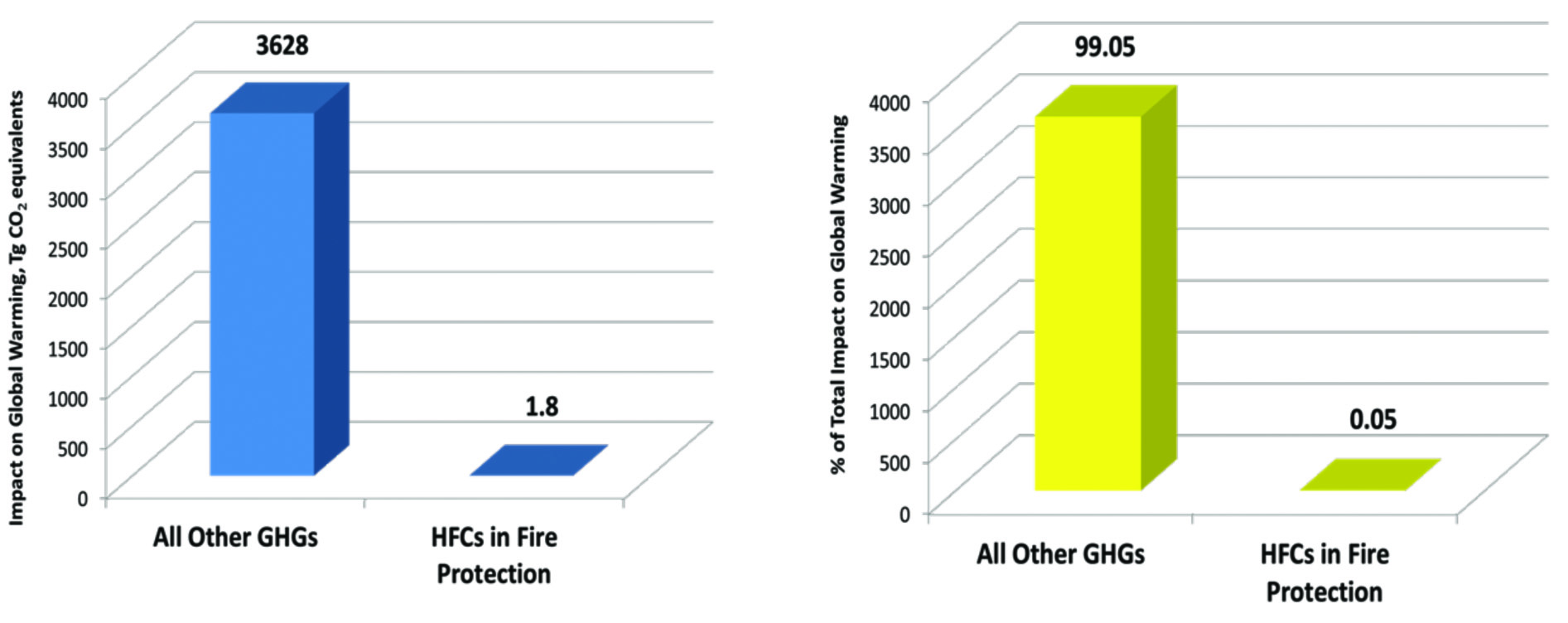
Due to the relatively small size of the HFC fire protection industry, emissions from HFC-based fire protection systems are extremely low, and as a result the impact of these emissions is essentially negligible. The most recent data from the European Environment Agency, depicted in Figure 1, indicates that for the EU-15 region, the impact of HFC-based fire protection agents on global warming represents approximately 0.05 percent of the impact of all GHGs [EEA Technical Report No. 9/2014].
Since HFCs in fire protection applications have a negligible impact on global warming, restricting HFC use in fire protection applications would not provide any significant reduction in global warming – for this reason the F-Gas II Regulation does not call for specific restrictions of the three HFCs most widely employed in fire protection (HFC-227ea, HFC-125, HFC-236fa).
HFCs in fire protection represent only a small fraction of the total EU HFC industry, and subsequently the allocation will not affect the fire sector. Figure 2 depicts the effects with time of the F-Gas II allocation scheme on the quantity of HFCs available for placing on the market in the EU. The HFC phase-down stipulated by the F-Gas II Regulation is unlikely to affect the supply of HFCs for fire protection in the EU market as fire protection represents only 1 percent of the EU HFC market on a mass basis and 3 percent of the total EU HFC market on a GWP-weighted basis.
Additional regulatory constraints on specific HFCs in refrigeration and other non-fire protection applications, along with the shrinking of the HFC refrigeration market as alternatives such as the hydrofluoroolefins (HFOs) replace HFCs in refrigeration, will result in the further releases of allowances, providing more than enough rights for HFCs used in fire protection. The allocation framework of the F-Gas II Regulation does not inhibit or limit the sale of HFCs into the fire suppression market.

- Articles Three to Ten
Chapter II (Articles three to ten) of the F-Gas II Regulation combines Articles from the original F-Gas Regulation related to containment, recovery and training; as a result, the requirements of Articles three to ten of the F-Gas II Regulation are already being complied with by the fire protection industry. Requirements related to containment including leakage prevention, repair and inspection schedule are satisfied by the existing inspection regimes established by the ISO 14520, EN 15004 or NFPA 2001 standards. Recovery related requirements are currently being met by the numerous commercial entities already actively involved in the recovery and reclamation of HFC-based clean fire extinguishing agents. Training and certification programs for personnel involved in the handling of fluorinated GHGs have been in place for more than a decade within the fire protection sector. In summary, the requirements of Articles three to ten of the F-Gas II Regulation involve activities already part of any responsible product stewardship program and impose no restrictions on the use of HFC clean agents.

- Article 11
Under Article 11 of the F-Gas II Regulation, the use of fire protection equipment that contains HFC-23 (trifluoromethane, CF3H) is prohibited after 1 January 2016, except in military applications. This prohibition is in line with the intent of the F-Gas II Regulation to avoid the use of certain gases where there are safe and efficient alternative technologies with no impact or a lower impact on the climate. HFC-23 is employed in only a very small selection of niche fire protection applications, primarily involving low temperature environments. The utilisation of HFC-227ea in place of HFC-23 represents an almost 80 percent reduction in potential climate impact based on their respective GWP values. In addition, due to recent advances in chemistry, HFC-23 has been rendered a valuable feedstock material for the production of pharmaceuticals and agrochemicals containing the trifluoromethyl (CF3) group [cf., Science, 338, p. 1324, 7 Dec 2012].
The allocation framework of the F-Gas II Regulation does not inhibit or limit the sale of HFCs into the fire suppression market.
Conclusion
The F-Gas II Regulation recognises the value, importance and non-emissivity of HFC clean agents in fire protection. The Regulation does not call for a ban on the use of HFC clean agents in fire protection nor does it call for a specific reduction in the emissions of HFCs in fire protection applications. The allocation scheme of the Regulation does not specifically target HFCs in fire protection and will not affect the fire sector due to the small size of the sector and the releases of allowances as HFCs in other applications are regulated or withdrawn from the marketplace, providing more than enough rights for fire protection applications.
The emissions of HFCs in fire protection are extremely low, meaning their impact on global warming is negligible. As a result, restricting HFC use in fire protection applications would not provide any significant reduction in global warming and efforts beneficial to the environment are more productively focused on other sectors with much larger impacts. Regulators understand this and as a result HFCs in fire protection are being treated differently than HFCs in other more emissive applications.
To date no product or technology has been found which satisfies all of the criteria of the ideal Halon 1301 replacement. Each class of clean fire extinguishing agent (HFCs, inert gases and perfluoroketones) has strengths and weaknesses, and clean agent selection must be based on the physical and chemical characteristics of the agent along with detailed knowledge of the specific project requirements. As seen from Table 2, no agent satisfies all of the requirements of the ideal Halon replacement; however, Table 2 shows that HFC-based clean fire extinguishing agents provide the best overall combination of the desired properties.
The cap and reduction scheme of the F-Gas II Regulation provides regulatory certainty for the fire suppression industry while allowing users and fire protection engineers to continue to select the most efficient and technically sound fire protection option for critical equipment and facilities – all while reinforcing emission reduction goals, responsible use of clean agents, and global climate change commitments.
For further information, go to www.dupont.com
About the Author
Mark L. Robin is Senior Technical Services Consultant, Specialty Fluorochemicals at Chemours.
