
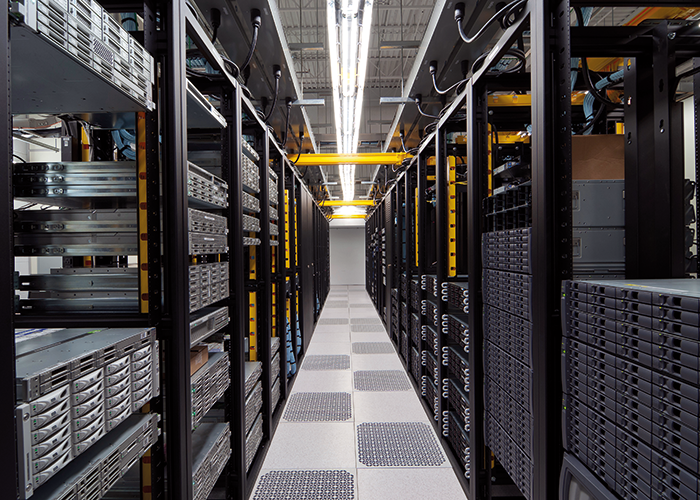
The occurrence of a fire in a mission critical facility can lead to business interruption costs exceeding tens of thousands of dollars per minute in the case of datacenters or online businesses. According to a 2013 Ponemon Institute report, the average cost of data center downtime is $7908 USD per minute – a cost of almost $155,000 USD per day of downtime. The total cost of downtime is not limited to revenue losses, but can ultimately include productivity losses, customer disruption, reputation damage, isolation and repair costs, loss of data and results, and lawsuits. Figure 1 summarizes the cost of a typical data center outage and shows that these additional costs can be significant.
Fire Protection Options
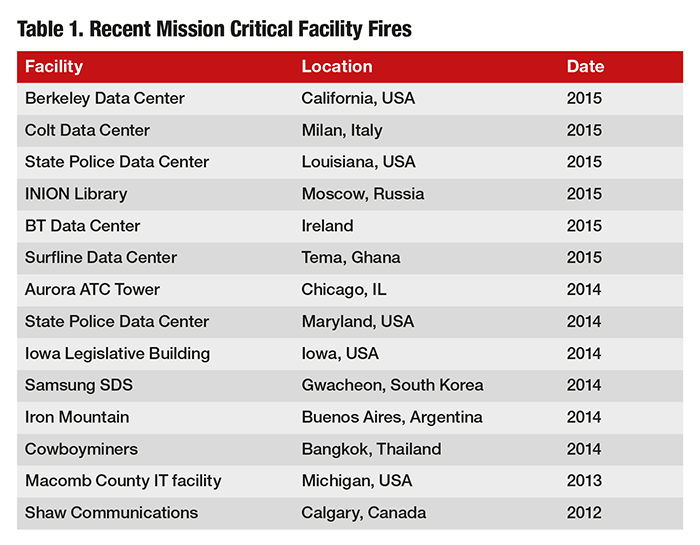
The high value and sensitivity of the electronic equipment found in mission critical facilities, combined with the consequences of system interruption, make fire protection a crucial component of any data center risk assessment. Fires do occur in these types of facilities as evidenced in Table 1, which lists a selection of mission critical facility fires reported within the last several years.
A. Structure Protection
Most mission critical facilities are required by code to have a sprinkler system installed for protection of the structure against fire. The primary objective of a sprinkler system is not fire extinguishment but fire control: confining a fire to its point of origin (preventing fire spread) and controlling ceiling temperatures to prevent structural damage.
Water has obvious disadvantages around electronics and electrical systems due to its electrical conductivity. In the event of sprinkler system activation, water damage to the facility and equipment can be substantial, often worse than the fire damage itself, and the cleanup required can be extensive. Sprinkler systems use water at a typical flow rate of 25 gallons per minute and sprinkler standards such as NFPA 13 typically require a 30 minute supply of water. This translates to 750 gallons of water dumped on the facilities electronic equipment from each sprinkler head activated. Sprinkler heads are activated by a thermally sensitive frangible bulb or fusible link which releases water only after the head reaches a preset minimum temperature, typically 135 oF or higher. By this time fires are well-developed and considerable direct fire, smoke, and water related damage can be expected. The extensive cleanup after a sprinkler system discharge, and the resulting business interruption, will add to the business cost of a fire.
Water is not a three dimensional agent, and cannot readily extinguish hidden or obstructed fires, such as an in-cabinet or in-rack fires. For these reasons, sprinkler systems are best suited for the protection of structures, not for the protection of mission-critical assets located within those structures.

B. Asset Protection
The protection of sensitive and expensive electronics requires the use of a clean fire extinguishing agent. The primary objective of a gaseous clean agent system is to extinguish the fire quickly, limiting fire damage to the object(s) involved in the origin of the fire. Hence, the primary purpose of a gaseous clean agent system is to protect the valuable, sensitive and mission-critical assets within the enclosure. This is clearly fundamentally different from the primary objective of sprinkler systems, as illustrated in Figure 2.
The primary advantages of total flooding clean agents are:
- Clean extinguishment – fires are extinguished without collateral damage due to agent discharge (no residues, no cleanup required)
- Rapid extinguishment during early stages of fire growth
- Ability to extinguish shielded, obstructed or three-dimensional fires in complex geometries

Clean agent systems employ a combination of rapid detection and rapid agent discharge, providing extinguishment of fires in their incipient stage. This significantly reduces asset damage due to thermal effects or fire combustion products, allowing facilities to quickly return to service after a fire event. Furthermore, clean agents do not leave corrosive or abrasive residues following their use, eliminating the cost and need for cleanup as well as the potential for longer term equipment operational issues. A gaseous clean agent penetrates into hidden or obscured areas and densely packed cabinets and racks. Consequently clean agent systems are ideally suited as the first line of defense to protect electronic equipment in mission critical facilities.
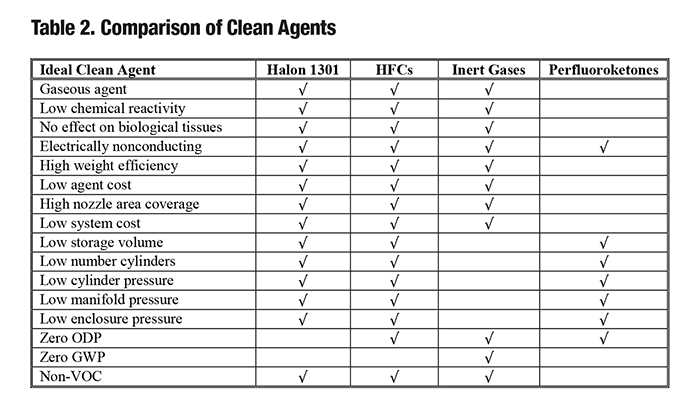
Clean agents can be divided into two classes: halocarbon agents, based on the elements of carbon, hydrogen, and halogen (for example, fluorine) and inert gas agents, based on gases such as nitrogen, argon and carbon dioxide. Table 2 provides a summary comparison of the clean agents in terms of desired properties.
As can be seen from Table 2, the HFCs, followed by the inert gases, provide the best overall combination of the properties desired in a clean agent. This can also be seen in the clean agent market: the most widely employed clean agent worldwide is the HFC agent FM-200TM, followed by the inert gas agent Inergen®.
HFC clean agent systems extinguish fire primarily through the absorption of heat, whereas inert gas systems extinguish fire by lowering the oxygen content to below the level required for sustained combustion.
HFC and inert gas agents are clean, electrically non-conductive, suitable for the protection of Class A, B and C hazards, and applicable for use in normally occupied areas. Both agents offer optimal safety in use as they are characterized by low chemical reactivity, high material compatibility and low toxicity (e.g., neither agent is metabolized in the body). The inert gas agents do not contribute to ozone depletion or global warming and are hence environmentally benign. The HFC clean agents do not contribute to ozone depletion and have a negligible impact on global warming: based on US EPA data, the impact on global warming of HFCs in fire protection applications represents less than 0.02% of the impact on global warming of all greenhouse gases.
The inert gas agents cannot be compressed to liquids and can only be stored as high pressure gases. As a result, inert gas extinguishing systems require the use of high pressure storage cylinders and high pressure piping, which leads to increased system costs. In addition, inert gas systems require a much larger number of cylinders and hence require much more storage space for system cylinders compared to the other clean agents, further adding to the cost of inert gas systems. In addition to the substantial weight and volume penalties associated with inert gas agents, acoustical damage to hard disk drives during inert gas agent discharges is well documented.
The HFC clean agents can be stored as liquefied compressed gases, and hence HFC systems require fewer cylinders and much less storage space compared to the inert gas agents and their use does not require high pressure cylinders or piping. To date there have been no instances of acoustical damage associated with the discharge of the HFC clean agents.
The perfluoroketone agent (NovecTM 1230) differs from all other clean agents in three major aspects. NovecTM 1230 is chemically reactive, undergoing reaction with common chemicals such as water, alcohols and amines. The inert gas and HFC clean agents are not chemically reactive. NovecTM 1230 also reacts in the body, i.e., it is hydrolyzed to HFC-227ea
and perfluoropropionic acid when it crosses the lung-air interface. The inert gases and HFCs do not undergo such reaction in the body. Finally, NovecTM 1230 is a liquid at room temperature, whereas the inert gas and HFC clean agents are gases at room temperature.
C. Clean Agent System Design Example
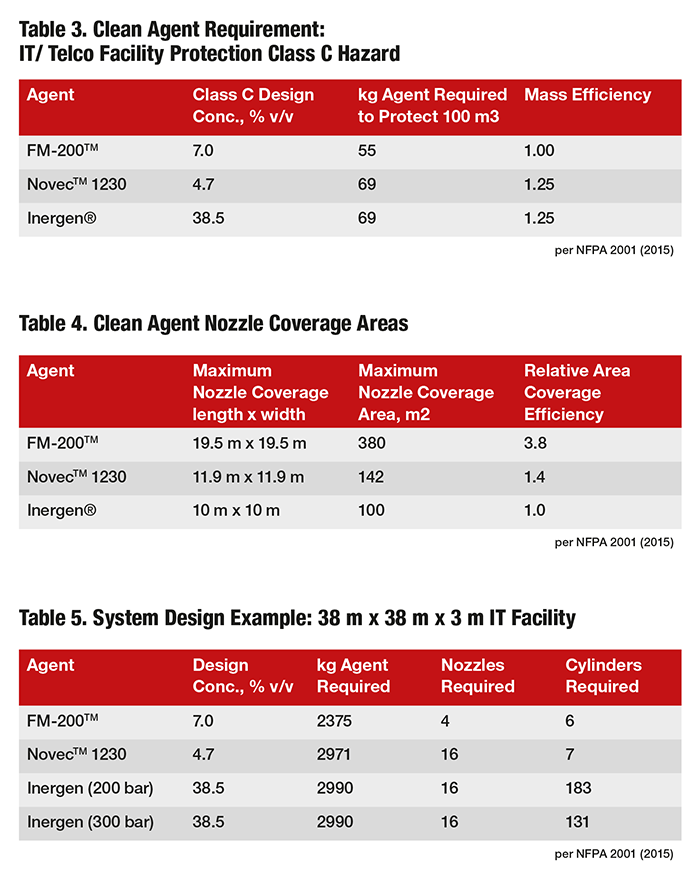
Tables 3 through 5 compare clean agent system design parameters for an IT facility – a typical mission critical facility. Clean agent requirements are compared in Table 3, where it can be seen that the highest mass efficiency is achieved with FM-200TM. Protection of the same facility requires 25 percent more agent by mass with NovecTM 1230 or Inergen compared to FM-200TM.
Table 4 provides a comparison of maximum nozzle area coverages. Due to its high boiling point, uniform distribution of NovecTM 1230 throughout an enclosure is more difficult to achieve compared to the case of low boiling agents such as FM-200TM. This difficulty in achieving uniform distribution is reflected in the relatively low nozzle area coverages provided by NovecTM 1230 systems. Inert gas systems also tend to have lower maximum nozzle area coverages: FM-200TM maximum nozzle area coverages of almost four times that of Inergen® or NovecTM 1230 are achievable.
Decreased nozzle area coverage leads to an increase in system cost due to the requirement of additional nozzles and piping. The requirement of additional nozzles and piping also increases the complexity and cost of system design. Table 5 compares the system requirements for a 38 m x 38 m x 3 m (4332 m3) IT facility. In addition to requiring 25% more NovecTM 1230 by mass, four times the number of nozzles are required for protection with NovecTM 1230 compared to protection with FM-200TM. Table 5 also demonstrates the large weight and volume penalties associated with inert gases due to the requirement of large numbers of cylinders: even for a 300 bar system, the Inergen® system requires over 100 cylinders, compared to 6 or 7 cylinders in the case of FM-200TM and NovecTM 1230, respectively.
The Minimalist Approach to Data Center Fire Risk Mitigation
A common minimalist approach to fire protection in mission-critical facilities is to install sprinklers for the protection of the structure and high sensitivity smoke detectors (HSSDs) for asset protection. The theory behind this approach is that once a fire is detected, someone can find the fire and extinguish it, perhaps with a handheld extinguisher. This approach requires 7×24 manning of the facility, and failure on the part of the operator to find and extinguish the fire could obviously lead to disastrous results impacting both the operator and the facility. The potential consequences of adopting a minimalist approach to data center fire protection can be clearly seen in the devastating results of a recent fire at the Shaw data center in Calgary, Canada. The fire protection system in this case consisted of the minimum protection required by code, i.e., a sprinkler system. The impact of this fire included:
- Knockout out of the primary and backup systems supporting key public services
- Loss of cable, telephone and Internet services by more than 20,000 Shaw business and household clients
- Crippled city services, including 311 emergency services
- Delay of hundreds of surgeries at local hospitals
- ATMs and debit terminals throughout the city affected
- Extensive water damage to equipment on the floors below the top story fire location
- Temporary relocation of over 900 Shaw employees while damage is repaired
- Six days of service outage
According to media reports, an electrical fire triggered the facility’s sprinkler system which ran for more than two hours, soaking furniture, walls and sensitive electronic equipment on floors below. The total cost of the incident is not limited to the costs associated with the above items, but will ultimately also include costs due to loss of data and records, lawsuits and the loss of customer confidence.
The Clean Agent Approach to Data Centre Fire Risk Mitigation
The advantages of clean agent fire protection for mission-critical data center assets can be seen in the results of a recent fire in the Iowa State Legislature Building in the United States. At approximately 3 PM on February 18, 2014, an electronic fire occurred and 2,400 pounds of FM-200TM was discharged into the room and raised floor. By 9 PM the data center was completely cleared of damaged equipment, and by 2 AM major Iowa government websites and agency systems were restored. By 3 AM – 12 hours from the start of the fire – all remaining agency applications were restored. Unlike the Shaw outage, which lasted six full days, the use of a clean agent system resulted in a return to normal operations within
a period of 12 hours, with losses limited to direct fire damage.
Ensuring Business Continuity
To ensure business continuity in mission-critical facilities, protection of both the structure and its contents is required. The added cost of installing a clean agent system is justified by its ability to provide what sprinkler systems cannot – protection of the sensitive, expensive and mission-critical assets located within the facility, and the minimization or complete elimination of business interruptions in the event of a fire.
As demonstrated by the recent fire in the Shaw facility in Calgary, opting for minimal fire protection of such critical facilities can lead to devastating results. Sprinkler systems and clean agent systems are fundamentally different in their purpose: sprinkler systems serve to protect the structure, whereas clean agent systems serve to protect the contents of the structure. Substantial risk reduction at very high benefit/cost ratios may be realized by protecting mission-critical facilities with both a clean agent system and a sprinkler system.
For more information, go to FM200.com
About the Author
Mark L. Robin is Senior Technical Services Consultant, Specialty Fluorochemicals at Chemours.
