Boston Logan International Airport completed its multimillion-dollar international terminal expansion project in August 2023, welcoming travellers to a reimagined space that blends aesthetics and functionality. The project upgraded existing infrastructure and expanded the terminal’s footprint with a 320,000sq. ft building addition, adding four new aircraft gates to increase the airport’s passenger capacity.
Terminal E is a notable example of how cities are investing in modernizing airport facilities to accommodate modern travellers, many of whom will spend hours working or relaxing at the terminal while waiting to board their flights. The bright-red, boomerang-shaped exterior is a memorable addition to the cityscape. Meanwhile, abundant, versatile interior spaces and floor-to-ceiling windows flood the terminal with natural light and provide scenic views of the historic city.
Architects achieved their goal of designing a beautiful, passenger-centric building. When it came to the fire-protection design, Rustic Fire Protection had to overcome unique challenges presented by the one-of-a-kind terminal’s complex architectural design. The fire-protection contractor applied innovative solutions to the main sprinkler and distribution lines to meet life-safety requirements while preserving the intended design vision.
Achieving deflection with grooved couplings
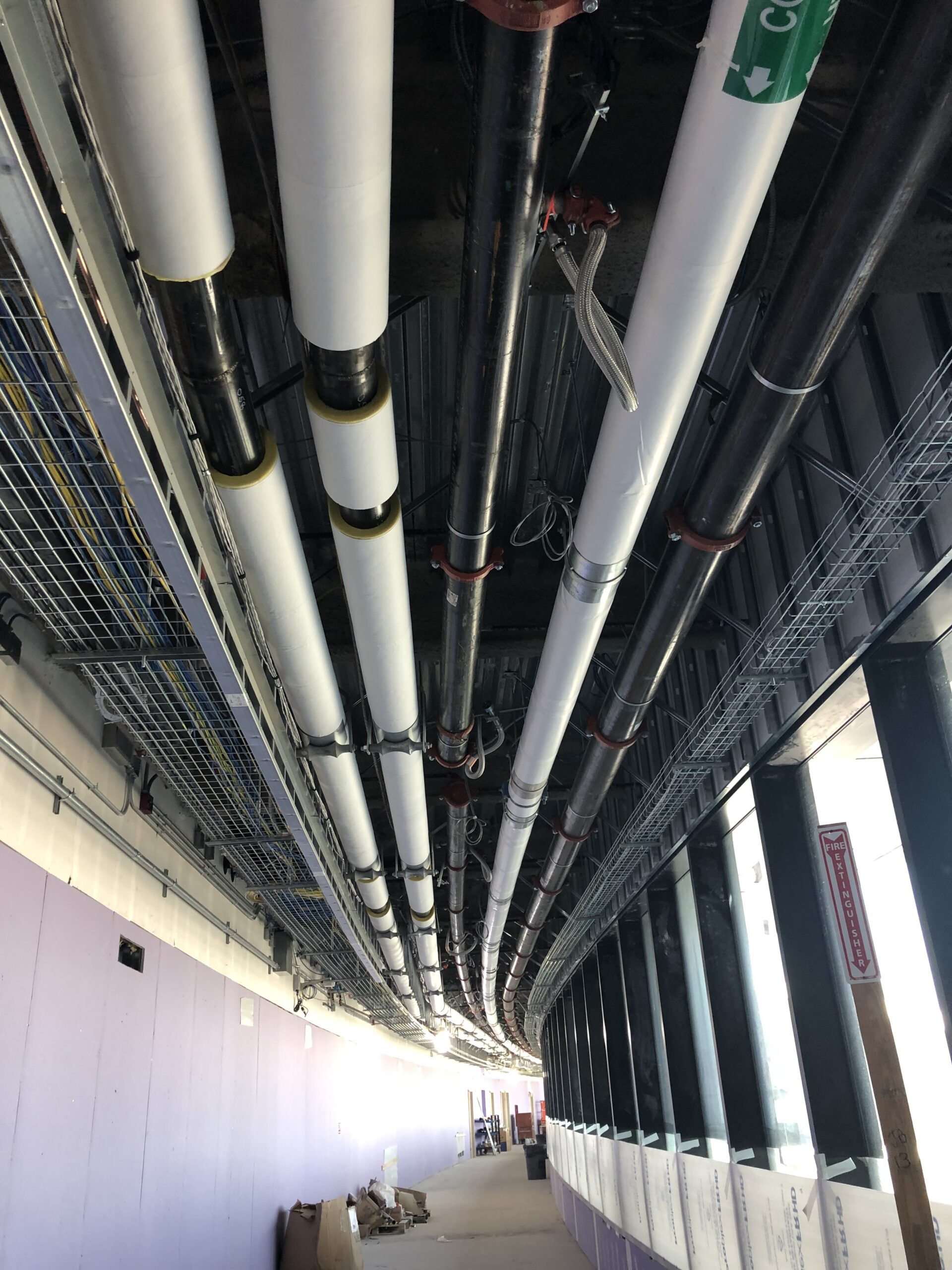
The long curving terminal creates a sense of movement and flow from security checkpoints to gate areas. The main sprinkler line runs through this ceiling area, but the structure’s shape impeded Rustic Fire from installing long pipe runs. Changing pipe directions to follow the curvature was also not feasible.
‘Adding elbows to change pipe directions takes up a large amount of space and can directly impact the other trades on the project. It’s also time-consuming and cost-ineffective for our team to add extra pipe materials and rework the hydraulic design,’ explained Ross Barton, the fire sprinkler system designer at Rustic Fire Protection, who led the project’s fire-protection design scope.
Rustic Fire partnered with Victaulic, a global producer of pipe-joining and fire-protection solutions, to meet the project’s demands. Instead of using extra materials to change pipe direction, Rustic Fire added grooved flexible couplings throughout the main line. The flexible couplings provided the necessary angular deflection for Rustic Fire to route a continuous, space-efficient mainline in the ceiling.
Flexible sprinkler solutions for sloped ceilings
To achieve an elevated look, Terminal E features sloped cloud ceilings that conceal overhead pipelines from sight. This ceiling construction has become popular in recent years in new builds but presents particular challenges for fire sprinkler installations. Notably, cloud ceilings often have varying slopes and elevations that can create trapped water points in sprinkler systems without adequate pitching. System designers must also consider how ceiling pockets may impact spray pattern coverage. Lastly, fire protection is one of the last scopes on a project, making it imperative for designers to create precise layouts that route around other trades and obstructions to mitigate costly rework.
‘There was no room for error. We had thousands of sprinkler heads that needed to be centred and slotted between different ceiling aspects while still meeting code requirements,’ Barton said.
Rather than hardpipe the sprinkler heads, Rustic Fire used flexible sprinkler drops to address the ceiling challenges. Rustic Fire calculated exact sprinkler head positions to meet coverage requirements in ceiling pockets and used the flexible braided hoses to make precision adjustments after ceiling tile installation. The contractor overcame pitching obstacles by using the same approach. Rustic Fire used braided hoses and flexible dry sprinklers to eliminate trapped water points throughout the system without altering distribution piping or conducting extensive hydraulic recalculations. In addition, the technology enabled Rustic Fire to perform hydraulic testing before contractors installed ceiling tiles. The testing revealed no leaks, and Rustic Fire’s work was mostly complete. The only remaining work was to align sprinkler heads into place using the flexible hose once the ceiling contractor finished their installation.
Innovative technology is the future
As terminal design trends continue to evolve, fire-protection specialists will increasingly need to navigate scenarios like those Rustic Fire faced throughout the Boston Logan International project. Rustic Fire successfully delivered its scope by partnering with Victaulic to devise creative solutions to unconventional design challenges. Similarly, fire-protection designers and contractors will be challenged to use technology in innovative applications to meet modern system requirements and owner expectations effectively.
For more information: www.victaulic.com