
The journey of residents affected by dangerous cladding across the UK has already been long and arduous, but the need for action is greater than ever.
There are an estimated 321,000 people living in high-rise apartment blocks in the UK that are deemed to be unsafe because of a combustible external facade, not to mention the millions living in mid and low rise.
Since 2010, 60% of high-rise facade fires have started externally, with causes including discarded cigarette butts on balconies, external lighting malfunctions, air conditioning units breaking down and fires in bins.
Intelliclad is a fire detection and alert system that has been uniquely designed for implementation into the external facade. Partnering with global wireless technology provider Ramtech, the solution is a huge step forwards for practical and effective building fire safety.
The system uses smart sensors, integrating Ramtech’s EN54-25 compliant WES3 wireless fire alarm solution. These sensors are fitted inside the cladding system and are connected to a control system so that in the event of a fire, an alert can be sent to all residents via a unique smartphone app and the main alarm system within the building, in compliance with BS 5839-1 L5.
Intelliclad uses cloud-based technology to give residents and the fire service valuable information on the location of the fire and its relative spread across the building due to its ability to monitor the situation in real time. Each sensor is aware of its exact location and can therefore provide precise information as whereabouts on the facade the fire is located.
Adam Jurka, national sales manager at Ramtech said: “Being able to respond in real-time to on-site emergencies is absolutely critical in the Intelliclad application. Technology is able to reach areas that on foot patrols simply can’t. What Intelliclad is doing alongside Ramtech is transforming building management, giving site managers unprecedented access to integrate automatic fire safety alerts at the touch of a button.”
The Intelliclad system has been tested by the Fire Protection Association (FPA), using a specially designed, true-to-life rig. In the test, it was found that sensors within the cavity were able to pick up on smoke entering the cavity from an external source and alert first responders minutes before the combustible materials caught fire. Watch the video for more information.
The team at Intelliclad have completed a number of internal and external installations across the UK since launching in late 2020, helping to create not just an improved fire-safety system but also helping to remove the costly and ineffective Waking Watch from these buildings.
Waking Watch patrols were initially intended as a temporary safety measure for residents of high-rise buildings with unsafe cladding systems until remediation work could be completed. However, the patrols have been highly controversial, with each resident paying on average as much as £500 per month for the patrols despite reports of instances where individuals have fallen asleep or been caught watching TV, putting residents’ lives at risk.
Intelliclad’s unique journey so far and their commitment towards collaboration in the name of improving building fire safety has seen the team gather some influential supporters from across the fire-safety sector and beyond.
This has led to the production of a whitepaper entitled ‘A Practical Approach to Fire Safety’ – including contributions from Chartered Building Engineer, Chartered Architectural Technologist and Fire Engineer Frances Maria Peacock, Facade Remedial Consultants Managing Director Dorian Lawrence and Stephen Greenhalgh, who was in the position of Minister for Building Safety & Fire at the time of publication for the whitepaper.
The project was led by Intelliclad Head of Operations, Ryan Brough, who said: ‘The purpose of this white paper is simply to shine a light on the benefits of mitigation measures in tackling the UK’s Building Safety Crisis.
‘However, the safety of residents is the only thing that truly matters as we try to move forward from this in a sustainable and effective way.
‘If I believed that a more realistic and practical method to ensure buildings across the UK are made safer existed, I would support it.
‘However, right now it looks as though mitigation is the way forward. Time really is of the essence.
‘I remember watching the Grenfell disaster unfold and the fear I felt in its aftermath when it became clear that a repeat could happen at any time.
‘There has been a major leap forward in understanding and knowledge with regards to fire safety technology in the five years since Grenfell and now is the time to utilise this.
‘We have brought together some of the most respected voices across fire safety for their honest thoughts on how support for mitigation measures can make a real impact.’
Contributions to the whitepaper focused on different elements of a mitigation first approach to addressing the UK’s building safety crisis.
FR Consultants’ Dorian Lawrence contributed a piece called ‘How Building Surveys Can Prove Mitigation is More Efficient and Effective Than Remediation’, which focuses on the PAS 9980:2022 standard and provides a methodology for the fire-risk appraisal of external wall construction and cladding of existing multi-storey and multi-occupied residential buildings.
Dorian said: ‘The introduction of this risk-based approach means that resources can, in theory, be expedited to buildings that are of higher-risk, whilst mitigation measures may be suitable in other buildings.
‘This, in conjunction with the recent progress of the Building Safety Bill, is a step in the right direction – although further clarity is needed in other areas, such as funding.
‘The introduction of PAS 9980 has been instrumental in working towards a more joined-up approach to building fire safety.
‘It can be used as a framework for assessing external walls as part of compliance with the Fire Safety Act 2021 as well as being able to facilitate the completion of an EWS1 form, whilst also being an important part of any building’s golden thread of information.’
The contribution of Frances Maria Peacock focused on how the fire safety sector can learn from previous building fires, including the Grenfell tragedy.
Frances is a renowned fire-safety expert whose technical reports have significantly contributed to the further understanding of facade fires, including a report submitted to the Grenfell Tower Inquiry. She said: ‘Sadly, it seems that the lessons of Grenfell, Lakanal and other fires have not been learned, and with so many buildings still covered in combustible material, the possibility of another fire cannot be discounted.
‘Work to remediate the risk is proving too slow, the costs too high, and in the meantime, the residents face financial ruin because costs for fire safety work – running into thousands of pounds – are being passed on to them.
‘It is therefore hardly surprising that the situation is affecting their mental and physical health, and many have had to put their lives on hold because they cannot sell their flats.
‘As it is unlikely that these buildings will be remediated anytime soon, it is now time for alternative solutions to be considered.
‘A well-planned mitigation strategy would be a viable alternative, as this would reduce costs, timescales and the impact on residents’ lives.
‘Rather than fully reclad affected buildings, measures aimed at bringing the risk down to an acceptable level could be introduced.
‘Intelliclad is one such measure because it can be installed directly into the facade where it is able to detect and warn residents of the first signs of fire.’
Following the call from Lord Stephen Greenhalgh for more buildings to be made safe ‘not by costly remediation’ but mitigation, the then Fire Safety Minister visited the site of an Intelliclad installation in Croydon.
This moment marked a significant step for the Intelliclad team, whose journey began in the aftermath of the Grenfell tragedy.
Director of Operations, Ryan Brough, said: ‘Over the weeks that followed, we assembled our team and began discussing realistic, achievable ways we could help increase building safety across the UK.
‘As the situation evolved it took turns that nobody had expected, highlighting a systemic and dangerous precedent towards building safety had long been set, with Grenfell shining a spotlight on an issue that desperately needed uncovering.
‘Our first internal and external installation – conforming with BS 5839-1 L5 standards as per the simultaneous evacuation guidance – allowed a West Croydon residential apartment building to remove its waking watch patrols.
‘This was followed by installations at the 33-apartment St Chad’s building in Plymouth and a mixed-use building in Bournemouth.
‘We are now supporting buildings across the UK and have seen our profile grow with support from leading fire-safety experts.
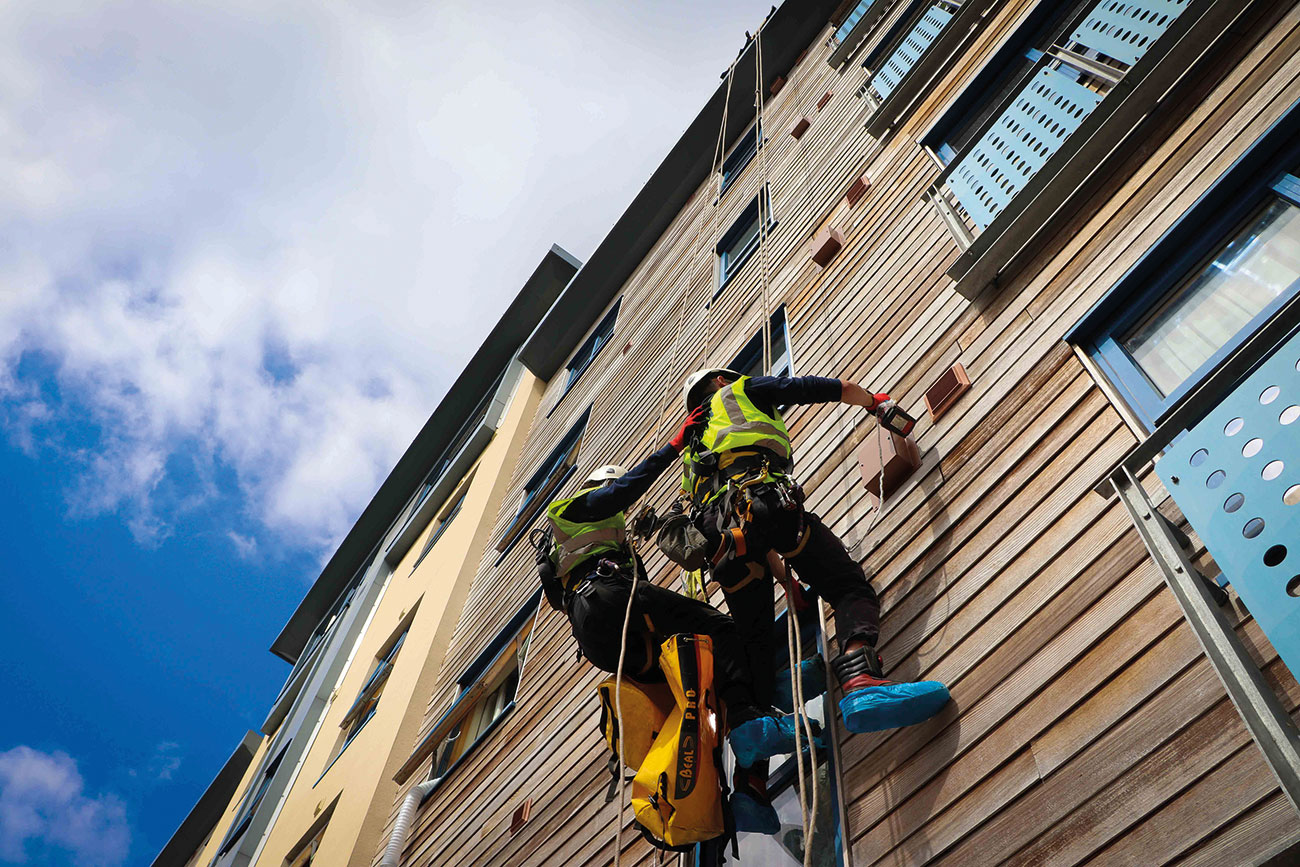
‘Our recent install at a 30m-tall residential building with restaurants located on the ground floor, used innovative installation techniques by replacing the terracotta tiles with A2 aluminium replicas fixed with an Intelliclad smoke detector.
‘From small beginnings, we are ready to act now and make a huge impact.’
The Intelliclad whitepaper ‘A Practical Approach to Fire Safety’ is now available from their website.
For more information, go to www.intelliclad.co.uk
