
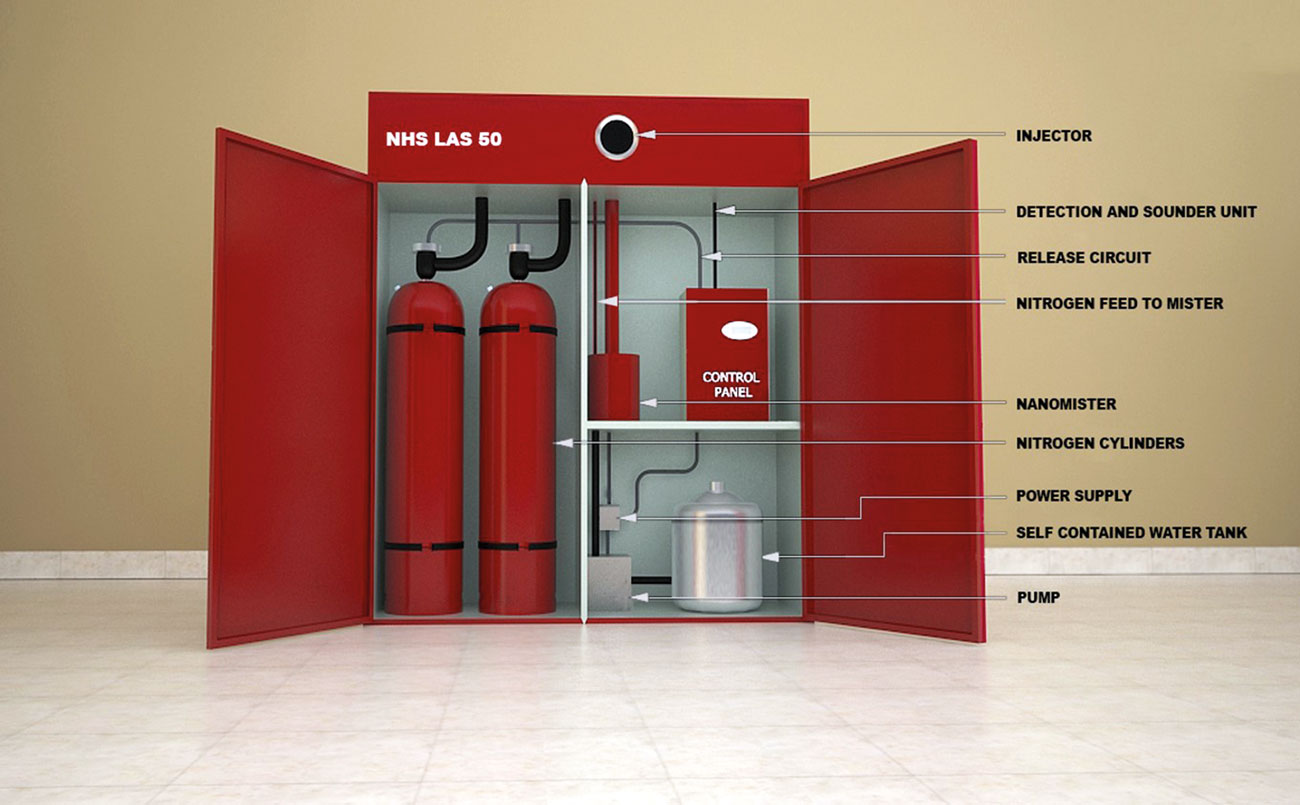
Nanomist hybrid system (NHS) is a disruptive fire protection technology using ultrafine water mist below 10-micron blended with nitrogen through a unique injector design generating converging diverging discharge flow. The system runs on UPS batteries. NHS has short extinction time of below 100 seconds at low nitrogen release pressures around 300 psi, not requiring high structural integrity. The breakthrough performance of NHS is due to the synergistic effect of components and water droplet-induced favorable flow dynamics.
A variety of complex fire protection systems exist today for a range of fire scenarios with varying degrees of success. Despite the latest advances in fire protection technology, there is a great need for a safe, environmentally friendly technology that causes minimal damage and business downtime for data centers and other high-end fire protection scenarios. Many systems are acceptable only in selected areas because of chemical toxicity, water damage and harmful oxygen levels in living areas, enclosure conditions of protected areas, structural integrity and pressure noise levels. In some scenarios, systems often can reduce oxygen to life threatening levels.
These are some specific inherent issues in current systems. CO2 systems are harmful to humans and cannot be used in normally occupied spaces. Chemical agents like HFCs need room integrity tests, are often unsuitable for occupied spaces, need expensive refills, have low ODP but high GWP and require complex software. Inert systems have a high operating pressure and require room integrity and suitable vent systems. High pressure release gas systems cause damage to data storage disks due to high SPL.
A new class of hybrid fire protection system addressing these factors and delivering higher performance is evolving now with relevant FM and UL approvals. For example, Victaulic Vortex uses a supersonic jet stream of nitrogen to atomize a low-pressure stream of water into sub-10-micron water droplets. The Victaulic droplet size is like NanoMist Hybrid but are produced differently. NanoMist is a singly fluid atomizer while Victaulic uses nitrogen. There are other hybrid systems with water atomized by pressurized nitrogen and propelled by nitrogen. In general, many water mist systems can accommodate nitrogen as an atomizing gas, driver, or propellant, but it may not contribute significantly to enhanced extinguishment behavior. The hybrid system performance does not merely depend on the presence of two components but strongly depends on the uniform droplet size of the water mist, relative velocities of mist droplets and the gaseous stream, the downstream mixing process, and discharge flow behavior. Amongst other factors, the commercial success of hybrids depends on agent composition, internal flow dynamics of enclosure and its interaction with the fire, the operating pressure, and discharge pressures.

NanoMist Hybrid System (NHS)
All hybrids are not equal, and there are opportunities for a revolutionary game changer technology with disruptive performance behavior. NanoMist Fire Safety (NFS) has been successful in unveiling an environmentally friendly fire protection solution long-sought gas-like ultrafine water mist hybrid system using a patented NanoMist single fluid atomizer device and a global patent pending injector system.
NHS provides a hybrid composition and a new device for fire protection by either local or total flooding. A homogeneous hybrid composition with less than 12% of water is formed and discharged from a swirling flow mixer-injector device. The nitrogen release pressure is maintained at 200-300 psi, unlike other high-pressure inert gas and hybrid systems, ensuring safety, building integrity and low SPL. The high-velocity nitrogen entrains the low-velocity mist coming at the mixing plane of the injector. At the exit, the device creates a high-speed (up to 75 mph) swirling, converging and expanding flow inside the protection volume at near ambient pressure. The hybrid composition extinguishes the fire by synergistic cooling, inerting, and water droplet induced flow dynamics. Apart from the cooling effect by the water component, the local oxygen composition stratification created by the ultrafine mist helps in transporting the oxygen deficient air into the fire base. Also, the mixer-injector device allows varying the ultrafine droplets and inert gas at the mixing plane. The extinguishing concentration is reached as quickly as possible, preferably locally at the fire base while maintaining low release pressure from nitrogen cylinders.
NHS 50, a self-contained system with nitrogen cylinders within the local agent source (LAS) cabinet, is seen in Figure 1. NHS 50 protects a 50 m3 room. It contains a detector system, gas release and mister actuator panel, and a water tank with a pump. The injector device on the top of the cabinet can be oriented in a specific direction. The agent discharge velocity varies depending on the local or total flooding (30-50 mph) applications. The flow converges leaving the injector and then diverges and penetrates into the firebase.
The system can also be installed as a remote agent source (RAS) with nitrogen delivered from a distributed bank. The release pressure can be set to 200-300 psi at the remote nitrogen bank. Due to the low pressure, the transport pipe can be CPVC rather than stainless steel. The RAS module (NHS 50) is shown in Figure 2. A high degree of enclosure integrity is not needed since the release pressure is relatively low compared to existing high-pressure inert gas systems. The operating sound pressure level (SPL) is relatively low (<105 dB) at 200-300 psi. The nitrogen transport pressure, whether RAS or LAS, is almost ambient because the injector design opens to the total flooding area. This is unlike high pressure systems discharging the agent through a nozzle requiring structural integrity and vent systems.
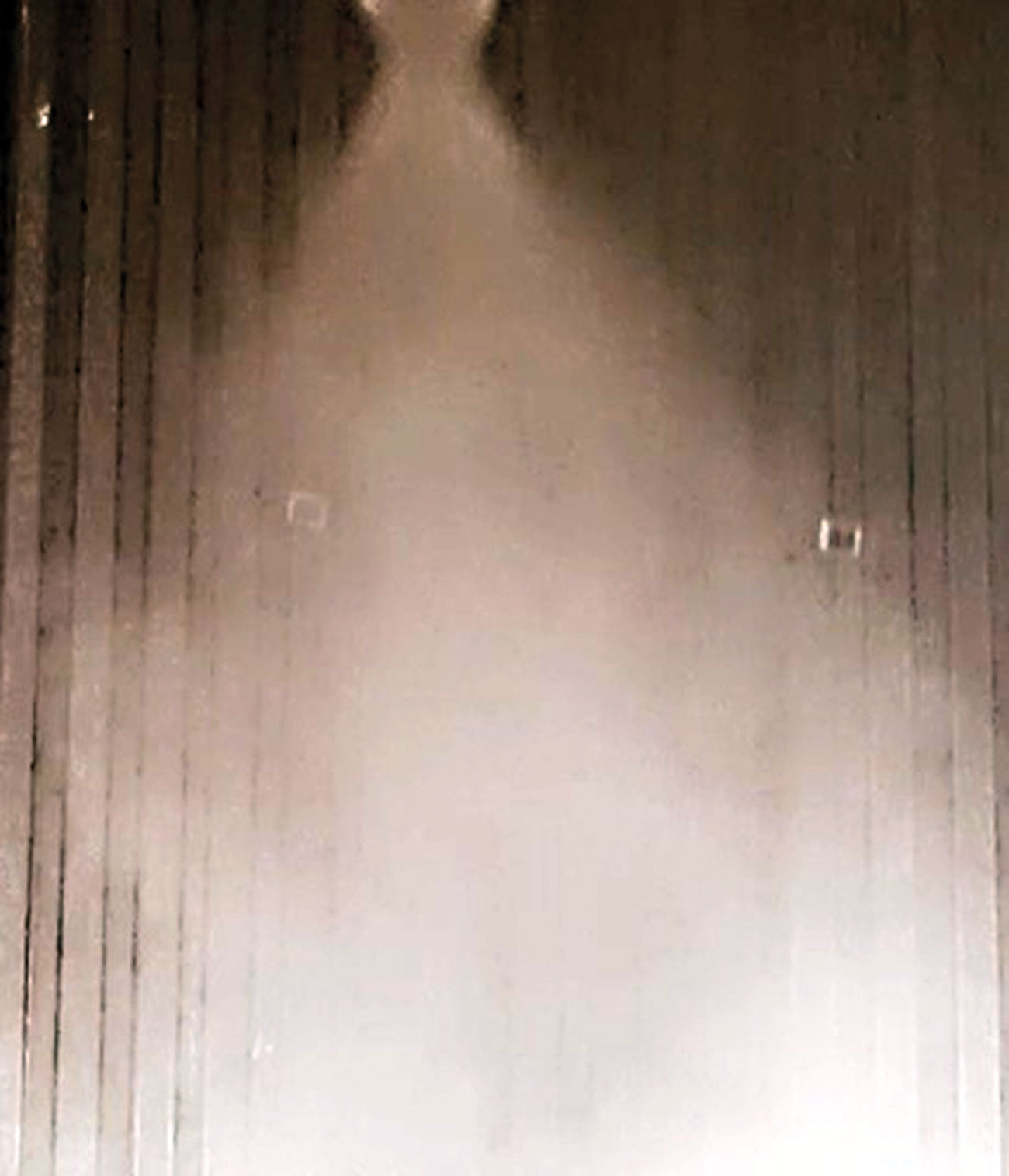
The converging-diverging flow pattern of NHS discharge is shown in Figure 3. From the injector, the flow converges first, and after an intense mixing of ultrafine mist and nitrogen the flow expands reaches the fire base.
NHS Performance Chart
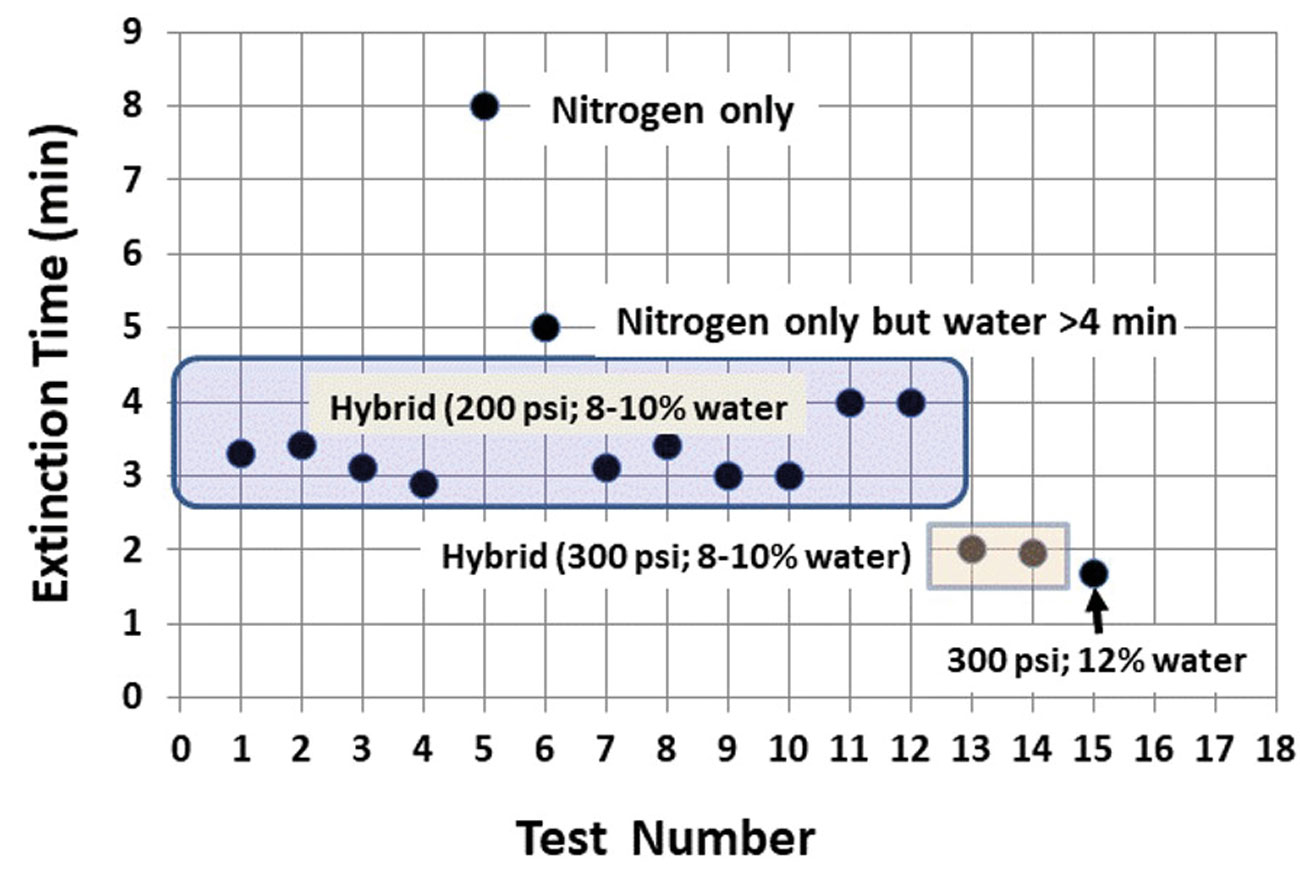
A comprehensive chart showing the performance of an NHS system in a 28 m3 room with n-heptane pan fire of 1-ft diameter is shown in Figure 4. The protocol follows FM 5580 in terms of core principle, and the fire size is scaled down to the enclosure size. The water/nitrogen proportions (by mass) are varied from 7-12%. The fire extinction time varied from 100 seconds to 3.5 min (200-300 psi). The oxygen level remained above 12.5%.
The performance of NHS extinction behavior at varying nitrogen composition and nitrogen release pressures are shown in Figure 4 with appropriate captions in the graph. Test #6 was nitrogen only up to 4 minutes with water mist turned on and extinction occurred at 5 minutes, showing the decisive effect of the water component. The colored band with Tests #1-#12, except 5 and 6, are hybrid systems at 200 psi release pressure and water varying from 8-10%. Tests #13 and #14 are at a slightly higher-pressure release of 300 psi and water up to 10%, and the fire was extinguished at around 120 seconds. Extinction occurred at 100 seconds at 300 psi and 12% water. This is lower than the NFPA 2001 code requirement. At 300 psi, a hybrid composition extinguished the fire in about 120 seconds or less, close to an inert gas at high-pressure release in other commercial technologies. Within the current data set presented, the shortest extinction (100 seconds) occurred at 12% water and 300 psi nitrogen release pressure (Test # 15). The most striking observation is the comparison of nitrogen only (test #6) and the rest of hybrids with water.
The Synergistic Effects of Components
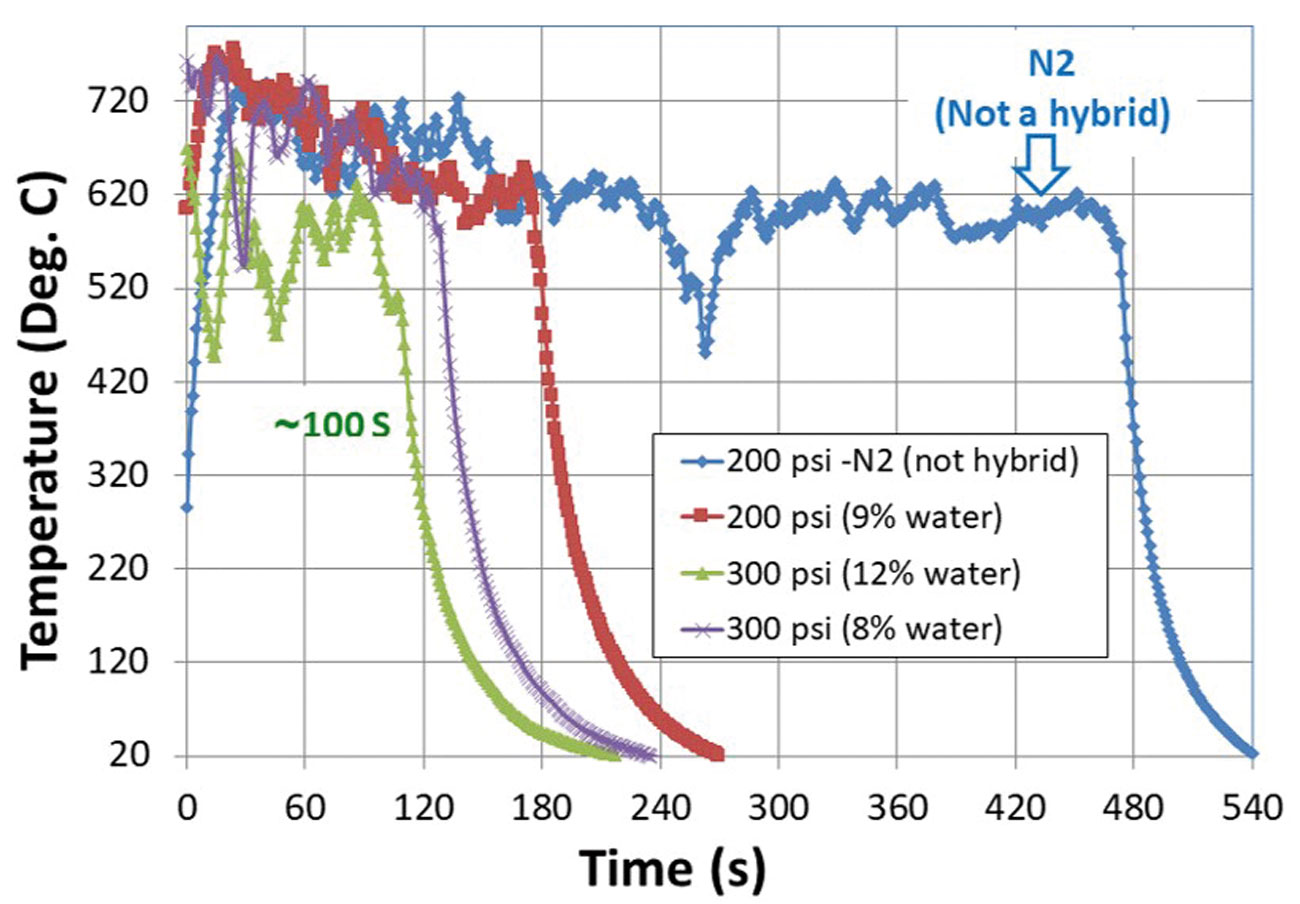
A unique extinction trend is observed with pure nitrogen (without water) and with about 10% water in a 28 m3 room on an n-heptane pool fire. It took about 8 minutes to put out the fire at 200 psi nitrogen release pressure. However, the best scenario occurred when pure nitrogen was mixed with ultrafine mist of about 12% water. The extinction time was as short as 100 seconds, as shown in Figure 5. This unique behavior is due to the synergistic effect of homogenous blending due to the below 10-micron ultrafine water mist which behaves like a pseudo gas with nitrogen coupled with flow dynamics inside. This technology is patent protected worldwide. A small percentage such as 12% of water mist reduced the extinction time from 8 minutes (pure nitrogen) to about 100-180 seconds depending on water concentration. As indicated before, nitrogen could not put out the fire in a 28 m3 room in a reasonable time (>8 min). Water alone at those flow rates of 400-500 ml/min also cannot put out the fire under similar fire conditions as confirmed by several tests in the past. However, a hybrid composition of these blends could put out a fire as quickly as 100 seconds. The reduced extinction time cannot be attributed to the water’s cooling effect alone at such a small percentage of 7-12%. Instead, it is due to combined effects of cooling and inerting and the discharge dynamics induced entrainment of oxygen-depleted air into the firebase.
Applications of NanoMist Hybrid
The NHS fire protection system is scalable in terms of NHS 50 modules and is cost effective. NHS is a potential alternative for the protection of data centers (electronics spaces), sub-floors and hot and cold aisles containment because of its non-wetting, safe oxygen level and very low release pressure with low SPL. Other applications include gas turbine cooling, machinery rooms, telecommunication facilities, museums, libraries, archives and clean rooms. Additional scenarios include residential and restaurant kitchen fire suppression, medical facilities, medical equipment, food processing and pharmaceutical lab spaces, mission-critical areas applications, transformer cooling (selected size and configurations), local flooding, inerting, air blanketing and preventing auto ignition, and lithium-ion battery explosion mitigation.
Conclusions:
NanoMist Hybrid System has begun a paradigm shift with remarkably enhanced performance due to “synergistic” effects of ultrafine water mist blended with an inert gas. Neither water nor inert gas used independently can provide the hybrid blend performance at similar mass flow rates. The 10-micron uniform droplet size of NanoMist ultrafine water droplets interact with fire generating favorable flow dynamics creating a local depletion of oxygen at the firebase. The analytical and CFD modeling is being developed. The important findings show that the nitrogen alone released at 200 psi did not extinguish the fire for up to 8 minutes in a 28 m3 room in total flooding. At 12% water and a 300-psi nitrogen release pressure, the extinction time was 100 seconds, like the extinction times of high-pressure inert gases. The main benefits of NHS: 1) Adding a very small percentage of ultrafine mist with uniform droplet size below 10 microns to nitrogen gas dramatically changes the extinction behavior which is a highly beneficial fire suppression system for data centers and telecommunication areas. 2) Achieving a quick extinction time while maintaining a very low release pressure without damaging the structure and reaching a high level of SPL makes NHS an attractive technology compared to high pressure inert gases. 3) A structural integrity test is not necessary. 4) Using a nitrogen distribution system, NHS RAS units can be installed at strategic locations using CPVC pipe. The NHS 50 and modular systems run on UPS (Uninterrupted Power Supply) systems.
The efficacy of NanoMist Hybrid System technology has been published at the website shown below. After independent tests and UL 2127 and FM 5580 listing processes by an OEM partner/buyer, the technology is ready for launching. NHS has multiple issued patents (world-wide) and pending non-provisional patent (global) and registered trade mark (NanoMist®).
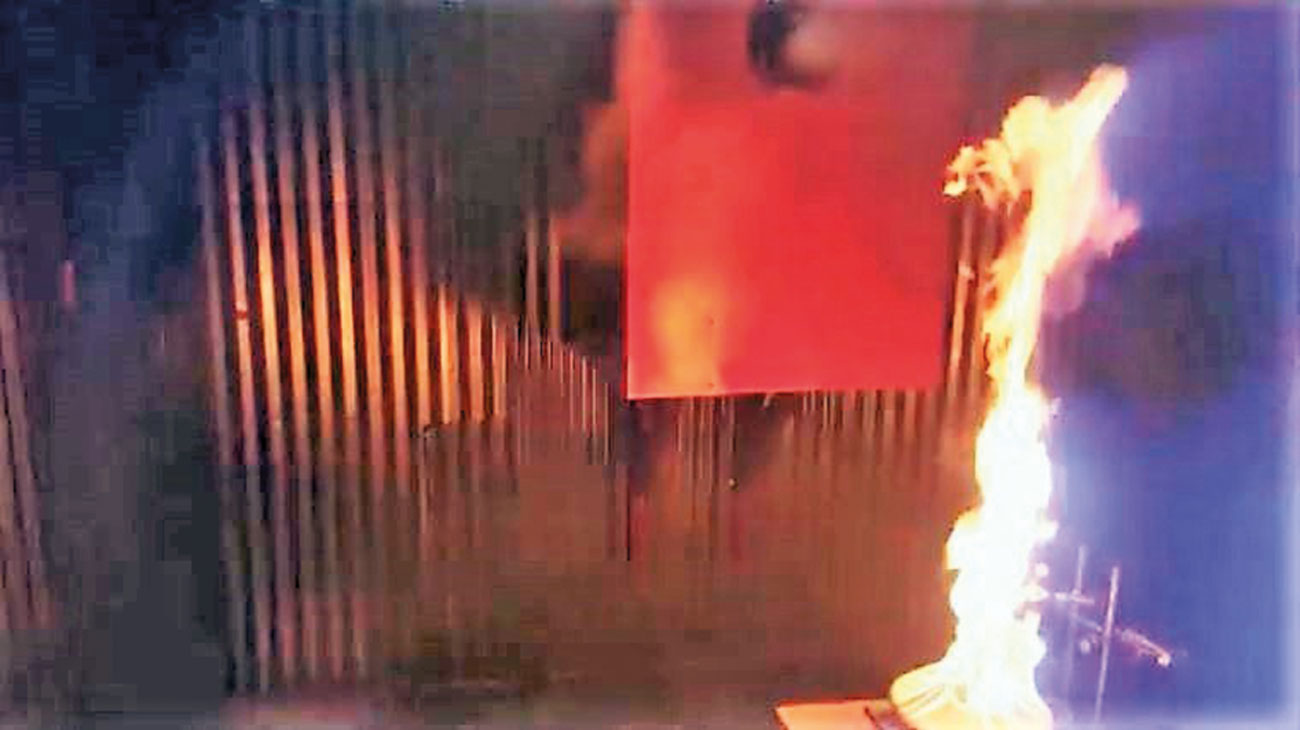
A snapshot of a movie clip of extensive tests conducted on n-heptane pool fires in 28 m3 (~1000 ft3) enclosure is shown in Figure 6. A modular RAS (Remote Agent Source) unit as shown in Figure 2 is located on one side of the wall. The nitrogen cylinders are connected from outside of the enclosure to RAS unit through CPVC pipes. The pool fire is at the center of the enclosure. The results are shown in in Figure 4 and more data is available in website.
For more information, go to www.Nanomistfiresafety.com
About the Author
K.C. Adiga, Ph.D. is the President of NanoMist Fire Safety (NFS) company developing hybrid fire suppression systems and modeling its behavior. He has a Ph.D. in rocket fuel combustion. He continues his R&D in fire protection, materials, and CFD modeling areas. Dr. Adiga is currently focused on commercializing NanoMist Hybrid System for datacenters, telecommunication space, machinery space, and other applications avoiding volume wetting and operate at low operating pressure not requiring air tight enclosures.

You must be logged in to post a comment.