

The year was 1920. The short-lived League of Nations was formed in the hope of keeping peace in the aftermath of World War I. Black market liquor and speakeasies became the rage in the United States after passage of the Volstead Prohibition Act. Prime Minister Lloyd George called for “Homes fit for heroes” to be built for veterans recently returned from the Great War, spurring a decade-long housing boom in the United Kingdom.1 In a haunting parallel of 2020, the world reeled and struggled to find its way forward in response to the Spanish Flu, a deadly pandemic the likes of which it had never seen, and for which it was woefully unprepared.2
On January 23rd, Frank J. Fee founded the Reliable Automatic Sprinkler Co., Inc.
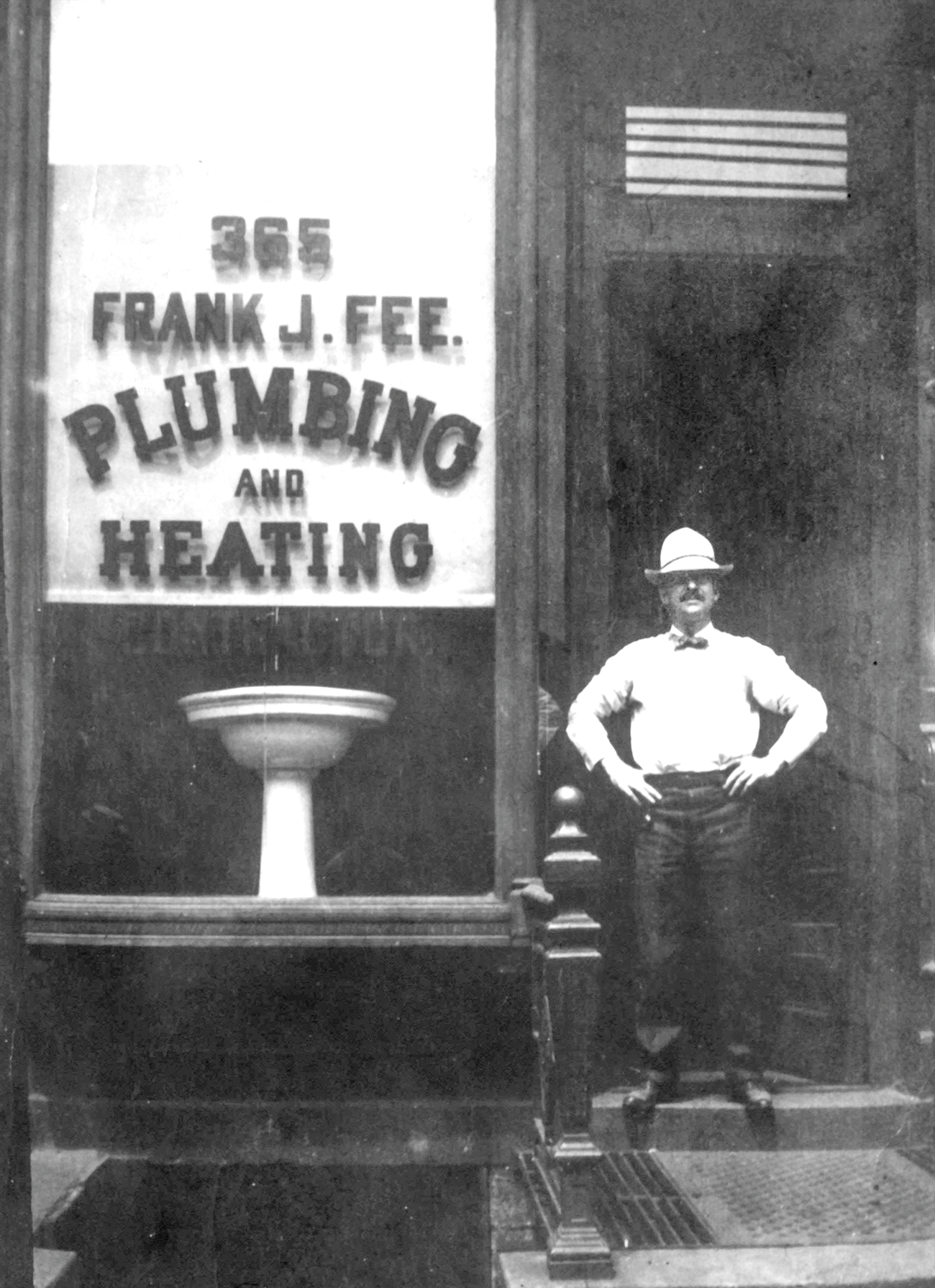
Frank was the youngest of nine children, born in County Monaghan, Ireland on July 14, 1872. In 1888, 17-year-old Frank departed from Liverpool, England on the S.S. Britannic, arriving on Ellis Island, New York on New Year’s Day 1889. He settled in Manhattan where he began as a laborer and completed an apprenticeship in the plumbing industry. Young Frank continued as a journeyman plumber and became a member of Local No. 2, Journeymen Plumbers Association, U.S.A. By 1896, he was a Master Plumber and operated a plumbing business on West 40th Street in New York City: Frank J. Fee Plumbing & Heating.
In the wake of tragic early 20th Century fires such as the Iroquois Theatre (Chicago, 1901) and the Triangle Shirtwaist Fire (New York, 1911), public outcry led to legislation and building codes mandating the use of automatic sprinkler systems in many manufacturing and public facilities.3 Although there were over 50 manufacturers of fire sprinklers in the United Kingdom and North America at that time, most of the sprinklers produced in that period were deemed “unreliable” by Underwriters Laboratories.3
Recognizing the opportunity for an improved, stronger link sprinkler, Mr. Fee began to design and secure patents for automatic fire sprinkler devices as early as February 1916. His first patent application was awarded in January 1918. In February of the same year, he received a patent for a fire sprinkler with a strengthened fusible link element. By 1920 his new company was in production of the Issue “A” solder link sprinkler.
“My grandfather was a gregarious Irishman,” mused Reliable board chairman FJ Fee III. Combined with his grit and political savvy, Frank’s personal and organization skills made him an effective leader not only of his company, but also by representing the young industry through political engagement and his dedication to professional associations.
Frank steered his foundling company through its early years, often bootstrapping it with personal capital and foregoing his salary to allow the company to flourish, even during the depths of the Great Depression. By 1937, in a position of financial stability, Reliable moved its operations to 78 Bronx Street in Mt. Vernon, New York.
Son Frank Fee Jr., a recent Mechanical Engineering graduate from New York University, was the primary architect and engineer for the new facility. Operating from its new location, Reliable customers benefited from both improved capacity and the expansion of its product line. After Frank Sr.’s death on March 23, 1945, Frank Jr. assumed the company presidency and oversaw the company’s expansion by adapting Reliable to the booming global post-war construction market.
FJ Jr. promoted and supported the sprinkler industry by becoming an officer of the National Fire Protection Association. Establishing a Reliable commitment that continues to this day, FJ Jr. gave freely of his time to support industry associations that now include BAFSA, NFSA, AFSA, IFSA and NFPA.
In 1969, grandson Frank J. Fee III was named as Executive Vice President, and in late 1976, after his father’s death, assumed the presidency. At the same time, Kevin T. Fee was elected as Executive Vice President, with FJ’s third grandson Michael joining the company shortly thereafter. During the late 1970s and 1980s, the first steps were taken to build international sales and distribution beyond what had been solely a Fee Family sales team in a single location in New York. One international regional manager and three U.S. regional managers joined the company and three additional distribution centres were established.

This period also marked the beginning of rapid growth in product technology in both the sprinkler industry and at Reliable. Use of fast response elements, larger K-factors, extended area coverage, and unique distribution patterns for warehouse protection and residential life safety was injected into sprinkler design.
“Lots of factors drove these changes,” notes Reliable VP of New Technology Steven Wolin. “Changes in warehouse commodities and the manner in which they are stored, combined with the recognition of the life-saving properties of sprinklers with fast response elements were key,” he continued. “And the ability to quickly and accurately calculate system hydraulics made these advances possible and practical.”
It was clear in the early 2000s that capacity in the New York facilities would not be adequate for the next industry growth cycle. In 2004, the decision was made to relocate valve and sprinkler production, product development and technical services to a new 28,335 square meter state-of-the-art facility in Liberty, South Carolina. The relocation decision embodied the Fee commitment to remain a U.S. manufacturing company, confident the new facility would allow Reliable to be even more globally cost competitive. Full operation in Liberty began in July 2007 and was expanded in 2018 to a total of 41,800 square meters.
“My grandfather created Reliable with the core valves that we produce quality products in the United States, treat our employees and customers as family, and to not compete with our contractor customers,” concluded Reliable President Kevin T. Fee. “We are proud to adhere to those values today and tomorrow…just as he did when he founded Reliable 100 years ago.”
For more information, go to www.reliablesprinkler.com
References
- The People History, 1920. (http://www.thepeoplehistory.com/)
- Ries, Julia, 2020. Here’s How COVID-19 Compares to Past Outbreaks, healthline.com.
- Solis, Hilda L. “What the Triangle Shirtwaist fire means for workers now” Washington Post (March 18. 2011)
- Dana, Gorham, 1914. Automatic Sprinkler Protection, Thomas Groom & Co., Inc., Boston.
About the Author
John Corcoran is the Digital Marketing Manager at Reliable Automatic Fire Sprinkler Co., Inc. He has worked in Marketing and Commercial Operations roles in the Fire Sprinkler Industry since 1993.

You must be logged in to post a comment.