
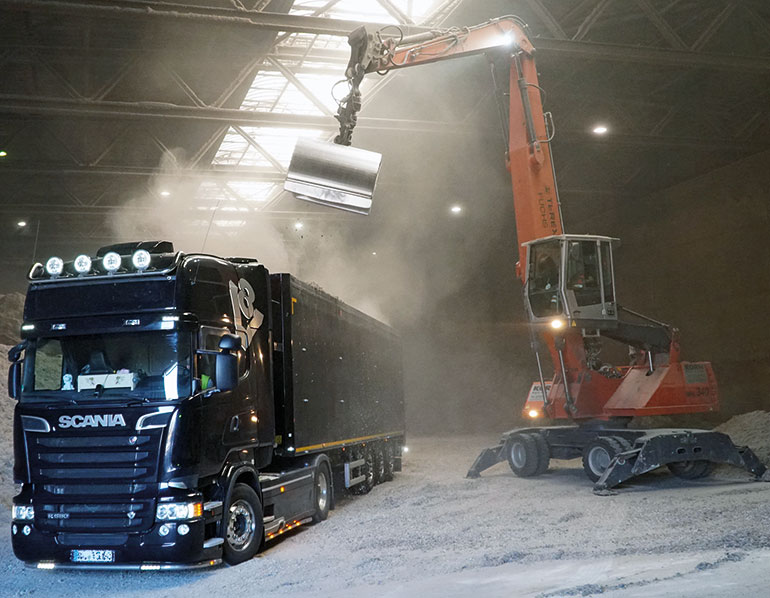
Waste is per se something ‘dirty’; hence, the environmental conditions within recycling facilities are most challenging. In addition, the environment is highly dynamic, the level of dust changes very quickly when, for example, trucks are loaded or unloaded.
Furthermore, fires in recycling facilities are far from rare and as the number of facilities is growing, the number of fires is unsurprisingly rising too.1 Due to the unknown nature and composition of the waste, fires in recycling plants pose additional threats, such as releasing of toxic gases into the environment as a direct result of fire or releasing of toxic substances into flowing water bodies and phreatic water because of contaminated fire water.
Damage resulting from property loss, fines, payments to settle civil damages claims as well as loss of reputation after an uncontrolled fire incident may drive the operator or owner of the recycling facility out of business. A professionally designed fire-protection scheme, which allows detection of and reaction to a fire as early as possible, is paramount.
Risk and cause
False alarms and their consequences are a major risk in the operation of recycling facilities. Why is that so? Statistics show that a recycling plant faces a fire incident on average every second year. Fire protection consequently is a critical element in the operation of a recycling plant. A fire-protection scheme includes staff that are thoroughly trained, stay alert and react in a professional manner to a fire alarm. False alarms undermine the alertness of the staff, which in turn can lead to false reactions in case of a real fire. They result from poor fire-protection design and/or inadequate fire-detection products and must be addressed in the fire-protection design.
Other risks are the processing of substances with an unknown fire load that produce combustible dust or that become combustible and/or fire accelerants when mixed suddenly or in an uncontrolled way.
Common fire causes are spontaneous ignition of waste material, smouldering waste material delivered to the stock, cutting or shearing containers, in particular when they contain com-pressed flammable gases, and hot works such as cutting, welding and soldering.
Challenges
Waste is ‘dirty’ by definition; the environment of a recycling facility therefore is far from clean (see Figure 1). In addition to that, the environment is highly dynamic and the level of dust changes very quickly.
Other challenges are a high temperature variation, with a build-up of foggy clouds at low ambient temperatures, a large, partly open space and therefore a high variation in airflow, diesel exhaust fumes and birds or other flying objects (plastic bags, wrappings, etc.).
Technical equipment, often mounted in places hard to reach and exposed to harsh environmental conditions unprotected, inescapably leads to high maintenance costs. A good fire-protection design aims to reduce the maintenance interval to the absolute minimum.
Application scenarios for reliable fire detection
In such harsh environments, the range of solutions is very narrow. One of the most reliable fire-detection solutions is based on an industrial-grade linear-type smoke detector and an ‘alarm buffer function’ to even out very fast changes in the dust load. The Securiton SecuriBeam ILIA Pro is an industrial-grade linear-type smoke detector that features a high dynamic range to be able to self-adjust in changing dust loads (a low dynamic range results in ‘beam obstructed’ fault messages). In addition, it offers flame-detection capabilities, to detect fires even in persistent high loads of dust. The alarm buffer function is a programmable feature of the Securiton SecuriFire 500 fire-alarm control panel. In combination, they address the two main issues: prevent false alarms and keep the maintenance interval low.
The SecuriBeam ILIA Pro system has a built-in active compensation for drift, which keeps the distance between the measured value and the alarm threshold constant over a wide range (high dynamic range).
- If the measured value rises quickly and above the alarm threshold, the pre-waiting time starts, to allow for swirled-up dust to settle or the ILIA Pro to compensate for the drift (see above).
- Once the pre-waiting time has expired, the SecuriFire 500 panel sends a reset command to the ILIA Pro and starts the waiting time.
- During the waiting time, the fire-alarm panel will immediately signal an alarm in case the measured value rises above the alarm threshold. Should the measured value not rise above the alarm threshold, the intermediate alarm storage is cleared, after the waiting time has expired.
Protecting the beam detectors from dust, acid concentrations in the air and accidental misalignment is one aspect of keeping the maintenance efforts low. The other aspect is keeping the lenses clean with the help of an air shield that creates a homogenous air curtain in front of the lenses. Both aspects are paramount to keeping the system operational and cutting down on maintenance cost. Figure 3 illustrates the air shield and the protective housing (right) and its impressive effectiveness in operation (left).
Contact Securiton and ask for the Case Study ‘Fire and smoke detection in recycling facilities’ which also covers the testing of this performance-based solution.2

Key criteria and benefits
A fire-detection solution with Securiton SecuriBeam ILIA Pro and SecuriFire 500 satisfies the key criteria preventing false alarms and reducing maintenance cost. This in turn is beneficial for the operator because:
- Fires are detected at an early stage and the staff stay alert and react skilfully to alarms signalled, ensuring fire alarms are reacted to in a professional manner before they become a major fire incident.
- The loss prevention is at a maximum and the risk for business interruption at a minimum, all at commensurate cost for maintenance.

Success Stories
Securiton SecuriBeam ILIA Pro fire-detection solutions are – among other – successfully in operation at the following facilities:
- KORN Recycling, Germany
- Clean R Recycling, Latvia
- SITA Rohstoffwirtschaft, Germany
- Durmin Entsorgung und Logistik GmbH, Germany
- Otto Dörner, Germany
For more information, go to www.securiton.com
References
- Waste, Recycling Facility Fires Up 26% in 2018 Compared to 2017. Retrieved on 2020-05-13 from https://www.waste360.com/safety/waste-recycling-facility-fires-26-2018-compared-2017
- Securiton AG (June 2020), SecuriBeam ILIA Pro, Fire and smoke detection in recycling facilities, Case Study, Zollikofen, Switzerland
About the Author
Markus Mueller is Director for Vertical Application Management at Securiton AG.

You must be logged in to post a comment.