
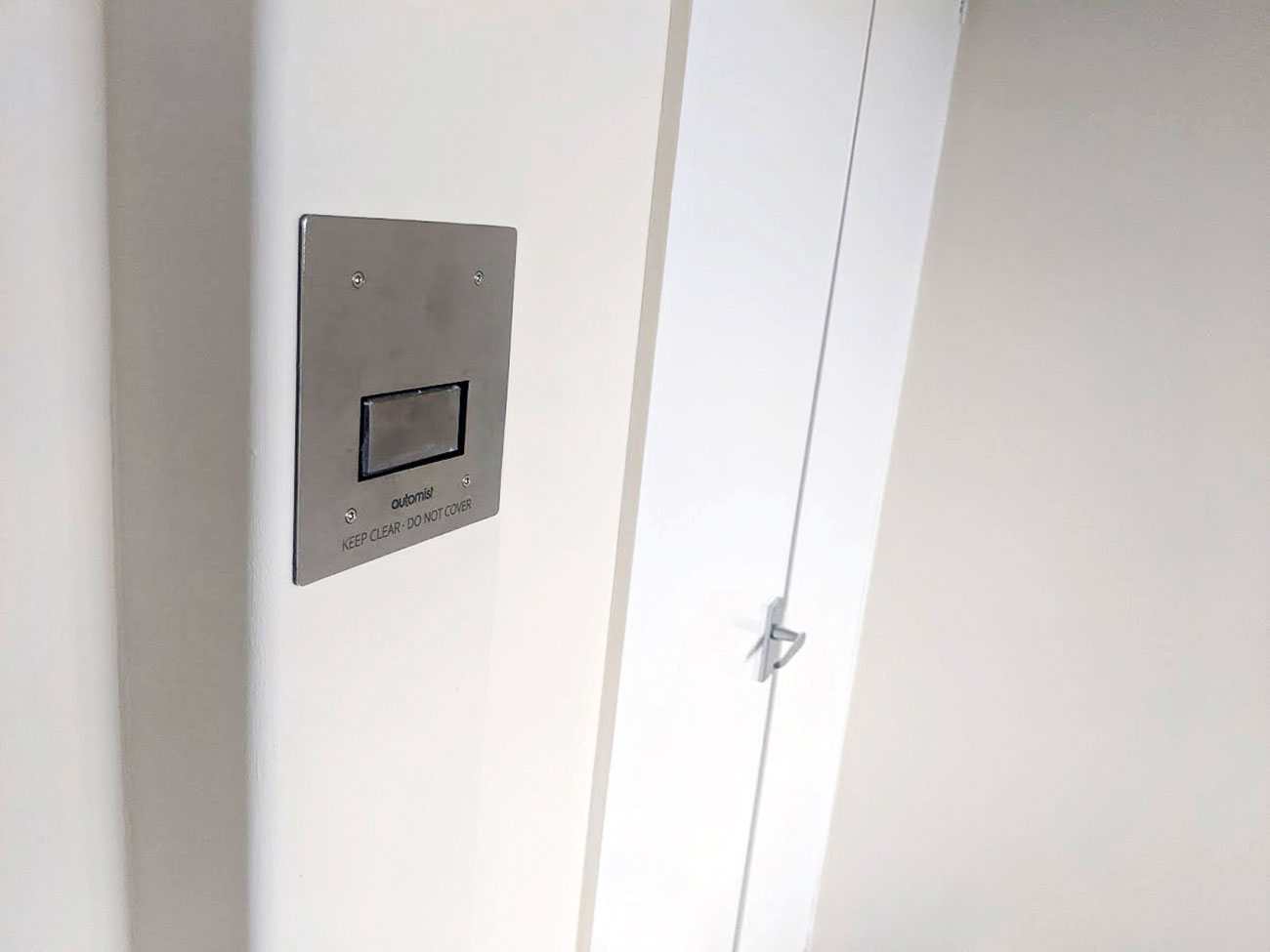
This feature discusses a recent project to test how the Plumis Automist fire-suppression system could play a key role in safeguarding social-housing residents and future-proofing homes.
The basic technology behind modern fire-safety sprinkler systems has changed little since its invention over 100 years ago. This is partly due to its simplicity and effectiveness but also the inevitable resistance to change and a tendency to become complacent if things go well for a long time.
At Plumis, we are keen to explore opportunities for improvement and address calls for innovation to ensure fire safety keeps pace with the ever-evolving challenges of our fast-changing world.
We recently teamed up with the Disruptive Innovators Network, which provides opportunities for social-housing providers to test and explore the latest innovations, on a project which opened our eyes to future possibilities.
Our DINLab programme involved four social landlords taking part in a six-month trial to see how Automist, our watermist alternative to sprinklers, could improve fire safety for their residents.
As fire-safety challenges have changed over the years, fire-safety systems need to change with them. For example, today’s housing associations have to take into account an ageing population, ageing housing stock and inherent fire risks from increased use of electrical goods.
With this project, we wanted to discover how our Automist technology – which involves temperature-detecting sensors activating targeted misting spray heads – could help them solve these modern-day problems.
Our approach
Initially we talked to landlords to identify the main challenges they faced. These included issues delivering outstanding actions from fire-risk assessments, as well as Personal Emergency Evacuation Plans for residents needing assistance to escape in the event of a fire.
Such actions can be difficult to affordably deliver without a relatively straightforward retrofit solution. Automist, which is easy and quick to install in an existing building with minimal disruption, potentially offered a viable way to solve this problem.
We fitted Automist in two homes for each of these social housing providers:
- Thorngate Churcher Trust, which offers independent assisted living and residential care in Hampshire – two flats which were home to vulnerable residents
- Loreburn Housing Association, which provides housing across Dumfries and Galloway in Scotland – two flats where residents had a higher fire risk due to issues such as limited mobility
- Worthing Homes, which has homes in the Sussex coastal area – two flats in high-rise blocks
- mhs homes, the largest independent landlord in Kent – two flats, one privately rented and one in a sheltered housing scheme.
The technology
We were keen to investigate the added value our system’s unique electronic sensors might be able to bring in addition to these landlords’ basic requirements.
In order to do this, we connected the sensors to the Internet, enabling data to be downloaded and monitored remotely if the system was activated.
The fact that our sensors monitor temperature also opened up the capability to identify issues that might need further investigation, such as residents not heating their homes sufficiently, heating being set too high or a thermal leak in the property.
Outcomes
Participating housing providers were pleased with the technology’s capabilities in terms of temperature monitoring, incident reporting and the improved fire safety it offered, while the residents and their families were reassured by the extra peace of mind it gave them.
An interesting outcome was when one of the Thorngate residents reported the system had activated but we received no activation notification. Initially we were concerned that something had gone wrong.
But, looking at the data gathered remotely, we saw the sensors had recorded a spike in temperature (caused by smoke from cooking) but the sprayheads were not triggered as no fire was detected.
Hence the system had done exactly the job it was supposed to do, and we were able to provide a full incident report to explain what had happened.

Added value
We were delighted to discover the added value this Internet-connected technology could bring for landlords and their customers beyond life safety. As well as enhanced fire safety, the temperature sensors can be used to detect issues relating to energy efficiency (amid the ongoing drive towards decarbonisation), fuel poverty, cold spots and damp problems in properties.
But we are particularly excited about the prospect of this being taken a step further, using these sensors to future-proof homes by monitoring people’s presence and movement in a building. This has amazing potential in terms of helping vulnerable people who need additional support to live safely in their homes for longer.
For example, it might highlight that an elderly resident has sat in their armchair all day, they no longer use the bathroom or are cooking in the early hours. This activity or lack of activity might indicate a decline in the person’s physical or mental health.
By flagging up this kind of information to the sheltered housing manager so they can visit and investigate further, we can help them do their job more efficiently.
In addition, if a fire did break out, data from the sensors could map where individuals were within a property, thereby helping firefighters do their job in working out the best way to help people escape from the building.
Future potential
Thorngate, in particular, is extremely interested in the scope of this movement monitoring capability of the enhanced version of our system. For some time, as well as an affordable fire-safety solution, the team had been looking for suitable sensor technology to enable them to support older residents to live independently for as long as possible.
This aspect of the DINLab programme’s findings was unexpected but something we, too, are keen to explore further in the second stage of the project starting this summer.
Personally, I am really inspired by the idea of a reactive fire-suppression system – something people invest in but hope they never have to use – being proactively harnessed to deliver positive results and better outcomes for residents.
By delivering smart solutions to a range of challenges in a cost-effective, minimally disruptive way, such a system might even pay for itself over its lifetime. This might be in terms of making a home more energy efficient to heat or enabling sheltered housing managers to use their time and target support more efficiently.
The potential to safeguard not only residents’ safety but also their health and wellbeing, while enabling better management of their housing, opens up huge scope to future-proof homes and make them more sustainable in the long term.
For more information, go to www.plumis.co.uk
About the Author
Yusuf Muhammad is Co-founder and Chief Design Officer at Plumis.

You must be logged in to post a comment.