

Timber is an incredibly attractive and flexible building material. Its popularity is evident across all manner of buildings, both internally and externally. With a renewable profile, timber is the perfect building material to assist the world in reducing carbon dioxide emissions. Yet, many specifiers have limited knowledge about fire retardant timber; how it works and when to specify it.
What is fire retardant timber?
There are four key stages to any fire: ignition, fire spread, flash point (the fire is out of control) and decay (the fire is put out).
To achieve the first stage of ignition, fire needs fuel, oxygen and heat. Fire retardant timber has been factory-treated to prevent oxygen from reaching the fuel (timber in this case). Without oxygen, the risk of ignition is greatly reduced.
Should a fire break out, the speed at which the fire will spread will be greatly reduced. And the time between ignition and flash point will be significantly extended. The practical impact of this is that people will have much more time to safely evacuate the building and less costly damage will occur before the fire is extinguished.
When should fire retardant timber be specified?
The requirement for fire retardant timber is usually identified from a building regulations report or a risk assessment. Likely reasons include: if a boundary falls within one metre of the edge of the building, or when timber cladding is used on a multi-story construction.
Always seek proper advice on the need for fire retardant timber.
The specific treatment required will depend on many factors such as the timber species, the product profile and dimensions, and the end use.
Why must I choose certified factory treatment?
Advisory bodies always recommend that treatment is undertaken in a controlled, factory environment. Spraying or coating timber is unreliable as complete coverage cannot be guaranteed. Certified treatments also provide you with the correct documentation for due diligence, allowing you to demonstrate your compliance.
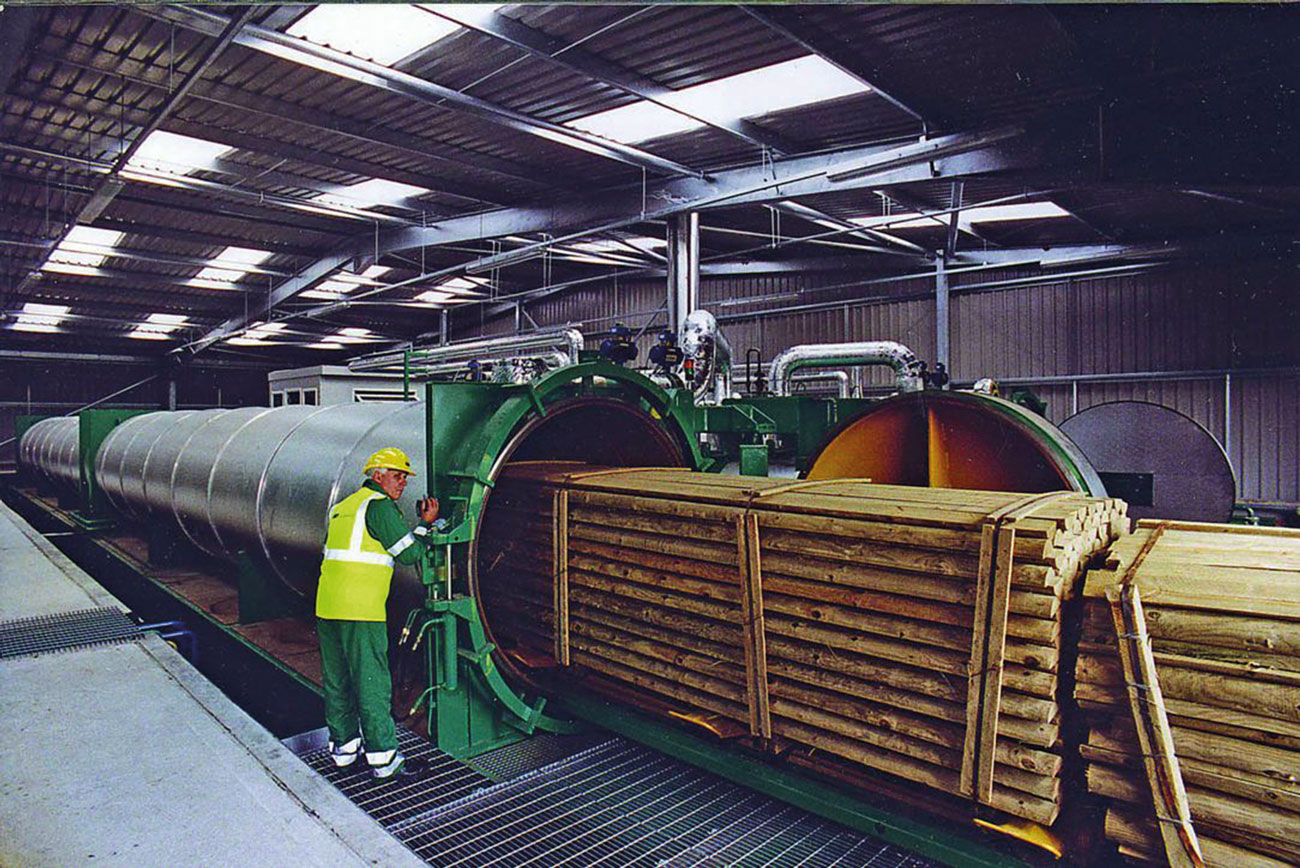
A robust, impregnation process is used in the factory, placing the timber into a large chamber to apply the fire retardant solution under pressure. The treatment is thorough and totally effective on all faces of the wood. It is also permanent, with no further maintenance required. Your documentation will support this.
The chemicals used are safe to the environment. Our Burnblock treatment, for example, is non-toxic, containing only food-grade ingredients. It’s a clear solution and minimal residue is left on the timber.
Kiln-drying can often be necessary after treatment as construction standards require a moisture content of between 10% and 18%. This process will bind the fire retardant agents to the wood and reduce the risk of mould growth. Any competent treatment provider will offer kiln-drying facilities as well.
Can you explain the classifications?
The key standard for fire retardant treatment is Euro class. This is due to permanently replace British Standards Class 0 and Class 1 due to the Construction Products Regulation (CPR). The aim is to harmonise standards in Europe and the Euro class system supports more modern test methods.
Untreated wood generally performs to Euro class D when tested. There are then two classes that are given to certified fire retardant timber. Euro class C indicates limited spread of fire, whilst Euro class B offers very limited spread of fire (similar to Class 0 in the old system).
All products are tested to European Standard EN13501-1:2007+A1:2009. Within this standard, two further tests are undertaken: single burn item test EN 13823:2002 and ignitability test EN 11925-2:2010.
You will also see ‘s’ and ‘d’ values stated in a fire classification report. S values indicate the level of smoke emitted during the burning process, with s1 offering the lowest emission and therefore the safest value. D values concern the level of flaming droplets produced during combustion. These can contribute to the spread of fire and so a low value (d0) offers the greatest protection.
Sometimes, you’ll be asked to specify to an FR number: 1 to 5. These highlight commodity specifications as laid out by the Wood Protection Association (WPA). FR numbers concern the end use of the fire retardant treated timber and are simply used as a guide to determine the most appropriate treatment. The five explanations are:
- FR1: Non load bearing for dry interior use
- FR2: Load bearing dry interior use
- FR3: Interior use with relative humidity
- FR4: Weather protected exterior use
- FR5: Weather exposed environment

What documentation should I ask my provider for?
The purpose of documentation is to provide evidence of your compliance to your authorities. It’s important that you retain it for future reference.
Treatment certificates, delivery notes and invoices should all align with treatment specifications and every batch of fire retardant treated timber should be accompanied by a Classification Report.
The Classification Report is independently certified and will be species specific. It will include details such as the fire classification achieved with treatment, the minimum thickness covered and the field of application. If you deviate from these specifics, your documentation will be invalid.
It’s always wise to double-check the details of your Classification Report against your specification for the project. Your documentation will only support you if the two match exactly.
Does fire retardant timber look different?
The treatment solution used in the pressure chamber is clear. However, certain wood species might exhibit slight darkening after treatment, with the graining becoming more pronounced. If the timber is to be used externally, this will fade with weathering. By talking to your treatment provider at the outset, they’ll be able to discuss the merits and limitations of different timber species and provide you with samples.

Can I coat fire retardant timber?
There’s no need to overcoat fire retardant timber for preservation purposes. Any factory-controlled process has treated your timber for the longevity required.
There might be times when you want to specify a particular coating for aesthetic reasons though. This must only be undertaken after full discussion with your treatment provider. Certain paints and stains are not fire retardant in themselves and might not adhere to the timber fully. You could be quite literally adding fuel to the fire.
Treatment providers generally have approved and fully tested coating systems that will maintain the fire retardant properties of the timber. They might also be able to apply them in a factory environment, following treatment and kiln-drying. This can deliver cost efficiencies and a superior finish.
Any advice for handling fire retardant timber?
We would always recommend that timber is cut, profiled and sanded before treatment. Any post-profiling could negatively impact on its fire retardancy. We can provide product machining and CNC cutting prior to treatment, helping to minimise any work to the timber after treatment. This is always the most effective route, ensuring your timber performs as intended, should a fire break out.
As with all treated timber, store it in a dry and well-ventilated location. It’s advisable to use gloves when handling the timber and acknowledge general health and safety advice.
Should you wish to attach fixings to the timber, we’d recommend opting for stainless steel. Other metals can react with the chemicals in the timber, causing unsightly corrosion. Though this is not an issue with Burnblock.
Fire retardant timber is generally safe to dispose of. Burnblock, for example, is not harmful to the environment and can even be used in biomass recycling. Its slow burning can actually increase the efficiency of the energy yield and can be considered non-hazardous in all instances.
Where can I learn more?
Certified fire retardant treatment providers should offer you a wealth of information and be able to answer many queries. They are used to working with architects, specifiers and contractors to deliver the optimum product for a building project. These businesses will also work very closely with their chemical providers and maintain all the documentation and testing evidence required for due diligence.
In the UK, the Wood Protection Association (WPA) and the Timber Decking and Cladding Association (TDCA) exist as independent trade associations to support the timber industry. Both are incredibly knowledgeable on the issues around fire retardant timber, supporting businesses daily.
Specifying fire-safe buildings is of utmost importance across the globe and those involved must take the time to acquire the right knowledge to do this correctly, for each specific project. Fire retardant timber is certainly complex, but the support and advice exists to ensure a totally effective specification that delivers the optimum level of fire safety, whatever the size and ambition of the construction.
For more information, go to www.wj-group.co.uk, www.wood-protection.org, www.tdca.org.uk
About the Author

Business owner and Managing Director, Mark Eggleston formed WJ Group in 2007, initially constructing timber roof trusses for the leisure building sector. WJ went on to develop a leading presence in factory-controlled timber treatment – the first of three treatment plants opening in 2009.
You must be logged in to post a comment.