
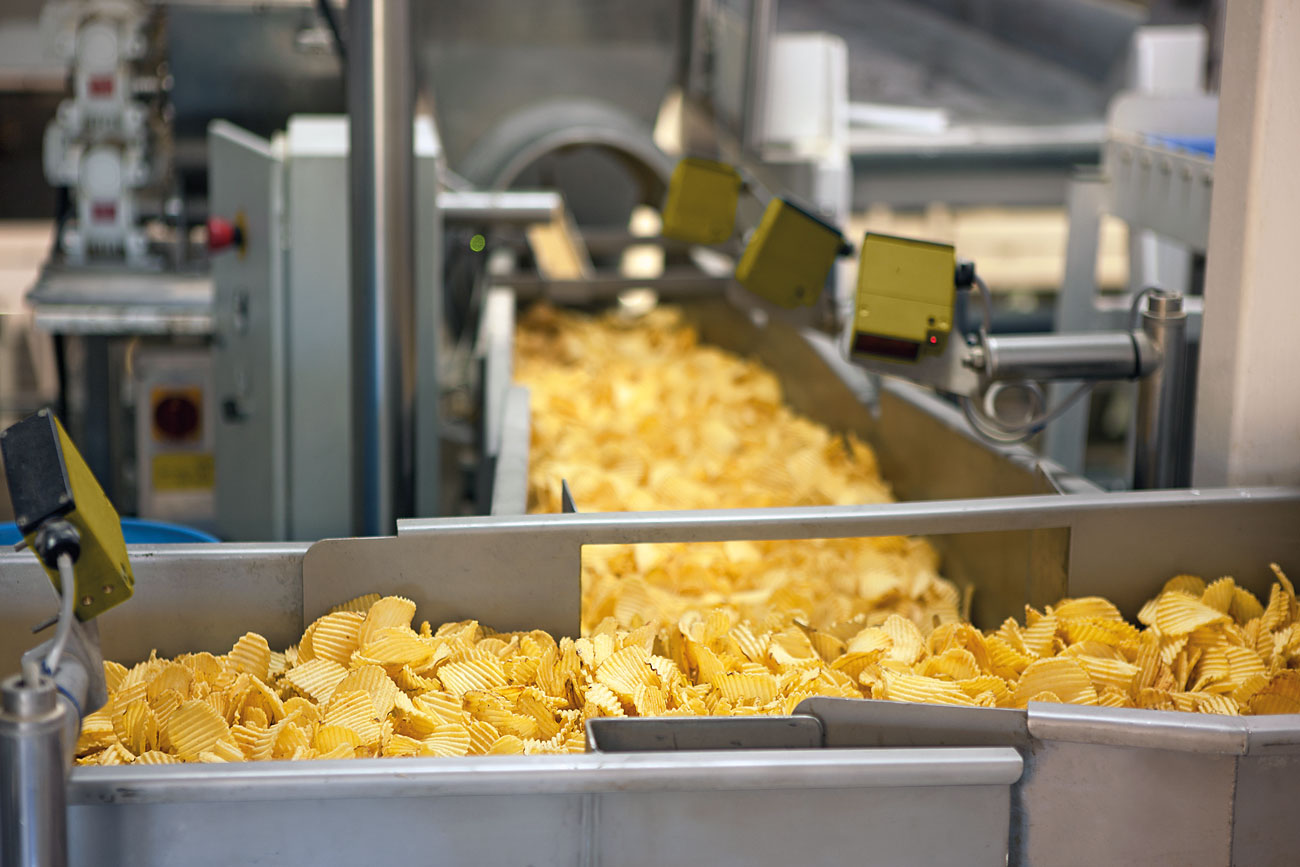
Industrial fryers and cookers are used in the food industry to produce packaged goods, such as breaded meats, potato products and precooked snacks. These fryers contain large amounts of cooking oil (up to 19,000 liters or 5,000 gallons) and operate at temperatures up to 354 C (670 F).
Product turnover rates for industrial fryers range between five and 12 per hour for continuous production. Even with careful control of all other aspects of frying – including temperature, moisture, crumb, seasonings and filtration – fryer oil will deteriorate after continuous use.
The risks behind fryer fires
A fire incident presents a major risk to any food manufacturing business, with the potential to affect operations across the entire facility. Damage can include loss of life, equipment, assets and production time – all of which can incur significant costs.
The combination of extreme heat and volume of fuel in fryers creates a significant fire risk. Fires occur when oil reaches its autoignition temperature or if ignition sources are introduced above the flashpoint of the oil.
Once heated, large volumes of oil remain at a high temperature and pose a fire risk for a long period of time – therefore cooling the oil is critical to avoid reignition. Unfortunately, a rapid cooling process can be difficult due to the energy-efficient, high-performance design of modern industrial oil cookers.
Why water and oil (usually) don’t mix
The general belief is that water is ineffective in fighting oil fires due to the spreading of oil and flames, as well as the interaction of water droplets that enter the oil. When large droplets of water enter oil that is hotter than the boiling point of water, the droplets sink into the oil while continuing to absorb heat.
Once the droplet absorbs enough heat to get converted to steam, it expands and rises to the surface. The steam erupts through the surface of the oil and sends the burning oil through the air, spreading the fire. Using large amounts of water can cause the oil in the fryer to flow out of the fryer, allowing the fire to spread. However, these concerns are only true when large quantities or large water droplets are used.
Traditional fryer protection solutions
A fryer fire protection system is an equipment-specific solution and not designed to be a replacement for the building’s overall fire protection system. To maximize the productivity of an industrial frying facility and mitigate fire risk, it’s crucially important to install an appropriate suppression system. By quickly extinguishing the fire and cooling the oil below its flashpoint temperature, the risk to life, unplanned downtime and clean-up costs can be minimized.
In the past, CO2 systems were typically used to extinguish industrial fryer fires, since it was understood that water would only contribute to the spread of an oil fire. Because food manufacturing facilities typically require workers to monitor industrial fryer productivity, the risk to human life can be compromised due to accidental discharges of CO2 suppression systems.
Although CO2 suppression is ideal for a variety of applications, the FM Global Loss Prevention Data Sheet for oil cookers (FMDS 7-20) does not list CO2 for oil cooker protection. While the NFPA 12 standard for CO2 still references deep fat cooker protection – and CO2 is still used for fryer protection – it is less effective to cool the oil below its flashpoint temperature.
However, it can be effective with extended discharge. This type of suppression could last up to 20 minutes and requires significant floor space for the CO2 cylinders, making it a less cost-effective solution. Recently, water mist technology has emerged as a safe and effective fire suppression solution for industrial fryer protection.
Protecting fryers with water mist
Over the past several years, testing has been completed around water mist technology that proves its effectiveness for industrial fryer protection. FM 5560 has a testing standard and listing requirement specific to industrial fryer (oil cooker) hazards. This testing validates a system’s performance to ensure the water mist system doesn’t create additional fire hazards, such as the spreading or splashing of burning oil or excessive flare-ups.
Water mist technology produces a variety of fine droplet sizes. Per NFPA standards, in order to qualify as water mist in the United States, 99% of droplets produced by the nozzles must be less than one millimeter in size.
Smaller water droplets absorb heat faster and easier than large droplets. By the time they reach the surface of the oil, most have already vaporized. There is some interaction that allows for cooling of the oil, but it is less violent when compared to larger droplets. FM-approved water mist systems are designed to flow continuously for a minimum of 10 minutes – ensuring the fire is completely extinguished and the oil is cooled below its flashpoint temperature.
Protecting vulnerable fryer areas
The total wetting of an oil surface is important to ensure adequate cooling. There are several areas that require protection on industrial fryers due to their risk of ignition. These include the primary cooking area, takeout area, exhaust stacks and fines box (a filtration system that takes out particulates that accumulate in the oil).
The hood and the outlet typically require a nozzle with a conical spray pattern which directs the water down towards the oil surface. However, the hood can present unique protection challenges. This is due to possible obstructions within the hood, such as piping, metal supports or conveyor belts that may obstruct the spray pattern of water mist.
For example, some conveyors hold product under the oil surface, which leads to the conveyor obstructing the oil surface. Other conveyors are located beneath the oil and present less of an obstruction to the spray pattern. Another challenge is that hoods are closed for cooking operations, but are often configured to rise for service and maintenance. A flexible hose connection is typically used so that the fixed piping system can accommodate the rising hood.
Another solution is to simply use extra nozzles in the hood area to compensate for obstructions. Additional nozzles will require more water to maintain flow for the required discharge time (10 minutes). Since every situation and piece of equipment is unique, it’s important to work with a company who can perform testing and develop a unique solution for the specific needs of the fryer.
Ensuring proper water pressure
As most water mist systems require pressure that is greater than what is typically available on-site, it is necessary to have either a pump or pressurized cylinders for proper system performance. For example, a mist control center (MCC) pump skid unit can be used which consists of a pump coupled to an electric motor that is factory wired to a full-service motor controller.
Installing valve cabinets on each fryer will help isolate the incident without having to shut down additional fryers in the facility. This ensures water will only enter the fryer where the fire detection was identified and activated.
Other fryer protection considerations
Since nozzles are located above hot oil, they need to be protected from rising grease that can make nozzles dirty and decrease spray performance. Today’s leading water mist systems use nozzle protection caps, often made of plastic, metal or high-temperature fluorosilicone rubber which has chemical resistance to oil. The protection cap remains on the nozzle until initial mist discharge, at which point it is ejected from the nozzle.
Despite common misconceptions about the use of water for protecting oil cookers, water mist has been proven to be an effective, efficient and potentially lifesaving solution for industrial fryer protection. Specifiers looking to use water mist for fryer protection should seek out an FM-approved water mist solution to achieve tested and proven fire extinguishment results.
For more information, go to www.tycofpp.com/aquamist
About the Author
Dennis Visser, global product manager, Water Mist, Johnson Controls.
