
As we rapidly move towards meeting net zero targets, a number of challenges present themselves in terms of innovative technological solutions being developed to generate, store and use energy and the associated fire risks that accompany them. This article explores the approach taken to address an innovative technology, video flame detectors, and the journey to ensure its suitability in the anticipated service environment. The collaborative approach demonstrated can be used to support the development of other net-zero-related innovative solutions.
Video flame detectors
Video flame detectors are increasingly being used to detect fires in areas where traditional detectors may be inappropriate, or where a quicker response is needed or visual verification is required. Indeed, they are increasingly used in areas to mitigate risks from net-zero-related technologies, such as batteries in waste recycling plants, solar farms, electric vehicle charging points, battery energy storage systems, energy generation from waste, etc.
These detectors use cameras to monitor large open spaces and are commonly used to provide early warning in challenging environments such as aircraft hangars, oil rigs, waste processing facilities, tunnels, and factories. They are more effective than traditional fire detectors in such applications as they do not require the smoke or heat from the fire to reach the actual detectors.
Despite their increasing use, due to their complex and variable functionality there were no test standards based on research providing a robust set of proven performance tests to assess the capabilities of video flame detectors. Manufacturers were keen to demonstrate that video flame detectors could be as effective as other approved fire detectors with the bonus of providing visual verification.
Collaborative research
The Fire Industry Association (FIA), the Building Research Establishment (BRE) and a group of fire detector manufacturers worked together to explore potential solutions as they focused on the challenges presented by the technology. The collaborative group researched reproducible test methods for assessing the ‘benchmark’ performance capabilities and explored suitable ‘operational performance’ tests to identify when these detectors could reliably detect a fire, hence identifying the product’s real detection capabilities.
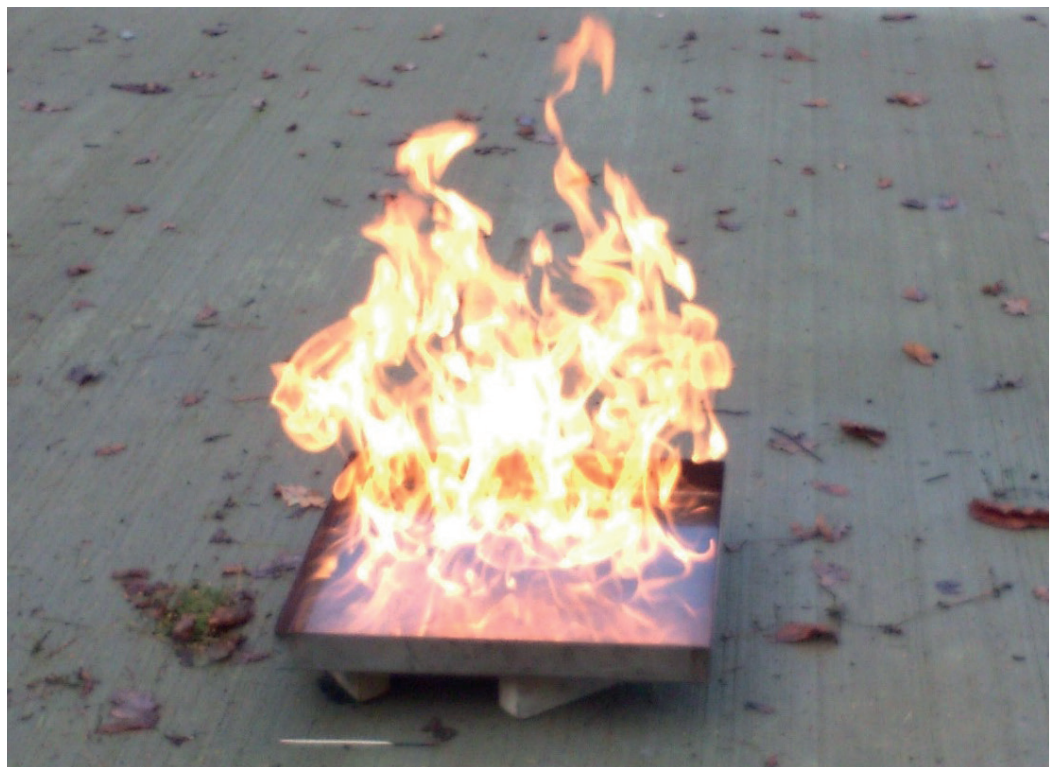
Using, as a foundation, the test methods established in the EN 54-10:2002 standard (for point type flame detectors) the group further developed these tests and then the BRE trialled them on a number of manufacturers’ products. The tests demonstrated that video flame detectors could detect fires in a metal tray (50 cm x 50 cm) at distances of up to 100 m (see Figure 1).
The data obtained from the different products tested was collated and analysed to determine pass and fail criteria that could be used in a product test standard. The analysis revealed a very repeatable response of the detectors that could be achieved using existing test methods with slight modifications. Similar pass and fail criteria were established from current standards, thus aiding acceptance and increasing likelihood of adoption in the future. The work was successful and a briefing paper summarising the work was published which is available for free from the BRE website.
Collaborative test standard
Following this work, a group of manufacturers were keen to continue with the work to develop a Loss Prevention Standard (LPS), which is a standard that the BRE produce and own, and pursue product approvals. The risks and opportunities were presented to the group along with a service development plan that would result in an approval service for the technology. Despite the risks (not knowing how much research would be required, the associated costs, not being approved for publication, etc) the group were keen to develop the required tests by performing further research work.
The work then continued with manufacturers, that together with the FIA and the BRE focussed on developing tests to address false alarms observed historically with these products in the service environment. These and the potential weaknesses of the technology were declared by manufacturers enabling specific tests to be developed. The group researched and proposed tests to assess the resistance to factors such as heat sources in the field of view of the camera, an excess of light saturating the camera or sunlight reflecting off water appearing like the shimmering of flames. Tests to replicate these phenomena were repeatably produced in the BRE test labs. Additionally, further relevant tests from EN 54-10 were used to test the performance for anticipated conditions in the service environment such as shocks, impact, vibrations, extremes of temperature, EMC, etc.
Once the collaborative group agreed on the set of tests and individual test methods, the standard was drafted and reviewed by the stakeholder group before it went out for a three-month public consultation. The consultation was successful and then LPS 1976, the product test standard for video flame detectors and video flame detection systems (see Figure 2) was published. The time taken from initial discussions to publication of the standard, including developing the new tests, was less than 15 months, which is significantly less than the time taken to develop and publish EN standards.
LPS 1976 specifies requirements, test methods and performance criteria for these types of detectors which specifically detect changes in video images by searching for and identifying signatures of flames generated during the combustion of carbon-based materials. Detectors complying with LPS 1976 can operate as primary detection systems, offering comparable levels of performance and protection as other fire detection products complying with the EN 54 series of standards.
Standards for innovative products
Products certified to standards strengthens their credibility in the marketplace and provides assurance to customers, specifiers, and enforcing authorities that products have been independently validated for safety and performance. It permits access to new markets and is more attractive for distributors and installers who prefer certified solutions. As well as differentiating offerings from competitors, speeding up acceptance by insurers, and supporting growth in sales, the certification reduces legal and liability risks by demonstrating due diligence in meeting recognised safety benchmarks.
By working collaboratively, openly sharing knowledge and expertise, this enabled comprehensive solutions to be developed that resulted in LPS 1976. Products complying with the standard will offer significant advantages over other detection technologies to provide optimum protection in the service environment in terms of detecting fires early but also being less likely to produce false alarms. Solutions for the early detection of fires produced by net zero technologies (e.g. from Solar PV Systems or batteries) have yet to be successfully developed. There is no reason why the approach detailed above cannot be applied to these or other challenging innovative solutions in the future.For more information, go to https://bregroup.com/firesafetyresearch
About the Author

Principal Consultant (Fire Safety) at BRE.

You must be logged in to post a comment.