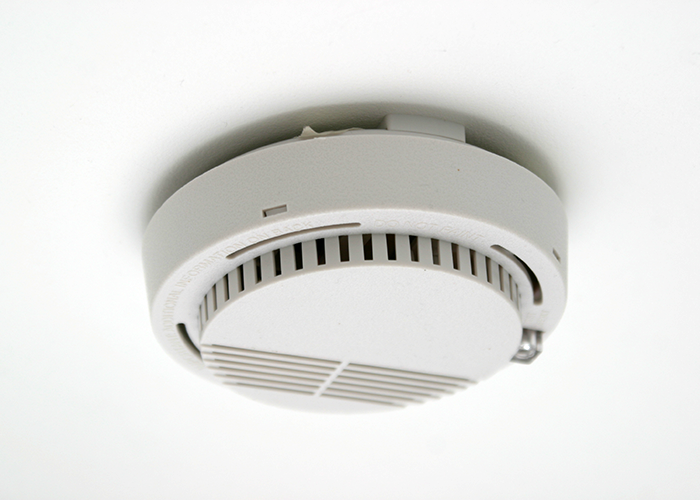
The test fires that are used to assess ionisation and optical smoke detectors were developed in the 1980s, but the materials found in modern service environments have changed since then. There is now a greater use of plastics and flame retardant foams in modern buildings, but little information is available on the response of detectors to the smoke generated by the burning or smouldering of such materials.
A research project investigated the smoke profiles generated from the fire tests specified in the EN 54-7 (commercial) and EN 14604 (domestic) smoke detector standards, and compared them with those produced from burning or smouldering materials commonly found in modern service environments. The intention was to establish whether the current test fires are adequate for assessing smoke detector performance to a broad range of fires involving modern materials.
Ionisation and optical smoke detectors
Both ionisation and optical smoke detectors have been used in commercial and domestic environments for many decades. They use different methods to detect smoke and each is more attuned to detecting certain types of smoke particles.
Ionisation smoke detectors are typically more responsive to flaming fires in which many small smoke particles are generated due to the high energy of the fire. These small particles tend to strip ions in the detection chamber which leads to a quick response. Smouldering materials, however, tend to produce fewer but larger particles that are more difficult for ionisation detectors to detect.
Optical smoke detectors are typically more responsive to the smoke particles from smouldering fires as the larger particles they generate cause greater scattering in the optical chamber. Optical detectors can be less responsive to the small particles produced during flaming fires that cause less scattering.
It is worth mentioning here that ionisation smoke detectors installed near kitchen areas are prone to causing false alarms. This is because the smoke generated during cooking and from toasters tends to comprise of smaller particles with high energy, which cause the ionisation detectors to respond. The greater use of optical smoke detectors near kitchens will lead to a reduction in false alarms from cooking fumes.
As both types of technology contain inherent strengths and weaknesses, this research project aimed to determine whether ionisation detectors perform poorly to smouldering fires and if optical detectors are less responsive to flaming fires.
The test fires used to assess smoke detectors
Both EN 54-7 and EN 14604 use the same methodology for identifying the most challenging conditions under which to test detectors. Four test fires are used to assess smoke detector performance – these are TF2: smouldering wood, TF3: smouldering cotton, TF4: flaming plastics and TF5: flaming n-heptane.
The average smoke profiles produced from the four test fires are shown in Figure 1. The y-axis (m) represents the optical density (measured in dB/m) and indicates the larger particles which are generated in greater quantities during smouldering fires. The x-axis (y) is a dimensionless quantity that reflects the amount of ionisation taking place and represents the number of smaller particles which are generated in greater quantities during flaming fires.
These four test fires produce a broad range of smoke types with different properties and are used to assess the smoke entry characteristics and sensitivity levels of smoke detectors. Materials such as plastics and flame retardant foams will generate smoke with different properties when flaming and when smouldering – depending on the type of smouldering (e.g. near a radiant heat source or sustained contact with hot surface). It was not known whether the smoke from such fires was effectively covered by existing fire tests, and how ionisation and optical detectors respond to such smoke – especially beyond the limits of the existing four test fires.


Test Methodology
The equipment specified in the smoke detector standards (thermocouples near the floor and ceiling, obscuration meter and measuring ionisation chamber in the 3m arc) was used in an 11m long, 7m wide and 4m high EN 54-7 fire test room.
Twelve approved smoke detectors and smoke alarm devices from undisclosed manufacturers were used for the fire tests; eight of these were installed on the ceiling and four on an adjacent wall. The detectors comprised of eight domestic smoke alarm devices (four ionisations and four opticals) and four commercial smoke detectors (two ionisations and two opticals).
To define the end point of the tests, guidance was taken from the EN 54-7 and EN 14604 standards, which specify end of test limits for smouldering and flaming fires that are m=2 dB/m or y=6 respectively.
Test fires and detector responses
Twenty-nine test fires were conducted, including the four test fires specified in EN 54-7 and EN 14604. Of these eleven were smouldering fires, sixteen were flaming fires and two started off smouldering and went on to become flaming fires. The fuels used included unleaded petrol, medium density fibreboard (MDF), PVC cable, flame retardant polyurethane foam, sunflower oil, newspaper, polyester, nylon, ABS, polystyrene, polycarbonate and polyethylene.
All of the detectors were periodically replaced, as exposure to the smoke from a number of tests could cause contamination in the smoke chambers that could potentially affect their response. The growth rates of m, y and CO (for interest), along with the detector responses, are shown for two of the tests in Figures 2 and 3.
The data presented in Figure 2 demonstrates the rapid response of the ionisation detectors (both commercial and domestic) to the small particles generated during the MDF flaming fire test. The response from the optical detectors is slightly delayed until the fire increases in size and the radiant heat leads to more smouldering particles being produced from the MDF. All detectors respond before the defined end of test for a flaming fire (y=6) is reached.
The test illustrated in Figure 3 demonstrates the difference in response between ionisation and optical detectors to a smouldering then flaming fire. At first the polystyrene fuel is smouldering due to the increasing temperature of the steel plate on which it rests. This leads to all 6 photoelectric detectors responding before the defined end of test for a smouldering fire (m=2 dB/m) is reached. When the temperature of the polystyrene reaches ignition point (shown as S-F in Figure 3) the fuel combusts. Within a few seconds the first ionisation detector responds and all ionisation detectors are in alarm before the defined end of test for a flaming fire (y=6) is reached.
Summary of the test fires and detector responses
Of the twenty-nine test fires conducted five produced too little smoke and were repeated with greater quantities of fuel.
Of the remaining twenty-four tests, sixteen fell within the m/y limits specified by the TF2-TF5 test fires from EN 54-7 and EN 14604. From these tests two negative responses were recorded with 190 positive responses. For the remaining eights tests, four had a high mean m/y ratio and four a low mean m/y ratio.
For the four tests with a high mean m/y ratio the detectors responded for all fires except for two domestic wall ionisation devices, which did not respond to a smouldering flame retardant polyurethane fire and two domestic ceiling optical devices that did not respond to a smouldering ABS fire.
For the four tests with a low mean m/y ratio the detectors responded for all fires except for five optical devices that did not respond to a flaming fire using nylon as the fuel source. This is most likely due to the relatively small size of the fire, as the peak m and y values generated during this fire were significantly lower than those in the other fires. If enough smoke had been generated during this test fire, all twelve devices may have responded. However this result has not been qualified, so from the results of the remaining twenty-three fires there were six no responses and 270 responses. This represents positive responses 97.8% of the time. The six no responses are attributed to the inconsistent responses of one particular type of detector and suspected contamination for the remaining ones.
Even though no statistical data was gathered by repeating the same tests, the results do provide evidence of the response characteristics for the types of detectors (optical or ionisation) to a variety of smoke types produced from smouldering and flaming fires.


Summary of the smoke profiles generated
Of the twenty nine test fires, four smouldering fires were found to be beyond the (m/y) limits for a TF2 and four flaming fires were found to be beyond the (m/y) limits for a TF5. The m/y ratio for a flaming wooden crib fire was found to be the worst case of all the flaming fires. For the smouldering tests carried out beyond the TF2 limit the m/y ratio for the smouldering ABS fire was significantly higher than the others.
The test fires TF2-TF5 do cover most general purpose applications as a real fire is unlikely to involve only a single type of material. As more materials with different smoke characteristics are involved in the fire the likelihood of detection increases.
However, it should be noted that smouldering fires can continue for a long time with only one material being involved, potentially leading to the production of toxic gases in fatal concentrations. An example is bedding in contact with a heat source such as a lit cigarette. In this case an ionisation detector may not respond and therefore should not be sited in locations where such a scenario is possible. In contrast a flaming fire in a building will eventually produce sufficient heat that will radiate onto other materials and lead to the production of smouldering smoke particles to which the optical detectors are expected to respond.
Conclusions and further work
The aim of this research was to measure the smoke characteristics of a number of test fires using modern materials, and assess them against the test fires specified in the EN 54-7 and EN 14604 standards.
The research demonstrated that commercial and domestic approved ionisation and optical smoke detectors respond to a broad range of fires with m/y ratios within and beyond the fire test limits of EN 54-7 and EN 14604. The fire tests specified in EN 54-7 and EN 14604 are considered to be appropriate and are sufficiently wide in terms of distribution of smoke characteristics. This demonstrates that the fire tests specified in these test standards are still applicable today and, despite the changes in the use of materials over the decades, approved smoke detectors have very wide smoke response capabilities.
Both ionisation and optical smoke detectors are attuned to detecting certain types of fires. In order to ensure that the most appropriate type of device is installed, guidance on the use of ionisation and optical smoke detectors should be sought from relevant codes of practice.
Further details of this work can be found in a briefing paper available from the following website address: http://www.bre.co.uk/page.jsp?id=3531
Further work is due to take place with a number of interested parties, which will investigate the performance of a variety of optical heat multi-sensor detectors to some of the test fires conducted during this research programme. Additionally, a repeatable smouldering fire with a high m/y ratio and a more challenging flaming fire with a low m/y ratio, such as a flame retardant poly-urethane fire, will be investigated.
For further information, go to www.bre.co.uk
About the Author

Principal Consultant (Fire Safety) at BRE.