

With the height threshold for sprinklers in new-build residential buildings lowered to 11m across the UK, it has been put at the top of the European table in terms of fire regulation.
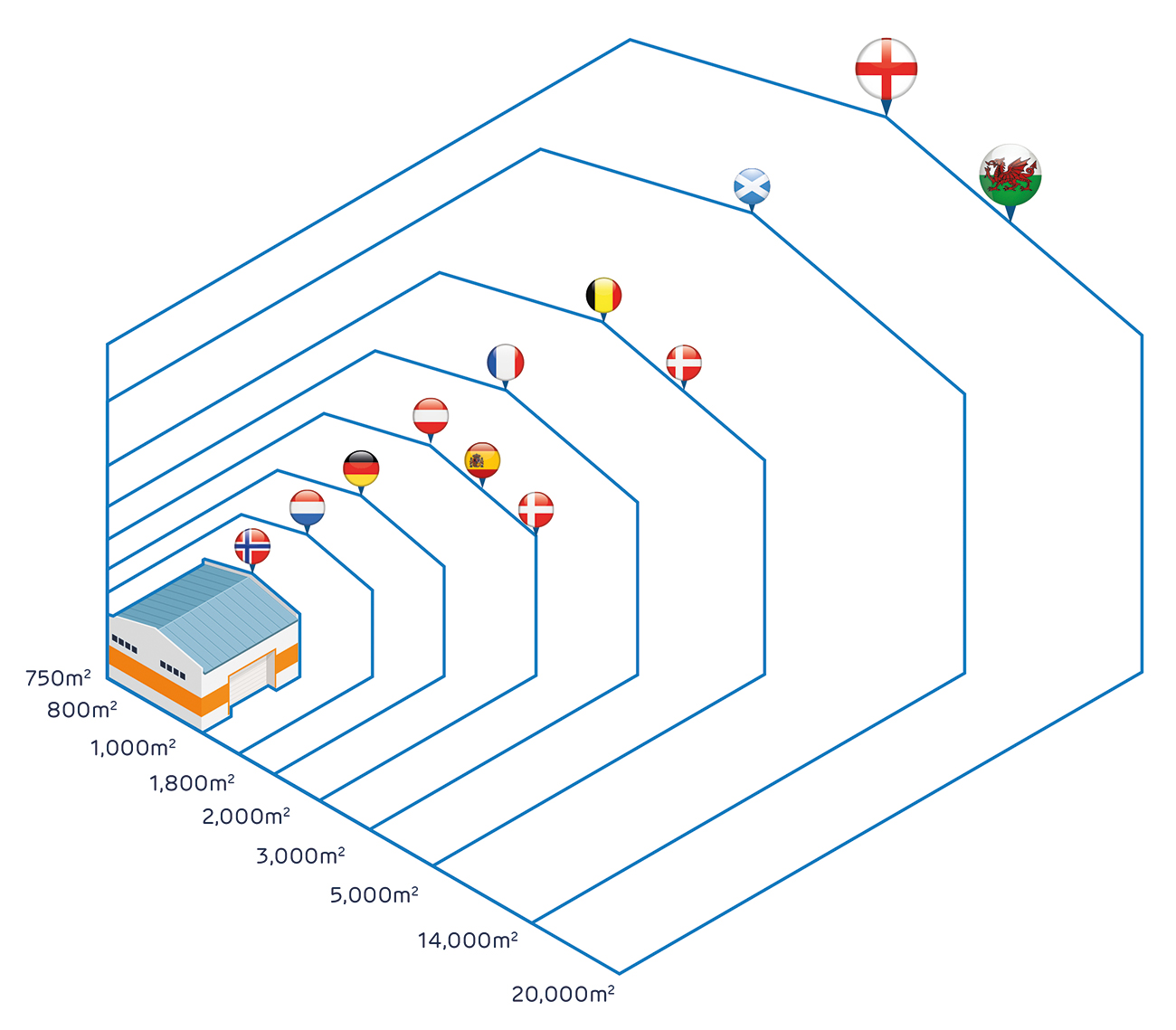
The same cannot be said for fire-safety guidance in warehouses, with the UK lagging far behind many of our European neighbours propping up the bottom of the table with sprinklers only guided in warehouses above an enormous 20,000m2 area under current guidance. This feature looks at the importance of business resilience and continuity, and why guidance levels in Europe mean that these markets are far better prepared to recover from devastating fires that threaten their businesses and economies.
When a large night-time fire broke out at Basildon-based food distributor Kent Foods on 29 August 2020, more than 100 firefighters and 20 fire appliances from Essex Fire and Rescue worked hard in arduous conditions to contain the blaze to the 7,300m2 warehouse. The Environment Agency was also involved to prevent products from the fire spreading into local water courses. The warehouse was destroyed. It serviced the company’s customers in south-east England and the business had to stretch to redistribute its work to other locations within the group to continue to supply customers. More than a year later the warehouse building is being rebuilt and is still not fully completed.
Compare this to a fire that broke out at the A.F Blakemore and Son food distribution warehouse in nearby Hastings in October 2020 and there was a very different outcome. A small fire located in a fan unit had been quickly extinguished by the sprinkler system in the 9,000m2 warehouse. Had the fire not been contained it could well have caused significant damage to this logistics business, which supplies food products to a network of stores across south-east England. In both cases, the warehouses were below 20,000m2, which under current guidance meant they were not guided to have sprinklers.
The contrast between two buildings with and without a sprinkler system in a fire can be quite stark. In the event of fire, many businesses with sprinkler systems suffer a minor interruption and find they’re back up-and-running in a matter of hours. Those without can see considerable damage and suffer longer spells of interruption.
It is interesting to note that the planning application for the reconstructed Kent Foods building that has been granted highlights the provisions of sprinkler tanks for the warehouse that is to be rebuilt.
Building Regulation guidance
The contrast in outcomes between the two buildings is clear, yet both will have met the minimum requirements of the Fire Safety Building Regulations (FSBR) guidance for industrial and commercial buildings. Interestingly for many, the outcome of meeting the FSBR should look rather more like that from the warehouse saved in Hastings than the norm that is portrayed by the warehouse destroyed in Basildon. A survey of SME businesses showed that 69% felt that their business was protected from the impact of fire by following the FSBR guidance. Indirectly, there are benefits but this is not their aim.
Indeed, the UK is very relaxed when compared to sprinkler requirements for similar buildings in other European countries where, on average, sprinklers are guided or required in industrial and commercial buildings with compartments greater than 4,000m2 in size. If either English building were replicated in our nearest comparable, neighbouring economies of Germany or France, they would have been subdivided or required to have sprinklers.
The remit of the FSBR is like that of the rest of Europe with a focus on ensuring the safety of occupants in the event of fire, access for firefighters and limiting the spread of fire between buildings. Yet such large compartments without sprinklers is not countenance in most parts of Europe. Generally throughout Europe, a fire is seen as a ‘success’ if all occupants evacuate safely and the fire does not spread, even if the building is badly damaged or destroyed. However, in the UK the loss is much greater due to the larger building footprints.
Stopping to think on that, the FSBR guidance envisages warehouses that are 14–20,000m2 in footprint and in many cases up to 18m tall, without incurring guidance for sprinklers. Such buildings are truly enormous, roughly seven times the size of your average out-of-town DIY store. But the FSBR makes no consideration for the protection of property – i.e. a building’s ability to withstand a fire.
The building will survive for the period it takes to get people out, after which we transition into a period where the inherent resilience diminishes. There is a twisted logic that says the building is disposable in the event of fire.
Fire resilience and sustainability
Given this approach one would also question its sustainability with our increased attention on conserving energy and resources to transition to a greener economy. Regulations and green rating systems may well recognise a high-performance building, but you only have to look at the devastating consequences of fire to realise that a building’s sustainability counts for naught if it is destroyed in a fire.
This was the case in 2018 when a fire completely consumed a newly opened Gardman garden products distribution warehouse in Daventry. The building achieved a ‘Very Good’ BREEAM rating for its energy efficiency. Sadly, this was not matched in terms of resilience, as the building lacked active protection such as sprinklers. The fire had far-reaching consequences, with rebuild costs placed at £30 million and the eventual sale of the Gardman garden supplies business. To date no rebuilding has taken place.
When we measure a building’s performance we should be measuring the performance across the board. Sustainability is one very important element but sustainability must include durability. There is often talk about sustainability, but we don’t talk about interruptions such as damage to a building caused by floods, storms or fire. A building’s sustainability or green rating is focused on such items as energy performance, material selection, limiting waste and pollution but those environmental credits are instantly lost, and adverse effects created when a building burns to the ground. Future views on conserving resources should also look at the building materials themselves and how they are used over time. To be truly sustainable, buildings should be resilient to fire, and fire sprinkler systems are proven to be the most effective means of fire protection.

Continuity
There is also much to be said about continuity of function and use in the event of a major disruption such as fire. Considering some of the large residential fires witnessed in the UK, the displacement of families has been a huge factor. One could argue that the move to add sprinklers into residential apartments in the UK will help with this approach in the face of a major fire event by reducing the damage in the affected area and enabling people to return to use their homes more quickly.
Ensuring continuity and productivity also needs to be part of a wider risk-management strategy for business. Judging by the many fires across the commercial sector, there is a disconnect between the business continuity plan and the building. If one of the big risks is the fact that you might lose a factory that is critical to your whole operation to a fire – and you haven’t protected it – then your disaster recovery will mean you will have to find new premises, machinery and logistics in order to recover. A more successful strategy would be to protect the very critical elements of its operation that are vulnerable in the first place using systems like sprinklers. It is clear that resilience has been assumed by complying with regulations, but unfortunately key stakeholders cannot see that this is not the case.
We expect that buildings will be safe, but beyond that I am not sure we set such demands on buildings in terms of their performance in the face of fires and floods. That is often assumed as a basic need and not an expression of interest. We think we have this now – but recent evidence is that the unintended consequences is that some buildings have fire-safety challenges. The building owners are facing remediation to buildings that will address fire safety. That will not make the building more resilient but instead will only meet the minimum outcomes required by regulation.
In light of the Grenfell Tower fire, the industry is talking about raising the bar in terms of standards and competence to meet current needs in relation to fire safety. This is reflected across Europe as experts discuss the potential impact of the Renovation Wave and the need to consider the impact of such work on fire safety. Perhaps we should be raising the bar to ask what is the outcome we wish to see? The only way to do this is to think hard about the outcome we see in fire. If we do not try and change the outcome, regulatory success will continue to look like the examples that we have seen. Why can’t we protect the building as well as the people in the building, and what’s wrong with not losing the building?
For more information, go to www.business-sprinkler-alliance.org
About the Author

Iain served in Royal Berkshire Fire and Rescue Service for 34 years, appointed Chief Fire Officer in 2003 he was awarded the Queen’s Fire Service Medal in 2009 and retired in 2013. He served as the Chief Fire Officers Association’s Director for Protection and Prevention between 2009 and 2011. Iain is currently the Chair of the Business Sprinkler Alliance and is a board member of BAFE. Iain holds a BSc from Reading University and an MA in Management from Coventry University.

You must be logged in to post a comment.