
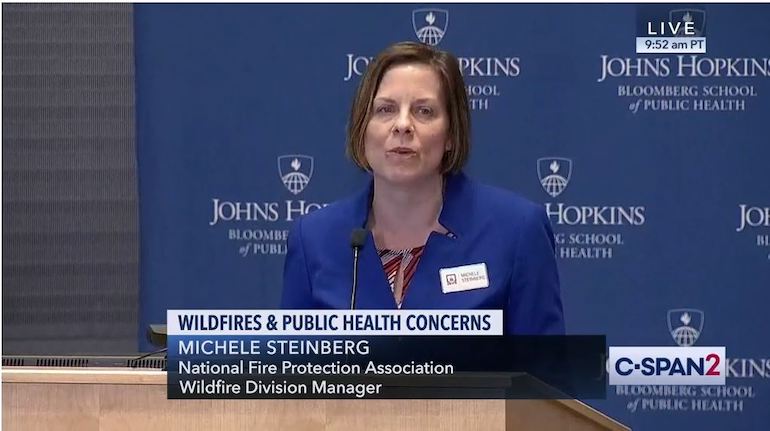
The National Fire Protection Association (NFPA) is pleased to announce Michele Steinberg, NFPA Wildfire Division Director, has been selected as a member of the Wildland Fire Mitigation and Management Commission. The Commission, established by President Biden’s Bipartisan Infrastructure Law and enacted in December 2021, will play a key role in recommending ways that federal agencies can better prevent, mitigate, suppress and manage wildland fires and advocate for policies and strategies to help restore lands affected by wildfire. Members of the commission include representatives from federal agencies, state, local and Tribal governments, and the private sector.
Reducing loss of life and property from wildfire is a key priority for NFPA. The association continues to expand its resources to help ensure everyone living at risk from wildfire has the information, knowledge and tools to help protect their homes and communities. Now in its 20th year, NFPA’s Firewise USA recognition program is the most extensive volunteer community program in the country to enlist homeowners to take mitigation action. There are currently 1,939 Firewise communities in the U.S.
In 2021, NFPA introduced Outthink Wildfire, a comprehensive policy strategy based on five fundamental tenets that must occur at all levels of government that will make it easier for communities to foster collaboration, enact change, achieve resilience and protect themselves from wildfire. Steinberg’s appointment to the commission comes at a critical time as the growing wildfire crisis in the U.S. poses significant danger to people, homes and communities, particularly those in wildfire/urban interface (WUI) settings.
‘I am extremely honored to be selected to serve on the Wildland Fire Mitigation and Management Commission,’ said Michele Steinberg, NFPA Wildfire Division Director. ‘NFPA’s Outthink Wildfire policy work is closely aligned with the commission’s mission. Federal policy can do much to help end wildfire disasters, and I look forward to working with the commission to help create a more definitive approach to how we live with wildfire in this country.’
The commission is scheduled to meet online for the first time this month and is tasked with preparing a report with policy recommendations and submitting them to Congress within a year of its first in-person meeting to be held in August.
More than 500 applications were received, and 36 non-federal members – 18 primary and 18 alternates – have been selected to serve on the commission. The commission will be co-chaired by the U.S. Departments of Agriculture, the Interior and Homeland Security, through the Federal Emergency Management Agency (FEMA).
Steinberg is the Wildfire Division Director at NFPA and serves on the Board of Directors of the International Association of Wildland Fire. She is co-founder of the Hazard Mitigation and Disaster Recovery Membership Division of the American Planning Association. Prior to her work at NFPA, Steinberg worked in disaster mitigation and community engagement and education as a floodplain manager with the Commonwealth of Massachusetts, a hazard mitigation specialist at FEMA Region I, and a special projects manager at the Insurance Institute for Business and Home Safety (IBHS). She holds a Master of Urban Affairs degree from Boston University.
For more information, visit www.nfpa.org. All NFPA codes and standards can be viewed online for free at www.nfpa.org/freeaccess.
About the Author

This post was uploaded and edited by Derek Smith.
Derek is the Online Digital Editor for MDM Publishing Ltd.
- Derek Smith
- Derek Smith
- Derek Smith
- Derek Smith
- Derek Smith
- Derek Smith
- Derek Smith
- Derek Smith
- Derek Smith
- Derek Smith
- Derek Smith
- Derek Smith
- Derek Smith
- Derek Smith
- Derek Smith
- Derek Smith
- Derek Smith
- Derek Smith
- Derek Smith
- Derek Smith
- Derek Smith
- Derek Smith
- Derek Smith
- Derek Smith
- Derek Smith
- Derek Smith
- Derek Smith
- Derek Smith
- Derek Smith
- Derek Smith
- Derek Smith
- Derek Smith
- Derek Smith
- Derek Smith
- Derek Smith
- Derek Smith
- Derek Smith
- Derek Smith
- Derek Smith
- Derek Smith
- Derek Smith
- Derek Smith
- Derek Smith
- Derek Smith
- Derek Smith
- Derek Smith
- Derek Smith
- Derek Smith
- Derek Smith
- Derek Smith
- Derek Smith
- Derek Smith
- Derek Smith
- Derek Smith
- Derek Smith
- Derek Smith
- Derek Smith
- Derek Smith
- Derek Smith
- Derek Smith
- Derek Smith
- Derek Smith
- Derek Smith
- Derek Smith
- Derek Smith
- Derek Smith
- Derek Smith
- Derek Smith
- Derek Smith
- Derek Smith
- Derek Smith
- Derek Smith
- Derek Smith
- Derek Smith
- Derek Smith
- Derek Smith
- Derek Smith
- Derek Smith
- Derek Smith
- Derek Smith
- Derek Smith
- Derek Smith
- Derek Smith
- Derek Smith
- Derek Smith
- Derek Smith
- Derek Smith
- Derek Smith
- Derek Smith
- Derek Smith
- Derek Smith
- Derek Smith
- Derek Smith
- Derek Smith
- Derek Smith
- Derek Smith
- Derek Smith
- Derek Smith
- Derek Smith
- Derek Smith
- Derek Smith
- Derek Smith
- Derek Smith
- Derek Smith
- Derek Smith
- Derek Smith
- Derek Smith
- Derek Smith
- Derek Smith
- Derek Smith
- Derek Smith
- Derek Smith
- Derek Smith
- Derek Smith
- Derek Smith
- Derek Smith
- Derek Smith
- Derek Smith
- Derek Smith
- Derek Smith
- Derek Smith
- Derek Smith
- Derek Smith
- Derek Smith
- Derek Smith
- Derek Smith
- Derek Smith
- Derek Smith
- Derek Smith
- Derek Smith
- Derek Smith
- Derek Smith
- Derek Smith
- Derek Smith
- Derek Smith
- Derek Smith
- Derek Smith
- Derek Smith
- Derek Smith
- Derek Smith
- Derek Smith
- Derek Smith
- Derek Smith
- Derek Smith
- Derek Smith
- Derek Smith
- Derek Smith
- Derek Smith
- Derek Smith
- Derek Smith
- Derek Smith
- Derek Smith
- Derek Smith
- Derek Smith
